Lawrence Livermore National Laboratory (LLNL) is partnering with Oxylus, a Yale spinout focused on CO2 electrolysis technology, to develop and, potentially, commercialize a reactor that could convert carbon waste to methanol without alkali cations.
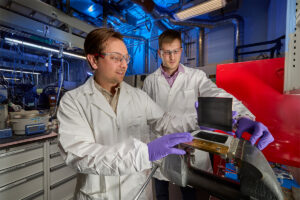
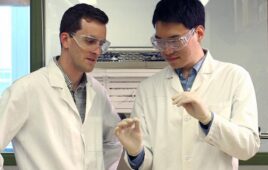
Researchers at LLNL and partners at Oxylus Energy are developing an electrochemical reactor that transforms waste carbon into valuable chemicals. (Photo: Garry McLeod/LLNL)
LLNL won $2 million from the DOE’s Industrial Technologies Office through the Technology Commercialization Fund with the aim of advancing the technology toward commercial use.
The partnership between LLN and Oxylus is a Cooperative Research and Development Agreement (CRADA), a mechanism that lets a federal lab and non-federal partner jointly conduct research while sharing resources, costs and negotiating in advance who owns and can commercialize the resulting technology.
Typically, electrolysis requires alkali cations to catalyze the reaction. However, they also cause salt precipitation which creates blockages in the reactor.
“[The alkali cations] induce failure modes, typically seen under 100 hours, and longer-term problems through non-steady-state operation,” Maxwell Goldman, a scientist at LLNL, said in an interview with R&D World. “So, the dream is to run it with deionized water, since deionized water isn’t conductive.”
Goldman’s team at LLNL developed a reactor that can convert CO2 to CO without alkali cations. Now, they are looking to see if they can use the same method to convert CO2 to methanol.
Goldman met Conor Rooney, CTO and co-founder of Oxylus, at a scale-up workshop LLNL held two years ago.
“I remembered Conor had said that salting is a problem for their system, and for everyone doing electrochemical CO2 conversion to methanol,” Goldman said. “I had an idea and I wasn’t sure if it would work. It works for CO2 to CO, so maybe it could work for CO2 to methanol. I asked if they were interested, and that started the conversation about what the project could look like and how we could help each other.”
Oxylus has developed its own catalyst for electrolysis, which the company is bringing to the partnership with LLNL. Oxylus’ catalyst solves a common problem for bulk metal catalysts: selectivity.
“Typically, catalysts for these types of devices are just bulk metal catalysts. For CO2 electrolysis, that’s often gold, silver or copper… The challenge with those is that it’s hard to control where the CO2 binds on the surface and how it gets converted, because there can be many different types of sites on the surface of those metals, like imperfections and defect sites, that steer the reactivity,” Rooney said in an interview with R&D World.
Oxylus’ catalyst is a single cobalt atom surrounded by four nitrogen atoms in an organometallic complex that is placed on a conductive carbon surface.
“We coat these cobalt-containing molecules onto the conductive carbon nanotube surface, and this has a special property in that it behaves like a metal, it’s very conductive, but it has well-defined sites where the CO2 binds,” Rooney said.
The company has been able to demonstrate its catalysts can operate continuously for over six months.
The partnership aims to combine Oxylus’s catalyst with LLNL’s reactor technology.
“There are two bottlenecks in CO2 electrolysis commercialization. One is having a stable catalyst, and I think at Oxylus we’ve solved that problem. The other is having a stable reactor, and the main reason reactors fail is salt precipitation… Lawrence Livermore has figured out a way not to use salt,” Rooney said. “So, together we’ve ideally solved both the catalyst and reactor bottlenecks.”
Under the partnership, Oxylus is also looking at the economic side, Goldman said, including how the balance of plant, the supporting equipment and infrastructure around the reactor itself, changes with and without salt and what commercialization could look like when scaling up the reactor.
The U.S. Department of Energy’s Technology Commercialization Fund (TCF) awarded LLNL $2 million to develop its reactor. Managed by the Office of Technology Commercialization, TCF seeks to bridge the gap between research and commercial applications, LLNL said in a press release.
Since the project began earlier this year, LLNL has been running experiments to produce the electrolyzer and optimize its performance while Oxylus provides materials and expertise on the catalyst system, Rooney said.
The first big milestone for the project is the proof of concept of the electrolysis reaction without alkali cations, Goldman said. “Right now, it looks extremely promising,” he added.
“By the end of the grant, our hope is to be at a large single-cell pre-pilot size, around the 100 square centimeter target,” he said. “If we go through there, then it would make a lot of sense to take it to the next step.”