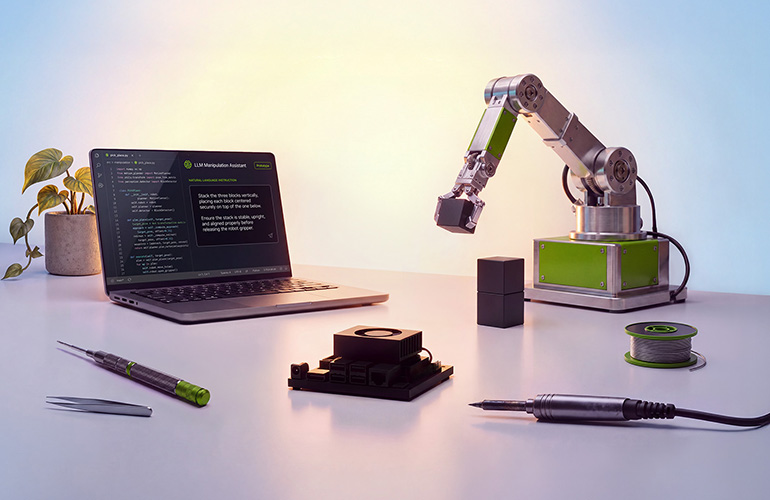
NVIDIA says Jetson Orin Nano 2 delivers 78 TOPS of AI compute with 8GB of memory in the same form factor as its predecessor, with availability expected in the first half of 2027. [Image courtesy of NVIDIA.]
Compact AI systems are already finding their way into research labs. Duke biomedical engineers, for example, have used the Jetson Orin Nano to control and process images in a compact optical coherence tomography system and to process holographic cytometry data in real time, while researchers developing the Chemist Eye platform use the same hardware for vision-based safety monitoring and robot decision-making in self-driving laboratories.
Meanwhile, Apple, which has emerged as an unlikely beneficiary of the local AI boom, announced a new Mac mini, offered with the M6 or M5 Pro. Preorders opened today, with delivery beginning September 22. The M6 is Apple’s first chip built on a 2 nm process.
On the 2026 innovators list
NVIDIA and Apple are among R&D World’s 100 most innovative companies of 2026. The list examines what each company built, who is using it and the results it has reported. R&D World will publish the full comparison in the 2026 Global R&D Funding Forecast.
In a press release, Apple says the new Mac mini offers “a massive leap in AI performance,” and is designed with “always-on agentic computing” in mind. Specifically, Apple says the M6 Mac mini delivers up to four times faster AI performance than the M4 model, including up to 4.8 times faster LLM prompt processing in LM Studio. M6 configurations have 16GB of unified memory as standard, are configurable to 32GB, and provide up to 170GB/s of memory bandwidth. Whereas Apple originally positioned the Mac mini as an affordable entry point for consumers switching to Mac, and at times went years between major updates, over roughly the past six months the diminutive desktop has gained traction among developers and AI enthusiasts running local models and autonomous agents such as OpenClaw, with Reuters reporting that demand depleted inventories at several Apple stores.
The new Mac mini launch comes amid criticism over delays to its Apple Intelligence features, including a more capable Siri. Apple has agreed to a $250 million settlement over claims that it advertised enhanced Siri and AI capabilities that had yet to arrive.
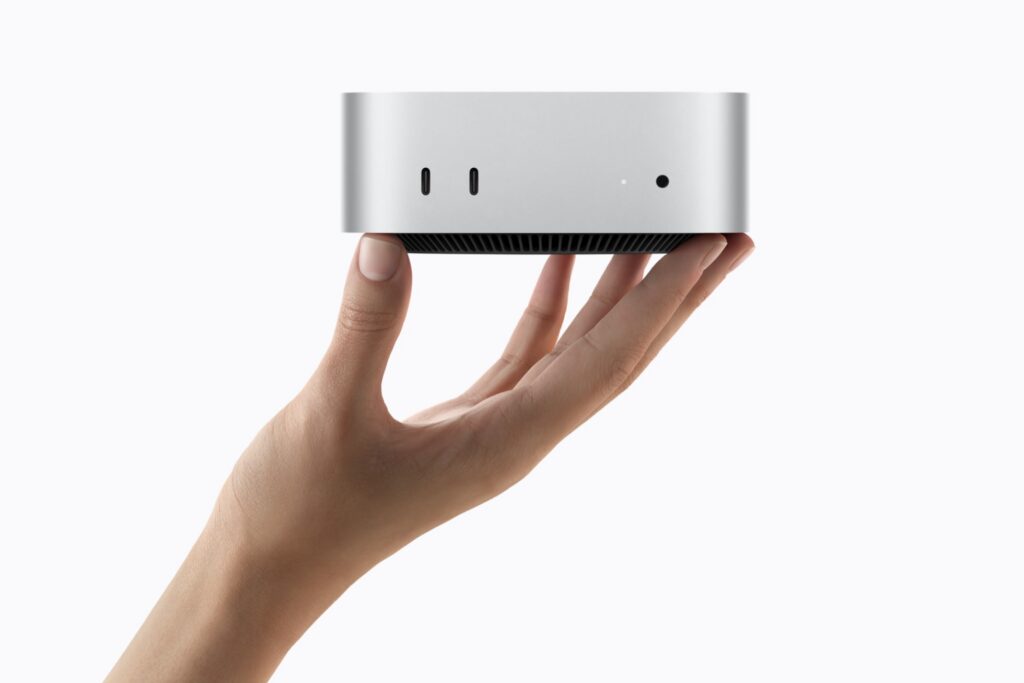
Apple says its new Mac mini, powered by the M6 and M5 Pro chips, delivers up to 4x faster AI performance and expanded memory options for local agentic workflows. [Image courtesy of Apple.]
NVIDIA’s own DGX Spark, for example, which began shipping in October 2025, is a purpose-built desktop AI system based on the Grace Blackwell GB10 chip. NVIDIA currently sells its 4TB Founders Edition for $4,699, with 128GB of unified memory, 273GB/s of memory bandwidth and up to one petaflop of FP4 AI performance. NVIDIA also offers a two-system bundle, and the systems can be linked over 200 Gb/s ConnectX-7 networking for distributed workloads.
ASUS, Dell, Lenovo and other manufacturers sell systems based on the same GB10 platform, with differences in storage, cooling, support and other system-level features.
Meanwhile, AMD’s Ryzen AI Max platform takes another approach, combining x86 CPUs, integrated Radeon graphics and large pools of shared memory in compact workstations from companies including HP and Framework.
As the table below shows, the compact AI computing landscape spans markedly different use cases, from low-power systems built into robots to deskside machines for developers, researchers and users running local models and autonomous agents. Their performance figures also require some caution: vendors cite a mix of TOPS, FP4 petaflops, memory bandwidth and application-specific benchmarks that are useful within context but cannot be compared directly across systems.
| System | Basic positioning | Memory | Claimed AI compute / relevant spec | Current price | Source |
|---|---|---|---|---|---|
| NVIDIA Jetson Orin Nano 2 | Robotics / edge deployment | 8GB | 78 TOPS; 2x inference vs. Orin Nano Super, or same performance at 40% less power in 15W mode | Not announced; module and developer kit expected H1 2027 | NVIDIA |
| Apple Mac mini M6 | General desktop / local agents | 16GB standard; configurable to 32GB | Apple claims up to 4x faster AI vs. M4 Mac mini and 4.8x faster LM Studio prompt processing; 170GB/s | $899+ | Apple |
| Apple Mac mini M5 Pro | Higher-end local AI / dev | Up to 64GB | Apple claims up to 4x faster LM Studio prompt processing vs. M4 Pro; 307GB/s | $1,699+ | Apple |
| NVIDIA RTX Spark PCs | Windows personal agents / local AI | Up to 128GB | Up to 1 PFLOP AI compute | TBD; systems expected fall 2026 | NVIDIA |
| Apple Mac Studio M5 Max | AI/pro workstation | Up to 128GB | Apple claims up to 3.9x faster LLM prompt processing in LM Studio vs. M4 Max; up to 614GB/s | $2,499+ | Apple |
| Apple Mac Studio M5 Ultra | Large local models | Up to 512GB (512GB configuration expected late October 2026) | 1.2TB/s memory bandwidth | $5,499+ | Apple |
| NVIDIA DGX Spark | Dedicated desktop AI development | 128GB | Up to 1 PFLOP FP4; 273GB/s | $4,699 | NVIDIA |
| ASUS Ascent GX10 | DGX Spark-class AI workstation | 128GB | 1 PFLOP FP4 | $4,699 | ASUS eShop |
| Dell Pro Max with GB10 | Enterprise local AI workstation | 128GB | GB10 Blackwell, 1 PFLOP FP4 | Configuration-dependent; verify current listing | Dell |
| Lenovo ThinkStation PGX | Enterprise AI workstation | 128GB | Up to 1 PFLOP FP4 with sparsity; 273GB/s | Varies by storage config; verify current listing | Lenovo Press |
| Framework Desktop, Ryzen AI Max+ 395 | x86/local AI PC | Up to 128GB | Radeon 8060S; 256GB/s | Configuration-dependent; 128GB mainboard $3,149 | Framework specs; mainboard |
Prices as of Aug. 25, 2026, and subject to change amid ongoing DRAM supply constraints.