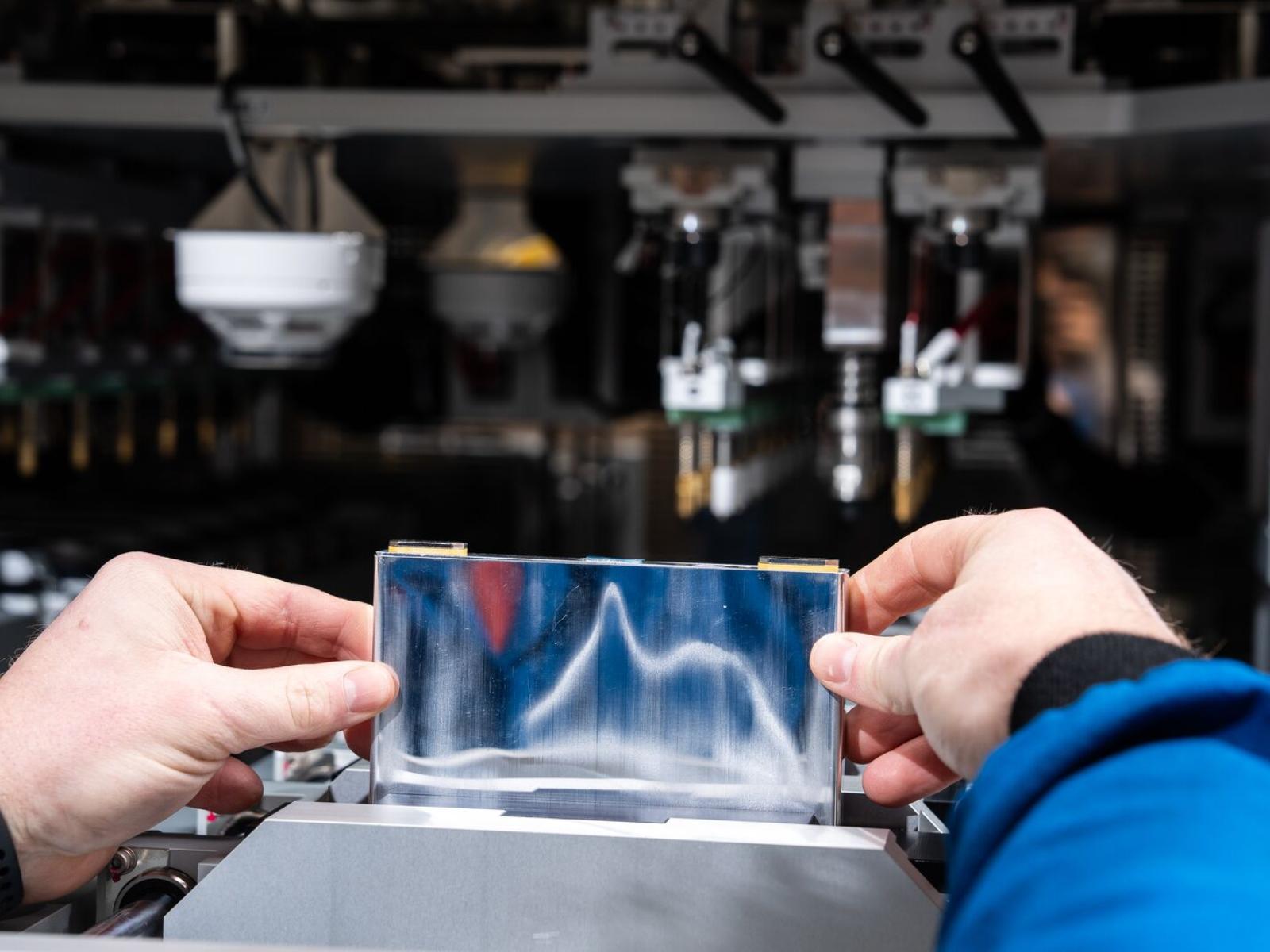
Credit: Andrea Starr / Pacific Northwest National Laboratory
Led by Pacific Northwest National Laboratory, the Battery Manufacturing Accelerator (BattMan) brings together Argonne, Oak Ridge and the National Laboratory of the Rockies to combine manufacturing research with machine learning and digital twins.
Scaling new battery chemistries brings manufacturing and financial risks: production can fall short, construction costs can climb and financing can run out. The Department of Energy announced BattMan on Oct. 28, 2026, to identify manufacturing problems earlier and reduce the cost and risk of moving technologies into commercial production.
Northvolt offers a case study of the production challenges. The Swedish cell maker delivered about 80 MWh of battery cells in the first nine months of 2023, according to Norran’s reporting on figures reviewed by Dagens Industri. That was roughly 0.5% of the eventual 16 GWh annual production target for its first two production blocks; installed capacity reached 16 GWh at the end of 2023. In June 2024, BMW canceled a €2 billion ($2.15 billion) order amid reported delivery delays and quality problems. Northvolt sought Chapter 11 protection in the U.S. on Nov. 21, 2024. It filed for bankruptcy in Sweden on March 12, 2025, citing production ramp-up difficulties alongside financing and market pressures.
While Northvolt shows the production difficulties, lithium-ion battery recycler Ascend Elements illustrates the construction and financing risks. It filed Chapter 11 petitions on April 9, 2026, in the U.S. Bankruptcy Court for the Southern District of Texas. In October 2025, E&E News reported that DOE had canceled a $316 million award, with the company saying it had already received $206 million and would lose the roughly $110 million remaining. Ascend’s first-day declaration attributed its financial difficulties partly to cost overruns, construction delays and contractor disputes at its Apex 1 project in Kentucky, which was about 60% complete. Turner-Kokosing claimed roughly $138 million for work on Apex 1; Ascend disputed the claim. The declaration separately listed more than $145 million in asserted statutory liens across Apex 0 and Apex 1, including potentially overlapping contractor and subcontractor claims.
“Processes that work at small scale can behave very differently at larger volumes,” said Claus Daniel, associate laboratory director for Argonne’s Advanced Energy Technologies directorate. BattMan aims to expose manufacturing uncertainties through testing and validation at increasing scales.
The University of Washington, Binghamton University, the University of Alabama, Arizona State University and the University of Michigan-Dearborn are founding partners. DOE’s Advanced Materials and Manufacturing Technologies Office (AMMTO), within the Office of Critical Minerals and Energy Innovation (CMEI), supports the program.
BattMan aims to lower manufacturing costs, shorten development timelines and advance battery materials made from more abundant domestic elements.
Under the program, PNNL will apply manufacturing science to demonstrate that new materials and processes can scale. Argonne will validate feasibility and increase production using its pilot lines. Both labs will supply materials, such as powders and electrodes, to Oak Ridge National Laboratory (ORNL) for smart coating process development. The National Laboratory of the Rockies (NLR) will lead advanced characterization, physics-guided quality control and digital materials design, feeding results back to project partners.
In the near term, the labs plan to use high-throughput experimentation, automated synthesis and characterization, and digital manufacturing tools to improve data quality, reproducibility and process consistency across partner sites. Argonne will generate synthesis and scale-up data, train machine learning models and use active learning to identify optimal processing conditions.
Longer term, BattMan aims to build on autonomous laboratory concepts by developing autonomous pilot lines. The planned self-optimizing manufacturing systems would combine real-time data, digital twins and closed-loop control to reduce scale-up time and costs and accelerate commercialization.
BattMan is establishing collaborations with companies across battery and materials manufacturing. Interested organizations can contact [email protected].

Tell Us What You Think!
You must be logged in to post a comment.