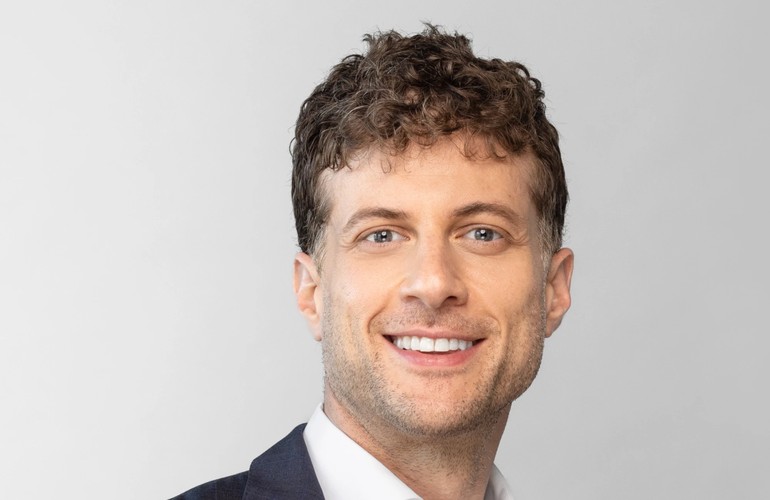
Michael Schnall-Levin. Credit: 10x Genomics
The vast majority of 10x Genomics employees and customers who write code have adopted AI tools, chief technology officer Michael Schnall-Levin says. 10x, a Pleasanton, California maker of single-cell and spatial biology instruments whose partners include NVIDIA and Anthropic, launched Sentira Single Cell on Nov. 2. The cloud application uses an agent built on Anthropic’s Claude to run custom analyses of data from the company’s Chromium single-cell platform. In other words, Sentira helps address the “last mile problem” in single-cell analysis, where answering a researcher’s specific biological question often requires a bioinformatician to write custom code. Researchers working with data from 10x’s Chromium platform can ask those questions in plain English, review the agent’s proposed analysis plan and examine the code behind its results.
In a Nov. 4 interview with R&D World, Schnall-Levin predicted that some parts of developing therapies and diagnostics “will get massively accelerated” while others “will still be really painfully slow.” He is still working out which parts land where. “I don’t have all the answers yet,” he said. Lab automation, he noted, has promise but remains “extremely niche” in actual experimentation.
This interview has been edited for length and clarity.
‘A pretty big split’
R&D World: In a few years, genAI went from niche tool to mainstream in software engineering where you have rival camps with strong views about what the best practices should be. What are you seeing in the lab?
Michael Schnall-Levin: There’s a pretty big split right now. Looking internally and talking to customers, on the data analysis and software side it’s very clear that AI is incredibly powerful and enabling. There’s still diversity of opinion about adopting it. But the vast majority of people, both internally and among our customers, who do coding-based work are adopting. Some people are more purists, or have skepticism for a variety of reasons, in some cases good reason, where it’s not working for them. But the vast majority are adopting.
In the lab, literally in the lab, it’s not helpful yet. There are people working on lab automation, but that’s not really there yet in terms of being helpful. Where we see people in the lab making heavy use of these tools is all the work around the experiment: planning an experiment, writing up a protocol. You might have someone follow a protocol you’ve modified for two days; AI can help you write that up for yourself or for whoever is going to conduct the experiments. Analyzing the data, putting together PowerPoint slides to share with your team. We’re seeing a lot of adoption there. But in terms of the actual experimentation, I would say it’s extremely niche right now. There are a few startups working on AI-enabled automation, and it gets people excited, but it’s not really happening yet. It’s more of a PowerPoint.
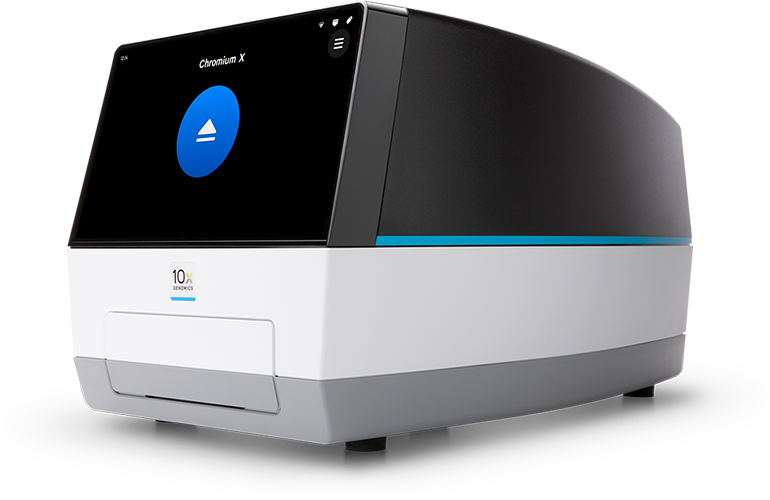
The Chromium X single-cell instrument. Credit: 10x Genomics
R&D World: One lab-automation CEO compared the goal to Waymo: robots that can run any procedure, the way a robotaxi can go anywhere. How far along is that?
Michael Schnall-Levin: I think it’s exciting. I’m intrigued, and there are definitely some people who are really intrigued by it. But it’s early still. AI for the physical world in general is just years behind AI for fully virtual or fully electronic work, whatever you want to call it.
‘Plumbing together different packages’
R&D World: Sentira Single Cell lets a bench scientist analyze single-cell data without writing code. Who gains the most, the bench scientist or the bioinformatician?
Michael Schnall-Levin: There are benefits here for two groups of people. There’s the scientist doing experiments who doesn’t have bioinformatics experience. For them, the advantage is that you’re more independent. You can ask questions yourself and don’t have to rely entirely on a bioinformatician to do that work for you. That can be accelerating. It can let people ask a lot more questions.
But even for bioinformaticians, there may be parts where really novel capabilities need to be developed, and they can spend their time on that. There’s a lot of work in bioinformatics that is plumbing together different packages: finding different software packages, putting them together, making sure they all work. Some of that is really not value-add, and I don’t think it’s what a lot of bioinformaticians like to do. So this can help that group automate some of it and focus on areas where they’re really spending their brain power, versus the more rote mechanics of setting things up.
‘You don’t have to suddenly flip everything over’
R&D World: Change management keeps coming up as a barrier to AI in pharma: executives who pay lip service to it, scientists who keep older ways of working. Does a natural-language tool make adoption easier?
Michael Schnall-Levin: I think that’s right. Something we’re seeing with the adoption of AI tools internally, outside of Sentira, is that AI automates changing systems to some degree. If you have a bunch of stuff stored in one format and now you want to move it over and do something different, it makes some of that easy. So we’ve found that change management may be easier in some cases than it historically was.
With this, it’s still early days, but we’re seeing a ton of excitement about adopting it, and a ton of acknowledgment that it really is just helpful. One thing that’s really helpful with these kinds of tools is that you can use them as much or as little as you want in a given setting. You don’t have to suddenly flip everything over. You could be doing a bunch of analysis in Sentira Single Cell and still say, “There are some things I want to export from some intermediate step and do myself,” or “I want to write my own tool and have that go in.”
It’s easier to get adoption when there’s a continuum: you can start adopting it as much as it is really helpful and keep increasing that as it gets more helpful. Versus something that requires a bunch of up-front costs, where it’s really painful to make a switch. Those adoptions are hard. You’re hopeful you’re going to get to a better state after you go through it, but going through it is hard. I think it’ll be a mix with AI overall, but with Sentira right now, we’re seeing it as mostly highly enabling to people, and not something that’s going to face too much friction.
‘A human being is responsible for the work’
R&D World: 10x tested Sentira against analyses a computational biologist had already done by hand, as our launch story describes. Coding agents can now spin up a second agent to act as a skeptic and review the work. How does Sentira show scientists that its conclusions rest on their actual data?
Michael Schnall-Levin: The way Sentira is set up, the term widely used now is the harness. You’re structuring different calls to the LLMs and putting them together with the right prompting. Part of the internals are some of what you’re talking about: some agents proposing a workflow, other agents criticizing it skeptically. Some of that is built into the structure of how Sentira works.
In terms of how we build trust, there are a few parts. One is that it really exposes all the choices it has made, so you can go back later and see what was done. It’s not just “here’s the answer,” without telling you anything about the reasoning and the steps. We think that’s important because ultimately a human being is responsible for the work. If you hired a summer intern and they helped you write some of your articles, or if you used ChatGPT or Claude to help you write or research your articles, you’re still accountable for your articles being correct. It’s the same for our customers, the scientists. They’re accountable for their work, so it’s on them to go and check the result and confirm everything. We try to expose the steps as part of that.
Nothing is perfect. Humans aren’t perfect either, obviously, but AI is not perfect yet. We think these are going to be incredibly enabling tools, but it’s important for people, once they’re submitting publications or doing things with these results, to confirm them in a variety of ways, and not just copy and paste from the chatbot and assume everything is perfect with no check.
‘Starting to build the different building blocks’
R&D World: Researchers in chemistry and pharma describe multi-agent workflows that span more than one step, including agents that could order reagents. Could Sentira work with other agents?
Michael Schnall-Levin: We have a vision of a more unified customer experience through Sentira, plus maybe other tools as well. As one example, we also recently put out the capability for some customer support, questions about our products, to be done through an agentic workflow. Not as a replacement for the personal touch, but for certain things it can be really helpful. We frequently get questions like, “I have this weird kind of sample. Which products can I run on it?” Maybe it’s not immediately obvious where to look for that information. You can ask this agentic support agent questions like that and it will answer them. You can do that at 3 in the morning in any time zone, and ask as many questions as you want, at a level that’s harder to do with a human being.
As you think about all the ways scientists interact with us, you can imagine a more unified experience between asking which products are the right ones to use, learning about the products, planning your experiments and deciding how to set them up, ordering reagents and analyzing the data. And people don’t work in isolation; they work with collaborators. Maybe one person is planning how to set up the experiment using tools we provide to help them automate that, and that could be easily shared with collaborators who are going to analyze the data, because knowing the exact experimental setup is helpful in analyzing the data.
So there’s a unified experience we could offer over time that could be really enabling, really conducive to collaboration, accelerating for people. We’re starting to build the different building blocks there, and then we’ll figure out how to put it all together.
R&D World: Sentira runs on Claude. What does the Anthropic relationship involve?
Michael Schnall-Levin: Overall we have a really good relationship. This has all been said publicly by them: there’s a lot of excitement from Anthropic’s leadership about applications of AI to biology. From Dario Amodei down, he has a background in biology and science from before he got into AI, so they’re really passionate about AI being used for biology and healthcare. There’s good philosophical alignment between the two companies. We’re really excited about biology and healthcare and having an impact, and about using AI tools for that. The main thing in this project is that the initial way we’re powering this is with their models, which we have found to be really good for this type of work. So it’s been a nice technical collaboration.
‘Where the real pain points are going to come and remain’

The Xenium Analyzer, 10x Genomics’ in situ instrument. Credit: 10x Genomics
R&D World: Much of the AI work in pharma focuses on one step, such as a trial protocol or one phase of molecule discovery. Anthropic has previewed a Model Hardware Standard that could let Claude operate instruments such as microscopes. How do you connect single-cell analysis to agents that work across a whole process?
Michael Schnall-Levin: We’re still trying to figure some of this out. It’s very clear these tools can have a hugely enabling role for scientists and customers through the whole journey of planning projects, planning experiments and analyzing data. We haven’t figured it all out, but there’s a ton of excitement about this accelerating the development of therapies and diagnostics overall.
If you think about a lot of the work our customers are doing, even in early discovery: why are we all doing biomedical research? There’s an intellectual curiosity aspect to it, but the main purpose is ultimately to cure, prevent and diagnose diseases. So I’m pretty interested in thinking about the maximal role we can play, both through our wet-lab data generation technologies and by deploying AI in the right way, to truly accelerate that.
It’s going to be really interesting, because there are parts that will get massively accelerated and parts that will still be really painfully slow. Some of the people who come purely from the AI world, without any experience in biology or biopharma, may be a little naive about the remaining bottlenecks: “We’re just going to cure every disease in six months,” or something like that.
So there are going to be these pain points. I’m really excited about what 10x can do to focus on where the real pain points are going to come and remain, and how to move the needle on those. I don’t have all the answers yet, but if you can focus there and really offer value there, that’s going to be incredibly impactful for the world. If we could actually have clinical trials succeed a lot more often, or be a lot less expensive, or a lot faster, or have many more drugs actually succeed, how do we do that? To me, part of that is that you have to actually focus on where the problem to be solved is, written out very clearly by the people who actually face that problem, and work back from that a little bit. Versus just throwing AI at it without thinking about it.
‘A very long-term bull’
R&D World: Several AI CEOs have made ambitious projections about AI’s potential to cure disease. Even a 10% better success rate for molecules and biologics before they reach human trials would be a big gain. Where do you land?
Michael Schnall-Levin: I’m a very long-term bull that we may actually be able to cure a bunch of diseases. But whenever there’s a new technological wave, and I believe this is the most important technological wave that’s happened in certainly many decades, maybe ever, there’s some over-exuberance about everything that can happen too quickly, and also maybe some skepticism about what’s going to happen 10 or 20 years from now. There’s probably a similarity here: some of these things are going to turn out to be harder than people think, but the actual impact ultimately may be enormous. It may be that we have cured many of these diseases in decades. I just don’t think it’s going to be in six months or 12 months.
Tell Us What You Think!
You must be logged in to post a comment.