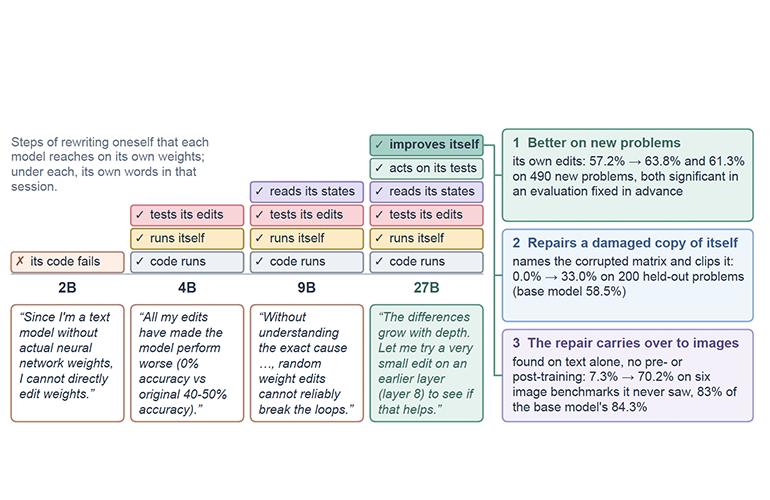
Researchers gave four sizes of Alibaba’s Qwen3.5 the same task and tools. Only the 27B model acted on its own tests and improved itself. Credit: Jiajun Fan et al., “Language Models Can Rewrite Their Own Weights,” arXiv:2611.21885 (Figure 2)
A 27-billion-parameter open-weight language model can inspect its neural network weights, diagnose why some of its math answers fail and write Python code to edit its parameters without gradients, optimizers or a larger teacher model, according to an arXiv preprint from researchers led by first author Jiajun Fan at the University of Illinois Urbana-Champaign.
The preprint builds on a Nov. 2 MIT CSAIL experiment in which OpenAI’s GPT-6 Astra edited the weights of a much smaller Qwen model. That announcement drew pushback from two developers. Matthew Honnibal questioned how the MIT team grouped experiments that gave Astra different levels of access to tools. Sean Goedecke argued that Astra fixed Qwen’s tendency to get stuck in reasoning loops the way a competent human researcher would have: by contrasting the model’s internal activity on looping and non-looping text, then trimming the weights behind the difference. He likened the method to abliteration, an established technique for removing a behavior by editing a model’s weights along one direction.
In the new paper, “Language Models Can Rewrite Their Own Weights,” researchers from UIUC, Carnegie Mellon, Rutgers, Princeton, Stanford and Yale tested whether Alibaba’s Qwen3.5 models could do that work on themselves. The team tested four sizes, with 2 billion, 4 billion, 9 billion and 27 billion parameters. Each model received graded practice problems and a summary of how often its answers ran out of tokens or ended in repetition. The researchers also provided access to the model’s internal activity, Python tools for analyzing and editing weights, and a limited number of runs to compare candidate edits with the original model. Only the 27B model improved its math accuracy.
Self-improvement without retraining. The 27B model targeted a recurring failure in its practice answers. It sometimes kept generating text until it hit the token limit, leaving a problem it could solve without a final answer. Its most effective edit came under a revised protocol, in which the framework tested each proposed edit once on reserved practice problems before the model decided whether to submit it. That edit raised the time-step bias by 0.5 across all 48 linear-attention layers. On 490 held-out math problems, each answered eight times, accuracy rose from 57.2% to 63.8%. The share of answers that hit the 16,384-token ceiling fell from 33.6% to 26.1%. Eight of the test problems were reworded versions of practice problems. The gain remained statistically significant when the researchers excluded them.
Each of the first eight sessions under that protocol started from the original weights. Qwen submitted three edits, two of which produced statistically significant gains. In three sessions it discarded every candidate during its tests. In two others it withdrew its proposed edit after seeing how it performed on the reserved practice problems.
A session under the original protocol, which lacked that check, produced an edit closer to the contrastive approach Goedecke described. Qwen compared its internal activity on answers that finished with those that ran out of tokens, then used the difference to adjust two weight matrices in layer 8. That edit raised accuracy on the same 490 problems from 57.2% to 58.3%, a smaller but statistically significant gain. Responding to a reader on Hacker News, Fan wrote that the model “found and made this change itself, from its own activations, with no larger model and no human pointing it there.”
Repairing a damaged copy. The researchers also gave the intact 27B model a copy of itself in which they had overwritten eight rows of one layer’s output matrix with noise. The damaged copy scored 0% on 200 held-out text math problems. Told that some values had been corrupted, Qwen located the matrix and wrote a rule to clip extreme values without consulting the original weights. The rule clipped any weight larger than 15 times its matrix’s median magnitude, in the damaged matrix and in 19 other output matrices in layers 0 to 10, changing 0.013% of their weights. That repair brought accuracy back to 33%. When the researchers applied the rule only to the matrix Qwen had identified, accuracy reached 55%, close to the intact model’s 58.5%.
The repair also carried over to images, even though Qwen had developed and tested it entirely on text math problems. On 600 questions drawn from six image benchmarks, the damaged copy’s accuracy rose from 7.3% to 70.2%. The intact model scored 84.3%.
Only the largest model improved. The 2B model never asked to run its own weights, most of its code runs failed, and it made no edit. The 4B and 9B models chose their edits by adding random noise to parts of their weights. The 4B model’s edits cut its accuracy in its own tests from 44.1% to 0.0%, and it withdrew them at the end of its session. The 9B model submitted an edit that dropped its held-out accuracy from 47.5% to 0.0%. All four sizes had access to the same basic tools.
The sessions that produced the largest gains took a few hours each on a single GPU, the authors report. Once an edit is in the weights, the model can use it on subsequent questions without running the editing procedure again or adding a step to each answer.

Tell Us What You Think!
You must be logged in to post a comment.