Research & Development World

  • R&D World Home
  • Topics
    • Aerospace
    • Automotive
    • Biotech
    • Careers
    • Chemistry
    • Environment
    • Energy
    • Life Science
    • Material Science
    • R&D Management
    • Physics
  • Technology
    • 3D Printing
    • A.I./Robotics
    • Software
    • Battery Technology
    • Controlled Environments
      • Cleanrooms
      • Graphene
      • Lasers
      • Regulations/Standards
      • Sensors
    • Imaging
    • Nanotechnology
    • Scientific Computing
      • Big Data
      • HPC/Supercomputing
      • Informatics
      • Security
    • Semiconductors
  • R&D Market Pulse
  • R&D 100
    • 2026 R&D 100 Award Winners
    • 2026 Professional Award Winners
    • 2026 Special Recognition Winners
    • R&D 100 Awards Event
    • R&D 100 Submissions
    • Winner Archive
  • Resources
    • Research Reports
    • Digital Issues
    • Educational Assets
    • Subscribe
    • Video
    • Webinars
    • PharmSci360
    • Content submission guidelines for R&D World
  • Global Funding Forecast
  • Top Labs
  • Advertise
  • SUBSCRIBE

A Photon Source That Operates at Ambient Temperatures on a Chip

By R&D Editors | May 4, 2016

Prof. Ronen Rapaport, of the Racah Institute of Physics, The Department of Applied Physics, and gthe Center of Nanoscience and nanotechnology at the Hebrew University of Jerusalem is part of the team that demonstrated the single photon theory.Quantum information science and technology has emerged as a new paradigm for dramatically faster computation and secure communication in the 21st century. At the heart of any quantum system is the most basic building block, the quantum bit or qbit, which carries the quantum information that can be transferred and processed (this is the quantum analogue of the bit used in current information systems). The most promising carrier qbit for ultimately fast, long distance quantum information transfer is the photon, the quantum unit of light.

The challenge facing scientists is to produce artificial sources of photons for various quantum information tasks. One of the biggest challenges is the development of efficient, scalable photon sources that can be mounted on a chip and operate at room temperature. Most sources used in labs today have to be very cold (at the temperature of liquid Helium, about -270C), which requires large and expensive refrigerators. Many sources also emit photons in undefined directions, making efficient collection a hard problem.

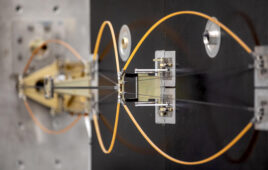
Now, a team of scientists from the Hebrew University of Jerusalem has demonstrated an efficient and compact single photon source that can operate on a chip at ambient temperatures. Using tiny nanocrystals made of semiconducting materials, the scientists developed a method in which a single nanocrystal can be accurately positioned on top of a specially designed and carefully fabricated nano-antenna.

In the same way large antennas on rooftops direct emission of classical radio waves for cellular and satellite transmissions, the nano-antenna efficiently directed the single photons emitted from the nanocrystals into a well-defined direction in space. This combined nanocrystals-nanoantenna device was able to produce a highly directional stream of single photons all flying to the same direction with a record low divergence angle. These photons were then collected with a very simple optical setup, and sent to be detected and analyzed using single photon detectors.

The team demonstrated that this hybrid device enhances the collection efficiency of single photons by more than a factor of 10 compared to a single nanocrystal without the antenna, without the need for complex and bulky optical collection systems used in many other experiments. Experimental results show that almost 40% of the photons are easily collected with a very simple optical apparatus, and over 20% of the photons are emitted into a very low numerical aperture, a 20-fold improvement over a freestanding quantum dot, and with a probability of more than 70% for a single photon emission. The single photon purity is limited only by emission from the metal, an obstacle that can be bypassed with careful design and fabrication.

The antennas were fabricated using simple metallic and dielectric layers using methods that are compatible with current industrial fabrication technologies, and many such devices can be fabricated densely on one small chip. The team is now working on a new generation of improved devices that will allow deterministic production of single photons straight from the chip into optical fibers, without any additional optical components, with a near unity efficiency.

“This research paves a promising route for a high purity, high efficiency, on-chip single photon source operating at room temperature, a concept that can be extended to many types of quantum emitters. A highly directional single photon source could lead to a significant progress in producing compact, cheap, and efficient sources of quantum information bits for future quantum technological applications”, said Prof. Ronen Rapaport, of the Racah Institute of Physics , The Department of Applied Physics, and the Center of Nanoscience and Nanotechnology at the Hebrew University of Jerusalem.

 

Related Articles Read More >

INL’s $60 million nuclear AI project will spend the first year testing where AI agents can help and where they might hurt 
The Space Systems Division (05)-developed Parallelogram Synchronized Truss Assembly (PaSTA), seen Aug. 12, 2025, is a mechanism that will be integrated into the Life-Extension In-orbit Servicer (LEXI) and Astroscale Prototype Servicer for Refueling (APS-R) spacecrafts.
One SwRI R&D 100 winner turns buckled fiberglass into a spacecraft truss. The other models freight rail with 900 hours of BNSF field data
Inside the Lab: NETL’s Oil and Gas Center of Excellence focuses on technologies to enhance production   
Inside S&C Electric’s and Argonne National Lab’s CRADA partnership
rd newsletter
EXPAND YOUR KNOWLEDGE AND STAY CONNECTED
Get the latest info on technologies, trends, and strategies in Research & Development.

R&D World Digital Issues

Fall 2025 issue

Browse the most current issue of R&D World and back issues in an easy to use high quality format. Clip, share and download with the leading R&D magazine today.

R&D 100 Awards
Research & Development World
  • Subscribe to R&D World Magazine
  • Sign up for R&D World’s newsletter
  • Contact Us
  • About Us
  • Drug Discovery & Development
  • Pharmaceutical Processing
  • Global Funding Forecast

Copyright © 2026 Arrowfly LLC. All Rights Reserved. The material on this site may not be reproduced, distributed, transmitted, cached or otherwise used, except with the prior written permission of Arrowfly
Privacy Policy | Advertising | About Us

Search R&D World

  • R&D World Home
  • Topics
    • Aerospace
    • Automotive
    • Biotech
    • Careers
    • Chemistry
    • Environment
    • Energy
    • Life Science
    • Material Science
    • R&D Management
    • Physics
  • Technology
    • 3D Printing
    • A.I./Robotics
    • Software
    • Battery Technology
    • Controlled Environments
      • Cleanrooms
      • Graphene
      • Lasers
      • Regulations/Standards
      • Sensors
    • Imaging
    • Nanotechnology
    • Scientific Computing
      • Big Data
      • HPC/Supercomputing
      • Informatics
      • Security
    • Semiconductors
  • R&D Market Pulse
  • R&D 100
    • 2026 R&D 100 Award Winners
    • 2026 Professional Award Winners
    • 2026 Special Recognition Winners
    • R&D 100 Awards Event
    • R&D 100 Submissions
    • Winner Archive
  • Resources
    • Research Reports
    • Digital Issues
    • Educational Assets
    • Subscribe
    • Video
    • Webinars
    • PharmSci360
    • Content submission guidelines for R&D World
  • Global Funding Forecast
  • Top Labs
  • Advertise
  • SUBSCRIBE