Research & Development World

  • R&D World Home
  • Topics
    • Aerospace
    • Automotive
    • Biotech
    • Careers
    • Chemistry
    • Environment
    • Energy
    • Life Science
    • Material Science
    • R&D Management
    • Physics
  • Technology
    • 3D Printing
    • A.I./Robotics
    • Software
    • Battery Technology
    • Controlled Environments
      • Cleanrooms
      • Graphene
      • Lasers
      • Regulations/Standards
      • Sensors
    • Imaging
    • Nanotechnology
    • Scientific Computing
      • Big Data
      • HPC/Supercomputing
      • Informatics
      • Security
    • Semiconductors
  • R&D Market Pulse
  • R&D 100
    • 2026 R&D 100 Award Winners
    • 2026 Professional Award Winners
    • 2026 Special Recognition Winners
    • R&D 100 Awards Event
    • R&D 100 Submissions
    • Winner Archive
  • Resources
    • Research Reports
    • Digital Issues
    • Educational Assets
    • Subscribe
    • Video
    • Webinars
    • PharmSci360
    • Content submission guidelines for R&D World
  • Global Funding Forecast
  • Top Labs
  • Advertise
  • SUBSCRIBE

Antireflective Semiconductor Surfaces Inspired by Cicadas

By AIP News Staff | October 12, 2016

A team of Shanghai Jiao Tong University researchers has used the shape of cicada wings as a template to create antireflective structures fabricated with one of the most intriguing semiconductor materials, titanium dioxide (TiO2). The antireflective structures they produced are capable of suppressing visible light — 450 to 750 nanometers — at different angles of incidence.

Why cicada wings? The surfaces of the insect’s wings are composed of highly ordered, tiny vertical “nano-nipple” arrays, according to the researchers. As they report this week in Applied Physics Letters, from AIP Publishing, the resulting biomorphic TiO2 surface they created with antireflective structures shows a significant decrease in reflectivity.

“This can be attributed to an optimally graded refractive index profile between air and the TiO2 via antireflective structures on the surface,” explains Wang Zhang, associate professor at State Key Laboratory of Metal Matrix Composites, Shanghai Jiao Tong University in China.

I. Photograph and scanning electron microscope characterizations of a black cicada wing (Cryptympana atrata Fabricius). II. Synthesis process of biomorphic TiO2 with ordered nano-nipple array structures. III. Counter map angle-dependent antireflection of biomorphic TiO2 and non-templated TiO2, respectively. Image: Shanghai Jiao Tong University

Small spaces between the ordered nano-antireflective structures “can be thought of as a light-transfer path that let incident light rays into the interior surface of the biomorphic TiO2 — allowing the incident light rays to completely enter the structure,” Zhang continues. “The multiple reflective and scattering effects of the antireflective structures prevented the incident light from returning to the outside atmosphere.”

Significantly, the team’s work relies on “a simple and low-cost sol-gel (wet chemical) method to fabricate biomorphic TiO2 with precise subwavelength antireflective surfaces,” Zhang points out. “The TiO2 was a purely anatase phase (a mineral form of TiO2), which has unique antireflective surfaces. This led to an optimally graded refractive index and, ultimately, to angle-dependent antireflective properties within the visible light range.”

In terms of applications, the team’s biomorphic TiO2 antireflective structures “show great potential for photovoltaic devices such as solar cells,” Zhang says. “We expect our work to inspire and motivate engineers to develop antireflective surfaces with unique structures for various practical applications.”

Even after high calcination at 500 C, the antireflective structures retain their morphology and high-performance antireflection properties. These qualities should enable the coatings to withstand harsh environments and make them suitable for long-term applications.

In the future, the team plans “to reduce the optical losses in solar cells by using materials with a higher refractive index such as tantalum pentoxide or any other semiconductor materials,” Zhang says.

Source: American Institute of Physics
Related Articles Read More >

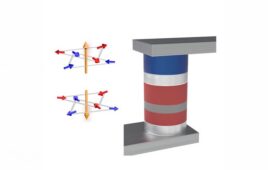
Illustration of an antiferromagnetic tunnel junction pillar beside the two spin configurations of platinum-manganese that store a bit.
Northwestern and Western Digital demonstrate a new way to write magnetic memory
Google teases Synaptics edge AI chip ahead of Oct. 20 launch
Materials startup Thintronics takes aim at Ajinomoto’s chip packaging film, with surging AI demand widening the opening
OpenAI and Synopsys plan a specialized model for chip design
rd newsletter
EXPAND YOUR KNOWLEDGE AND STAY CONNECTED
Get the latest info on technologies, trends, and strategies in Research & Development.

R&D World Digital Issues

Fall 2026 issue

Browse the most current issue of R&D World and back issues in an easy to use high quality format. Clip, share and download with the leading R&D magazine today.

R&D 100 Awards
Research & Development World
  • Subscribe to R&D World Magazine
  • Sign up for R&D World’s newsletter
  • Contact Us
  • About Us
  • Drug Discovery & Development
  • Pharmaceutical Processing
  • Global Funding Forecast

Copyright © 2026 Arrowfly LLC. All Rights Reserved. The material on this site may not be reproduced, distributed, transmitted, cached or otherwise used, except with the prior written permission of Arrowfly
Privacy Policy | Advertising | About Us

Search R&D World

  • R&D World Home
  • Topics
    • Aerospace
    • Automotive
    • Biotech
    • Careers
    • Chemistry
    • Environment
    • Energy
    • Life Science
    • Material Science
    • R&D Management
    • Physics
  • Technology
    • 3D Printing
    • A.I./Robotics
    • Software
    • Battery Technology
    • Controlled Environments
      • Cleanrooms
      • Graphene
      • Lasers
      • Regulations/Standards
      • Sensors
    • Imaging
    • Nanotechnology
    • Scientific Computing
      • Big Data
      • HPC/Supercomputing
      • Informatics
      • Security
    • Semiconductors
  • R&D Market Pulse
  • R&D 100
    • 2026 R&D 100 Award Winners
    • 2026 Professional Award Winners
    • 2026 Special Recognition Winners
    • R&D 100 Awards Event
    • R&D 100 Submissions
    • Winner Archive
  • Resources
    • Research Reports
    • Digital Issues
    • Educational Assets
    • Subscribe
    • Video
    • Webinars
    • PharmSci360
    • Content submission guidelines for R&D World
  • Global Funding Forecast
  • Top Labs
  • Advertise
  • SUBSCRIBE