Those hot summer days may soon get a little bit cooler thanks to a new material that can help cool down roofs.
A team of engineers from the University of Colorado Boulder have developed a scalable manufactured metamaterial—an engineered material with extraordinary properties not found in nature—that will act as an air conditioning system for structures, even under direct sunlight with zero energy and water consumption.
The new material could end up providing an eco-friendly means of supplementary cooling for thermoelectric power plants, which currently require large amounts of water and electricity to maintain the operating temperatures of their machinery.
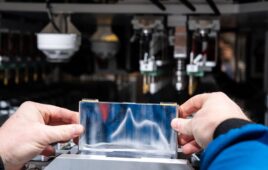
The glass-polymer hybrid material measures just 50 micrometers thick, slightly thicker than the aluminum foil found in a kitchen, and it can be manufactured economically on rolls, making it a potentially viable large-scale technology for both residential and commercial applications.
“We feel that this low-cost manufacturing process will be transformative for real-world applications of this radiative cooling technology,” Xiaobo Yin, co-director of the research and an assistant professor who holds dual appointments in CU Boulder’s Department of Mechanical Engineering and the Materials Science and Engineering Program, said in a statement.
The material uses passive radiative cooling, the process by which objects naturally shed heat in the form of infrared radiation without consuming energy.
While thermal radiation provides some natural nighttime cooling and is often used for residential cooling in some areas, daytime cooling has historically been challenging.
A structure exposed to even a small amount of directly-absorbed solar energy is enough to negate passive radiation.
However, the researchers embedded visibly-scattering but infrared-radiant glass microspheres into a polymer film and then added a thin silver coating underneath in order to achieve maximum spectral reflectance.
“Both the glass-polymer metamaterial formation and the silver coating are manufactured at scale on roll-to-roll processes,” Ronggui Yang, a professor of mechanical engineering and a Fellow of the American Society of Mechanical Engineers, said in a statement.
During field tests the metamaterial successfully demonstrated its average radiative cooling power larger than 110W/m2 for continuous 72 hours and larger than 90W/m2 in direct, noon-time sunlight. That cooling power is roughly the equivalent to the electricity generated using solar cells for a similar area but the radiative cooling has the advantage of continuous running both day and night.
“Just 10 to 20 square meters of this material on the rooftop could nicely cool down a single-family house in summer,” Gang Tan, an associate professor in the University of Wyoming’s Department of Civil and Architectural Engineering and a co-author of the paper, said in a statement.
Another use for the material will be to help improve the efficiency and lifetime of solar panels, where in direct sunlight panels can overheat to temperatures that hamper their ability to convert solar rays into electricity.
“Just by applying this material to the surface of a solar panel, we can cool the panel and recover an additional one to two percent of solar efficiency,” Yin said. “That makes a big difference at scale.”
The engineers have already applied for a patent for the technology and will now work on potential commercial applications.
The current plan is to create a 200-square-meter “cooling farm” prototype in Boulder in 2017.
“The key advantage of this technology is that it works 24/7 with no electricity or water usage,” Yang said. “We’re excited about the opportunity to explore potential uses in the power industry, aerospace, agriculture and more.”
The study was published in Science.
Co-authors of the new research include Yao Zhai, Yaoguang Ma and Dongliang Zhao of CU Boulder’s Department of Mechanical Engineering; Sabrina David of CU’s Materials Science and Engineering Program; and Runnan Lou of the Ann and H.J. Smead Department of Aerospace Engineering Sciences.