
Research & Development World

  • R&D World Home
  • Topics
    • Aerospace
    • Automotive
    • Biotech
    • Careers
    • Chemistry
    • Environment
    • Energy
    • Life Science
    • Material Science
    • R&D Management
    • Physics
  • Technology
    • 3D Printing
    • A.I./Robotics
    • Software
    • Battery Technology
    • Controlled Environments
      • Cleanrooms
      • Graphene
      • Lasers
      • Regulations/Standards
      • Sensors
    • Imaging
    • Nanotechnology
    • Scientific Computing
      • Big Data
      • HPC/Supercomputing
      • Informatics
      • Security
    • Semiconductors
  • R&D Market Pulse
  • R&D 100
    • 2026 R&D 100 Award Winners
    • 2026 Professional Award Winners
    • 2026 Special Recognition Winners
    • R&D 100 Awards Event
    • R&D 100 Submissions
    • Winner Archive
  • Resources
    • Research Reports
    • Digital Issues
    • Educational Assets
    • Subscribe
    • Video
    • Webinars
    • PharmSci360
    • Content submission guidelines for R&D World
  • Global Funding Forecast
  • Top Labs
  • Advertise
  • SUBSCRIBE

Scientists Create 3D Objects Made from Light

By Kenny Walter | July 11, 2017

A team from Southern Methodist University have used photoswitch molecules to bring to life 3D light structures that can be viewed from 360 degrees.

“Our idea was to use chemistry and special photoswitch molecules to make a 3D display that delivers a 360-degree view,” chemist Alexander Lippert, who led the research, said in a statement. “It’s not a hologram, it’s really three-dimensionally structured light.

“With real 3D results of an MRI, radiologists could more readily recognize abnormalities such as cancer,” he added. “I think it would have a significant impact on human health because an actual 3D image can deliver more information.”

The researchers used a photoswitch molecule that switches between non-fluorescent and fluorescent in reaction to the presence or absence of ultraviolet light. They discovered the on-off switch for tuning the molecule’s rate of thermal fading by adding to it the chemical amine base trimethylamine.

Shaping light into volumetric objects can have applications in several fields, including biomedical imaging, education and engineering, as well as TV, movies and video games.

The new technology differs from 3D movies or 3D computer design that are flat displays that use binocular disparity or linear perspective to make objects appear three-dimensional.

“When you see a 3D movie, for example, it’s tricking your brain to see 3D by presenting two different images to each eye,” Lippert said. “Our display is not tricking your brain—we’ve used chemistry to structure light in three actual dimensions, so no tricks, just a real three-dimensional light structure.

“We call it a 3D digital light photoactivatable dye display or 3D Light Pad for short, and it’s much more like what we see in real life,” he added.

Lippert said offices could create a virtual conference call with volumetric 3D images projected onto chairs, while construction and manufacturing projects could be rendered in 3D to observe. The military could also use tactical 3D replications of battlefields on land, in the air, under water or in space.

The study was published in Nature Communications.
Related Articles Read More >

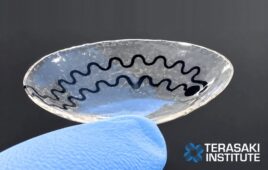
Smart contact lenses move from glucose to stress and mood
Speaker Giving a Talk at Business Meeting. Audience in the conference hall. Business and Entrepreneurship. Panoramic composition suitable for banners.
BioPharma Supply Chain & Logistics Nexus returns to San Diego in November
How Cypris evolved from selling patent reports to agentic R&D intelligence
New video series: Travel for engineers
rd newsletter
EXPAND YOUR KNOWLEDGE AND STAY CONNECTED
Get the latest info on technologies, trends, and strategies in Research & Development.

R&D World Digital Issues

Fall 2025 issue

Browse the most current issue of R&D World and back issues in an easy to use high quality format. Clip, share and download with the leading R&D magazine today.

R&D 100 Awards
Research & Development World
  • Subscribe to R&D World Magazine
  • Sign up for R&D World’s newsletter
  • Contact Us
  • About Us
  • Drug Discovery & Development
  • Pharmaceutical Processing
  • Global Funding Forecast

Copyright © 2026 Arrowfly LLC. All Rights Reserved. The material on this site may not be reproduced, distributed, transmitted, cached or otherwise used, except with the prior written permission of Arrowfly
Privacy Policy | Advertising | About Us

Search R&D World

  • R&D World Home
  • Topics
    • Aerospace
    • Automotive
    • Biotech
    • Careers
    • Chemistry
    • Environment
    • Energy
    • Life Science
    • Material Science
    • R&D Management
    • Physics
  • Technology
    • 3D Printing
    • A.I./Robotics
    • Software
    • Battery Technology
    • Controlled Environments
      • Cleanrooms
      • Graphene
      • Lasers
      • Regulations/Standards
      • Sensors
    • Imaging
    • Nanotechnology
    • Scientific Computing
      • Big Data
      • HPC/Supercomputing
      • Informatics
      • Security
    • Semiconductors
  • R&D Market Pulse
  • R&D 100
    • 2026 R&D 100 Award Winners
    • 2026 Professional Award Winners
    • 2026 Special Recognition Winners
    • R&D 100 Awards Event
    • R&D 100 Submissions
    • Winner Archive
  • Resources
    • Research Reports
    • Digital Issues
    • Educational Assets
    • Subscribe
    • Video
    • Webinars
    • PharmSci360
    • Content submission guidelines for R&D World
  • Global Funding Forecast
  • Top Labs
  • Advertise
  • SUBSCRIBE