Research & Development World

  • R&D World Home
  • Topics
    • Aerospace
    • Automotive
    • Biotech
    • Careers
    • Chemistry
    • Environment
    • Energy
    • Life Science
    • Material Science
    • R&D Management
    • Physics
  • Technology
    • 3D Printing
    • A.I./Robotics
    • Software
    • Battery Technology
    • Controlled Environments
      • Cleanrooms
      • Graphene
      • Lasers
      • Regulations/Standards
      • Sensors
    • Imaging
    • Nanotechnology
    • Scientific Computing
      • Big Data
      • HPC/Supercomputing
      • Informatics
      • Security
    • Semiconductors
  • R&D Market Pulse
  • R&D 100
    • 2026 R&D 100 Award Winners
    • 2026 Professional Award Winners
    • 2026 Special Recognition Winners
    • R&D 100 Awards Event
    • R&D 100 Submissions
    • Winner Archive
  • Resources
    • Research Reports
    • Digital Issues
    • Educational Assets
    • Subscribe
    • Video
    • Webinars
    • PharmSci360
    • Content submission guidelines for R&D World
  • Global Funding Forecast
  • Top Labs
  • Advertise
  • SUBSCRIBE

Extracting Sugar from Waste Key to Greener Production

By Kenny Walter | September 11, 2017

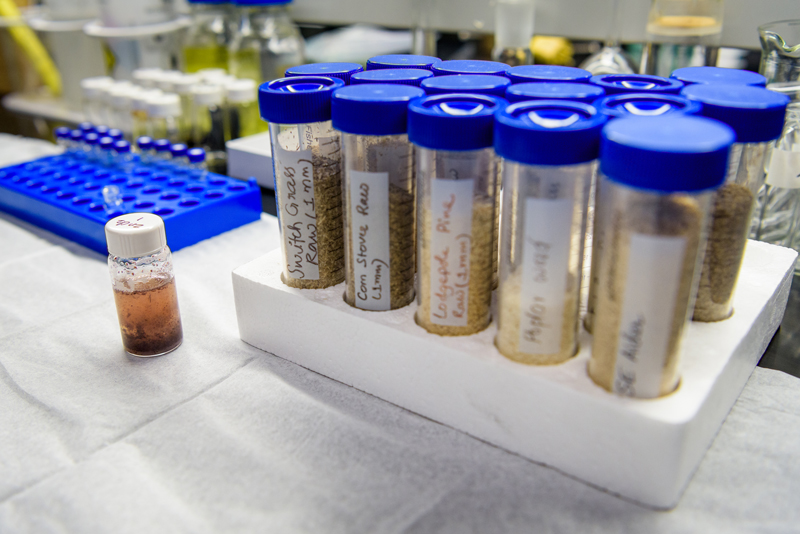
From waste materials such as wood chips and corn cobs, UD researchers are extracting sugars that can replace petroleum in the manufacture of thousands of consumer products. Credit: The University of Delaware

Sugar may hold the key to eliminating the reliance on fossil fuels to produce products like shampoo, medicine and other everyday products.

Researchers from the University of Delaware have developed a new process to extract sugar from wood chips, corncobs and other organic waste from forests and farms to create a cheaper, sustainable substitute for petroleum used to manufacture goods.

“To make greener chemicals and fuel, we’re working with plant material but we don’t want to compete with its food value,” Basudeb Saha, an associate director for research at UD’s Catalysis Center for Energy Innovation, said in a statement. “So instead of taking corn and extracting its sugars to make ethanol, we’re making use of the stalks and cobs left over after the corn is harvested, as well as other kinds of waste like wood chips and rice hulls.”

In the last 10 years, researchers have sought new ways to use waste—called lignocellulosic biomass—to create chemicals for producing biodegradable plastics, pharmaceuticals, cosmetics and biofuels. However, it is difficult to extract sugars from wood chips and corn cobs.

“The lignin that makes their cell walls so tough and sturdy acts like superglue, holding tightly to the sugars,” Saha said.

Scientists currently separate out sugars from the lignin by using harsh chemicals and an expensive enzyme in a two-step process.

The new process developed at Delaware integrates the pretreatment step and the hydrolysis of cellulose and hemicellulose in one pot and operates at considerably low temperature with a reaction time of only one hour.

The researchers use a concentrated solution comprised of an inorganic salt in the presence of a small amount of mineral acid. This requires a minimal amount of water, while the solution swells the particles of wood or other biomass, allowing it to interact with the fibers.

“Our process enables — for the first time — the economical production of feed streams that could profoundly improve the economics of cellulosic bioproducts manufactured downstream, not to mention the environmental benefits of replacing petroleum,” Saha said. “More than 10,000 million metric tons of carbon emissions were reported in 2010 from conventional fossil fuels and chemicals, which has a long-term catastrophic effect on our environment.”
Related Articles Read More >

A researcher handles a prismatic battery cell on PNNL’s manufacturing line.
DOE’s BattMan brings four national labs together to de-risk battery scale-up
INL’s $60 million nuclear AI project will spend the first year testing where AI agents can help and where they might hurt 
The Space Systems Division (05)-developed Parallelogram Synchronized Truss Assembly (PaSTA), seen Aug. 12, 2025, is a mechanism that will be integrated into the Life-Extension In-orbit Servicer (LEXI) and Astroscale Prototype Servicer for Refueling (APS-R) spacecrafts.
One SwRI R&D 100 winner turns buckled fiberglass into a spacecraft truss. The other models freight rail with 900 hours of BNSF field data
Inside the Lab: NETL’s Oil and Gas Center of Excellence focuses on technologies to enhance production   
rd newsletter
EXPAND YOUR KNOWLEDGE AND STAY CONNECTED
Get the latest info on technologies, trends, and strategies in Research & Development.

R&D World Digital Issues

Fall 2026 issue

Browse the most current issue of R&D World and back issues in an easy to use high quality format. Clip, share and download with the leading R&D magazine today.

R&D 100 Awards
Research & Development World
  • Subscribe to R&D World Magazine
  • Sign up for R&D World’s newsletter
  • Contact Us
  • About Us
  • Drug Discovery & Development
  • Pharmaceutical Processing
  • Global Funding Forecast

Copyright © 2026 Arrowfly LLC. All Rights Reserved. The material on this site may not be reproduced, distributed, transmitted, cached or otherwise used, except with the prior written permission of Arrowfly
Privacy Policy | Advertising | About Us

Search R&D World

  • R&D World Home
  • Topics
    • Aerospace
    • Automotive
    • Biotech
    • Careers
    • Chemistry
    • Environment
    • Energy
    • Life Science
    • Material Science
    • R&D Management
    • Physics
  • Technology
    • 3D Printing
    • A.I./Robotics
    • Software
    • Battery Technology
    • Controlled Environments
      • Cleanrooms
      • Graphene
      • Lasers
      • Regulations/Standards
      • Sensors
    • Imaging
    • Nanotechnology
    • Scientific Computing
      • Big Data
      • HPC/Supercomputing
      • Informatics
      • Security
    • Semiconductors
  • R&D Market Pulse
  • R&D 100
    • 2026 R&D 100 Award Winners
    • 2026 Professional Award Winners
    • 2026 Special Recognition Winners
    • R&D 100 Awards Event
    • R&D 100 Submissions
    • Winner Archive
  • Resources
    • Research Reports
    • Digital Issues
    • Educational Assets
    • Subscribe
    • Video
    • Webinars
    • PharmSci360
    • Content submission guidelines for R&D World
  • Global Funding Forecast
  • Top Labs
  • Advertise
  • SUBSCRIBE