Research & Development World

  • R&D World Home
  • Topics
    • Aerospace
    • Automotive
    • Biotech
    • Careers
    • Chemistry
    • Environment
    • Energy
    • Life Science
    • Material Science
    • R&D Management
    • Physics
  • Technology
    • 3D Printing
    • A.I./Robotics
    • Software
    • Battery Technology
    • Controlled Environments
      • Cleanrooms
      • Graphene
      • Lasers
      • Regulations/Standards
      • Sensors
    • Imaging
    • Nanotechnology
    • Scientific Computing
      • Big Data
      • HPC/Supercomputing
      • Informatics
      • Security
    • Semiconductors
  • R&D Market Pulse
  • R&D 100
    • 2026 R&D 100 Award Winners
    • 2026 Professional Award Winners
    • 2026 Special Recognition Winners
    • R&D 100 Awards Event
    • R&D 100 Submissions
    • Winner Archive
  • Resources
    • Research Reports
    • Digital Issues
    • Educational Assets
    • Subscribe
    • Video
    • Webinars
    • PharmSci360
    • Content submission guidelines for R&D World
  • Global Funding Forecast
  • Top Labs
  • Advertise
  • SUBSCRIBE

Infrared Spectroscopy Could Lead to Rapid Diagnostic for Two Types of Cancer

By Ryan Bushey | December 12, 2017

An experimental medical diagnostic could serve as a new screening technique for two fast growing forms of cancer.

Researchers from Georgia State University analyzed blood samples taken from healthy mice as well as mice with subcutaneous melanoma and non-Hodgkin’s lymphoma (NHL) using a form of mid-infrared spectroscopy called Fourier Transform Infrared (FTIR) spectroscopy in Attenuated Total Reflection (ATR) sampling mode and found that the  technique could detect biochemical changes induced by both cancers.

FTIR spectroscopy in ATR sampling mode has been shown to provide rapid and reliable detection of different health conditions using body fluid samples, with the added benefit of producing high-quality results with better reproducibility compared to other vibrational spectroscopy.

Here’s how the process worked.

Blood serum droplets taken from the cancerous mice and the control mice were placed on an ATR crystal built into the FTIR instrument, according to the announcement.

Incident infrared beams were absorbed and reflected by the serum, generating a wave that the team recorded and used to create an absorbance curve with peaks that pinpointed the presence of certain biomarkers residing in the sample.

The scientists then compared the absorbance curves from the control and tumorous mice by assessing biochemical changes trigged by non-Hodgkin’s lymphoma and subcutaneous melanoma.

Results demonstrated “remarkable differences” between the ATR-FTIR spectra of serum samples between both groups of mice. The scientists noted these findings are applicable to humans, as mice and humans have some biomarkers and chemicals in common.

“This study shows infrared spectroscopy can identify cancer. Right now, when you go to the doctor, they do blood tests for sugar and several other things, but not for serious diseases like cancer and colitis. If you are a healthy person, there is a range that is normal. One day, we hope that even these serious diseases can be rapidly screened. Your primary doctor could keep a record of your number and check that every time you come back. Then, if there is some indication of cancer or colitis, they can do biopsies, colonoscopies, etc,” said lead researcher Dr. Unil Perera, Ph.D., a regents professor of physics at Georgia State, in a statement.

Data derived from this study could lead to the development of diagnostic techniques that are safer, less time consuming and less invasive compared to the current methods used on melanoma and lymphoma patients.

In addition, early diagnosis and treatment of these malignancies can improve patients’ chances of survival, which is why developing a rapid and reliable prescreening strategy for melanoma and lymphoma is important.

The next phase of this research would involve using infrared spectroscopy to analyze samples from human patients to identify cancer and other diseases.

Findings from this experiment were published in the journal Scientific Reports.
Related Articles Read More >

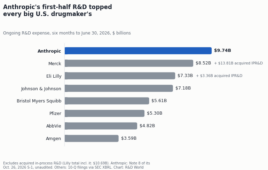
Bar chart of first-half 2026 R&D: Anthropic $9.74 billion, above the ongoing R&D of Merck, Eli Lilly, Johnson & Johnson, Bristol Myers Squibb, Pfizer, AbbVie and Amgen
Anthropic’s R&D budget now rivals Eli Lilly’s
100 million data points per blood sample: How IMU will profile immunity across 80,000 UK Biobank donors
Jabil’s 2026 digital health survey: Confidence in AI’s potential rises as confidence in internal readiness falls
Two RFD4-Proteina-designed enzymes that break down the pesticide paraoxon, with their structural accuracy and catalytic efficiency.
NVIDIA and UW’s protein design model produces 158 binders from 188 designs
rd newsletter
EXPAND YOUR KNOWLEDGE AND STAY CONNECTED
Get the latest info on technologies, trends, and strategies in Research & Development.

R&D World Digital Issues

Fall 2025 issue

Browse the most current issue of R&D World and back issues in an easy to use high quality format. Clip, share and download with the leading R&D magazine today.

R&D 100 Awards
Research & Development World
  • Subscribe to R&D World Magazine
  • Sign up for R&D World’s newsletter
  • Contact Us
  • About Us
  • Drug Discovery & Development
  • Pharmaceutical Processing
  • Global Funding Forecast

Copyright © 2026 Arrowfly LLC. All Rights Reserved. The material on this site may not be reproduced, distributed, transmitted, cached or otherwise used, except with the prior written permission of Arrowfly
Privacy Policy | Advertising | About Us

Search R&D World

  • R&D World Home
  • Topics
    • Aerospace
    • Automotive
    • Biotech
    • Careers
    • Chemistry
    • Environment
    • Energy
    • Life Science
    • Material Science
    • R&D Management
    • Physics
  • Technology
    • 3D Printing
    • A.I./Robotics
    • Software
    • Battery Technology
    • Controlled Environments
      • Cleanrooms
      • Graphene
      • Lasers
      • Regulations/Standards
      • Sensors
    • Imaging
    • Nanotechnology
    • Scientific Computing
      • Big Data
      • HPC/Supercomputing
      • Informatics
      • Security
    • Semiconductors
  • R&D Market Pulse
  • R&D 100
    • 2026 R&D 100 Award Winners
    • 2026 Professional Award Winners
    • 2026 Special Recognition Winners
    • R&D 100 Awards Event
    • R&D 100 Submissions
    • Winner Archive
  • Resources
    • Research Reports
    • Digital Issues
    • Educational Assets
    • Subscribe
    • Video
    • Webinars
    • PharmSci360
    • Content submission guidelines for R&D World
  • Global Funding Forecast
  • Top Labs
  • Advertise
  • SUBSCRIBE