Research & Development World

  • R&D World Home
  • Topics
    • Aerospace
    • Automotive
    • Biotech
    • Careers
    • Chemistry
    • Environment
    • Energy
    • Life Science
    • Material Science
    • R&D Management
    • Physics
  • Technology
    • 3D Printing
    • A.I./Robotics
    • Software
    • Battery Technology
    • Controlled Environments
      • Cleanrooms
      • Graphene
      • Lasers
      • Regulations/Standards
      • Sensors
    • Imaging
    • Nanotechnology
    • Scientific Computing
      • Big Data
      • HPC/Supercomputing
      • Informatics
      • Security
    • Semiconductors
  • R&D Market Pulse
  • R&D 100
    • 2026 R&D 100 Award Winners
    • 2026 Professional Award Winners
    • 2026 Special Recognition Winners
    • R&D 100 Awards Event
    • R&D 100 Submissions
    • Winner Archive
  • Resources
    • Research Reports
    • Digital Issues
    • Educational Assets
    • Subscribe
    • Video
    • Webinars
    • PharmSci360
    • Content submission guidelines for R&D World
  • Global Funding Forecast
  • Top Labs
  • Advertisers
    • Advertise
    • PR Submissions
    • Eblast Submissions
  • SUBSCRIBE

Novel Metal Manufacturing Method Could Result in Ultrafast Devices

By Kenny Walter | July 19, 2018

Roll-to-roll laser-induced superplasticity, a new fabrication method, prints metals at the nanoscale needed for making electronic devices ultrafast. Credit: Purdue University image/Ramses Martinez

A new process combining existing manufacturing tools with enhanced speed and precision could help produce faster electronics. Researchers from Purdue University have created a new manufacturing process to produce the smoother and more flexible metals required to make ultrafast electronic devices.

The new method—called roll-to-roll laser-induced superplasticity—uses a rolling stamp similar to what is used to print newspapers at high speed.

The researchers applied high-energy laser shots to different metals to induce the ultrahigh-strain-rate deformation of metallic films at room temperature into low-cost polymeric nanomolds. This enables the metal to flow into the nanoscale features of the rolling stamp while circumventing the formability limit.

“In the future, the roll-to-roll fabrication of devices using our technique could enable the creation of touch screens covered with nanostructures capable of interacting with light and generating 3D images, as well as the cost-effective fabrication of more sensitive biosensors,” Martinez said.

Electronic devices like cellphones, laptops and tablets all rely on metallic circuits to process information at high speeds. Current metal fabrication techniques tend to make the circuits with a thin rain of liquid metal drops that pass through a stencil mask in the shape of a circuit.

“Unfortunately, this fabrication technique generates metallic circuits with rough surfaces, causing our electronic devices to heat up and drain their batteries faster,” Ramses Martinez, assistant professor of industrial engineering and biomedical engineering, said in a statement.

However, as technology evolves, future devices will require significantly smaller metal components and a higher resolution to make them at a nanoscale size.

“Forming metals with increasingly smaller shapes requires molds with higher and higher definition, until you reach the nanoscale size,” Martinez said. “Adding the latest advances in nanotechnology requires us to pattern metals in sizes that are even smaller than the grains they are made of. It’s like making a sand castle smaller than a grain of sand.”

The researchers were able to overcome the roughness and low-resolution limitations with the new method, which enables smooth metallic circuits to form at the nanoscale by using conventional carbon dioxide lasers.

 “Printing tiny metal components like newspapers makes them much smoother,” Martinez said. “This allows an electric current to travel better with less risk of overheating.”

The study was published in Nano Letters.
 

Related Articles Read More >

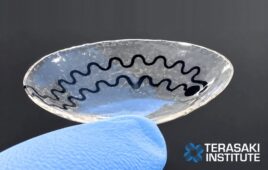
Smart contact lenses move from glucose to stress and mood
Speaker Giving a Talk at Business Meeting. Audience in the conference hall. Business and Entrepreneurship. Panoramic composition suitable for banners.
BioPharma Supply Chain & Logistics Nexus returns to San Diego in November
How Cypris evolved from selling patent reports to agentic R&D intelligence
New video series: Travel for engineers
rd newsletter
EXPAND YOUR KNOWLEDGE AND STAY CONNECTED
Get the latest info on technologies, trends, and strategies in Research & Development.

R&D World Digital Issues

Fall 2026 issue

Browse the most current issue of R&D World and back issues in an easy to use high quality format. Clip, share and download with the leading R&D magazine today.

R&D 100 Awards
Research & Development World
  • Subscribe to R&D World Magazine
  • Sign up for R&D World’s newsletter
  • Contact Us
  • About Us
  • Drug Discovery & Development
  • Pharmaceutical Processing
  • Global Funding Forecast

Copyright © 2026 Arrowfly LLC. All Rights Reserved. The material on this site may not be reproduced, distributed, transmitted, cached or otherwise used, except with the prior written permission of Arrowfly
Privacy Policy | Advertising | About Us

Search R&D World

  • R&D World Home
  • Topics
    • Aerospace
    • Automotive
    • Biotech
    • Careers
    • Chemistry
    • Environment
    • Energy
    • Life Science
    • Material Science
    • R&D Management
    • Physics
  • Technology
    • 3D Printing
    • A.I./Robotics
    • Software
    • Battery Technology
    • Controlled Environments
      • Cleanrooms
      • Graphene
      • Lasers
      • Regulations/Standards
      • Sensors
    • Imaging
    • Nanotechnology
    • Scientific Computing
      • Big Data
      • HPC/Supercomputing
      • Informatics
      • Security
    • Semiconductors
  • R&D Market Pulse
  • R&D 100
    • 2026 R&D 100 Award Winners
    • 2026 Professional Award Winners
    • 2026 Special Recognition Winners
    • R&D 100 Awards Event
    • R&D 100 Submissions
    • Winner Archive
  • Resources
    • Research Reports
    • Digital Issues
    • Educational Assets
    • Subscribe
    • Video
    • Webinars
    • PharmSci360
    • Content submission guidelines for R&D World
  • Global Funding Forecast
  • Top Labs
  • Advertisers
    • Advertise
    • PR Submissions
    • Eblast Submissions
  • SUBSCRIBE