Research & Development World

  • R&D World Home
  • Topics
    • Aerospace
    • Automotive
    • Biotech
    • Careers
    • Chemistry
    • Environment
    • Energy
    • Life Science
    • Material Science
    • R&D Management
    • Physics
  • Technology
    • 3D Printing
    • A.I./Robotics
    • Software
    • Battery Technology
    • Controlled Environments
      • Cleanrooms
      • Graphene
      • Lasers
      • Regulations/Standards
      • Sensors
    • Imaging
    • Nanotechnology
    • Scientific Computing
      • Big Data
      • HPC/Supercomputing
      • Informatics
      • Security
    • Semiconductors
  • R&D Market Pulse
  • R&D 100
    • 2026 R&D 100 Award Winners
    • 2026 Professional Award Winners
    • 2026 Special Recognition Winners
    • R&D 100 Awards Event
    • R&D 100 Submissions
    • Winner Archive
  • Resources
    • Research Reports
    • Digital Issues
    • Educational Assets
    • Subscribe
    • Video
    • Webinars
    • PharmSci360
    • Content submission guidelines for R&D World
  • Global Funding Forecast
  • Top Labs
  • Advertise
  • SUBSCRIBE

New Antibody Breaks Through Cancer’s Defense System

By Kenny Walter | November 14, 2018

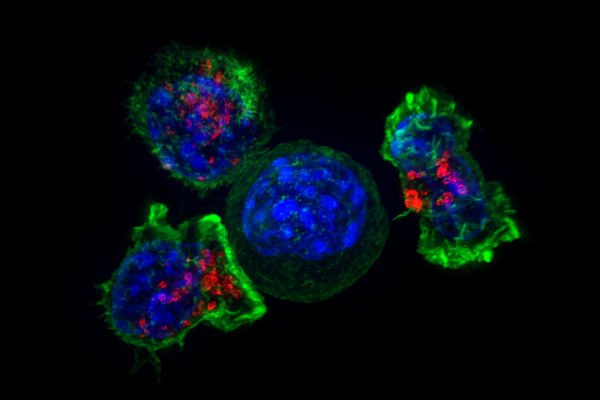
Killer T cells surround a cancer cell. Credit: NIH

A newly engineered antibody holds promise in leading the fight against cancerous tumors.

Researchers from the University of Southampton have developed a new antibody that could unlock cancer’s defense against the body’s immune system by targeting 4-1BB, an immune receptor that can activate the killer T-cells to find and destroy cancer cells.

The researchers found that 4-1BB is present mainly on a population of T cells within regulatory T cells, which switch off the killer T cells.

The team found that in a pre-clinical tumor, setting an anti-4-1BB antibody that deleted regulatory T cells caused regression in the tumor. However, because the type of antibody that is good at deleting regulatory T-cells does not stimulate the killer T-cells and vice versa, it is not possible to use a regular type of antibody to harness both therapeutic approaches.

In the study, the researchers designed and engineered the new antibody to delete the regulatory T cells within the cancerous tumor, removing the suppression they exert, while also activating the killer T cells at the same time. In laboratory testing, the dual-purpose antibody was highly effective in eradicating cancerous tumors.

“Antibody immunotherapy has transformed patient outcomes in a number of cancers, but responses are frequently restricted to a minority of patients,” professor Stephen Beers said in a statement. “This is really very exciting breakthrough.

“Immune activating antibodies targeting immune receptors like 4-1BB have failed to translate successfully to the clinic but hold great potential if we can understand how to target them successfully in cancer patients,” he added. “We have identified some of the reasons that stop them treating cancer and for the first time, demonstrated that you can combine the two approaches of deleting regulatory T cells and activating killer T cells. This could potentially improve the way we treat patients in the clinic.”

The researchers believe the antibody can be applied to both ovarian cancer and a common form of non-melanoma skin cancer called Squamous Cell Carcinoma. However, the research team thinks it could be applicable to more cancers with further research.

“This study is an important step towards improving immunotherapy,” Sean Lim, PhD, Cancer Research UK’s expert in immunotherapy, said in a statement. “It helps us to understand why this type of treatment isn’t as successful in patients as hoped.

“But critically, it also presents a potential solution as to how we can overcome these challenges to develop effective immunotherapy that works for more patients,” he added.

The study was published in Immunity.


Related Articles Read More >

100 million data points per blood sample: How IMU will profile immunity across 80,000 UK Biobank donors
Jabil’s 2026 digital health survey: Confidence in AI’s potential rises as confidence in internal readiness falls
Two RFD4-Proteina-designed enzymes that break down the pesticide paraoxon, with their structural accuracy and catalytic efficiency.
NVIDIA and UW’s protein design model produces 158 binders from 188 designs
Schematic of a whole-brain Perturb-seq atlas split into 1,946 perturbation profiles, each analyzed by its own AI agent.
OpenAI deploys nearly 2,000 GPT-Rosalind agents to generate biological research leads in 32 minutes
rd newsletter
EXPAND YOUR KNOWLEDGE AND STAY CONNECTED
Get the latest info on technologies, trends, and strategies in Research & Development.

R&D World Digital Issues

Fall 2025 issue

Browse the most current issue of R&D World and back issues in an easy to use high quality format. Clip, share and download with the leading R&D magazine today.

R&D 100 Awards
Research & Development World
  • Subscribe to R&D World Magazine
  • Sign up for R&D World’s newsletter
  • Contact Us
  • About Us
  • Drug Discovery & Development
  • Pharmaceutical Processing
  • Global Funding Forecast

Copyright © 2026 Arrowfly LLC. All Rights Reserved. The material on this site may not be reproduced, distributed, transmitted, cached or otherwise used, except with the prior written permission of Arrowfly
Privacy Policy | Advertising | About Us

Search R&D World

  • R&D World Home
  • Topics
    • Aerospace
    • Automotive
    • Biotech
    • Careers
    • Chemistry
    • Environment
    • Energy
    • Life Science
    • Material Science
    • R&D Management
    • Physics
  • Technology
    • 3D Printing
    • A.I./Robotics
    • Software
    • Battery Technology
    • Controlled Environments
      • Cleanrooms
      • Graphene
      • Lasers
      • Regulations/Standards
      • Sensors
    • Imaging
    • Nanotechnology
    • Scientific Computing
      • Big Data
      • HPC/Supercomputing
      • Informatics
      • Security
    • Semiconductors
  • R&D Market Pulse
  • R&D 100
    • 2026 R&D 100 Award Winners
    • 2026 Professional Award Winners
    • 2026 Special Recognition Winners
    • R&D 100 Awards Event
    • R&D 100 Submissions
    • Winner Archive
  • Resources
    • Research Reports
    • Digital Issues
    • Educational Assets
    • Subscribe
    • Video
    • Webinars
    • PharmSci360
    • Content submission guidelines for R&D World
  • Global Funding Forecast
  • Top Labs
  • Advertise
  • SUBSCRIBE