Research & Development World

  • R&D World Home
  • Topics
    • Aerospace
    • Automotive
    • Biotech
    • Careers
    • Chemistry
    • Environment
    • Energy
    • Life Science
    • Material Science
    • R&D Management
    • Physics
  • Technology
    • 3D Printing
    • A.I./Robotics
    • Software
    • Battery Technology
    • Controlled Environments
      • Cleanrooms
      • Graphene
      • Lasers
      • Regulations/Standards
      • Sensors
    • Imaging
    • Nanotechnology
    • Scientific Computing
      • Big Data
      • HPC/Supercomputing
      • Informatics
      • Security
    • Semiconductors
  • R&D Market Pulse
  • R&D 100
    • 2025 R&D 100 Award Winners
    • 2025 Professional Award Winners
    • 2025 Special Recognition Winners
    • R&D 100 Awards Event
    • R&D 100 Submissions
    • Winner Archive
  • Resources
    • Research Reports
    • Digital Issues
    • Educational Assets
    • R&D Index
    • Subscribe
    • Video
    • Webinars
    • Content submission guidelines for R&D World
  • Global Funding Forecast
  • Top Labs
  • Advertise
  • SUBSCRIBE

Atomic lift-off yields 10‑nm membranes for cooling‑free infrared detection

By Brian Buntz | August 20, 2025

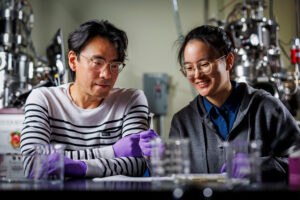
Jeehwan Kim (left) and Xinyuan Zhang working on ultrathin electronic membranes.<br />Photo: Adam Glanzman

Jeehwan Kim (left) and Xinyuan Zhang working on ultrathin electronic membranes. Photo: Adam Glanzman

Scientists at Rensselaer Polytechnic Institute, working with MIT and a multi-university team, have demonstrated a nanomanufacturing method that peels off 10-nanometer-thick crystalline membranes for highly sensitive infrared detection without cryogenic cooling. The approach, called atomic lift-off (ALO), eliminates the buffer “release” layers common in prior techniques and achieved a record pyroelectric response in ultrathin films, according to a Nature study first published online April 23 that RPI recently highlighted.

Conventional high-performance night-vision and thermal-imaging detectors (e.g., HgCdTe and antimonide systems) typically require bulky, power-hungry coolers to suppress noise, driving cost and form-factor limits in defense, industrial and medical devices. The ALO result points to cooling-free detectors that can cover the far-infrared (FIR) range, potentially shrinking and bringing the costs down for night-vision goggles, thermal cameras and other IR systems.

What’s new

The team uncovered a materials-level “nonstick” pathway: when the ultrathin film contains lead, interfacial charge transfer between the film and its substrate drops, weakening chemical bonding so the film can be lifted off intact—without a sacrificial buffer layer. Density functional theory (DFT) analysis supporting this mechanism was led by RPI’s Yunfeng Shi. “We demonstrate that the release layer used in conventional exfoliation is in fact not necessary for certain systems,” Shi said in a press release. “This is paradigm changing.”

Using ALO, the team fabricated freestanding PMN-PT (lead magnesium niobate–lead titanate) pyroelectric membranes about 10 nm thick and integrated them into a 100-pixel test array. The membranes showed a record pyroelectric coefficient of 1.76×10⁻² C·m⁻²·K⁻¹, enabled by the extreme thinness and freestanding nature, and were highly sensitive across the far-infrared spectrum at room temperature (no cooler), as the Nature paper noted

This method offers an approach to manufacturing cooling-free detectors that can cover the full far-infrared spectrum, marking a notable advancement in detector technology. —from the abstract in Nature abstract

What could it enable

As mentioned above, room-temperature far-IR sensitivity could translate to lighter, less expensive night-vision goggles and thermal cameras; noncontact biomedical and environmental sensing (e.g., thermography, gas monitoring) and astronomy/space instrumentation where mass and power budgets are tight.

Earlier routes typically used water-soluble sacrificial layers, such as “super-tetragonal” Sr₄Al₂O₇, to release freestanding complex-oxide membranes, or relied on graphene-mediated remote epitaxy and 2D-materials layer transfer for wafer-scale membranes and device arrays. ALO differs by removing the extra buffer layer entirely, simplifying stacks and potentially improving throughput; it also complements prior demonstrations of freestanding complex-oxide stacks for heterogeneous integration.

Related Articles Read More >

This 60 milligram zero-battery sensor tracks monarch migration
Kaman Precision Products introduces KD-2306 non-contact displacement sensing system
Pocket-sized sensor takes on E. coli
The 2025 R&D 100 Finalists are here
rd newsletter
EXPAND YOUR KNOWLEDGE AND STAY CONNECTED
Get the latest info on technologies, trends, and strategies in Research & Development.
RD 25 Power Index

R&D World Digital Issues

Fall 2025 issue

Browse the most current issue of R&D World and back issues in an easy to use high quality format. Clip, share and download with the leading R&D magazine today.

R&D 100 Awards
Research & Development World
  • Subscribe to R&D World Magazine
  • Sign up for R&D World’s newsletter
  • Contact Us
  • About Us
  • Drug Discovery & Development
  • Pharmaceutical Processing
  • Global Funding Forecast

Copyright © 2025 WTWH Media LLC. All Rights Reserved. The material on this site may not be reproduced, distributed, transmitted, cached or otherwise used, except with the prior written permission of WTWH Media
Privacy Policy | Advertising | About Us

Search R&D World

  • R&D World Home
  • Topics
    • Aerospace
    • Automotive
    • Biotech
    • Careers
    • Chemistry
    • Environment
    • Energy
    • Life Science
    • Material Science
    • R&D Management
    • Physics
  • Technology
    • 3D Printing
    • A.I./Robotics
    • Software
    • Battery Technology
    • Controlled Environments
      • Cleanrooms
      • Graphene
      • Lasers
      • Regulations/Standards
      • Sensors
    • Imaging
    • Nanotechnology
    • Scientific Computing
      • Big Data
      • HPC/Supercomputing
      • Informatics
      • Security
    • Semiconductors
  • R&D Market Pulse
  • R&D 100
    • 2025 R&D 100 Award Winners
    • 2025 Professional Award Winners
    • 2025 Special Recognition Winners
    • R&D 100 Awards Event
    • R&D 100 Submissions
    • Winner Archive
  • Resources
    • Research Reports
    • Digital Issues
    • Educational Assets
    • R&D Index
    • Subscribe
    • Video
    • Webinars
    • Content submission guidelines for R&D World
  • Global Funding Forecast
  • Top Labs
  • Advertise
  • SUBSCRIBE