When there’s a fire, smoke detectors beep when enough smoke fills the air to scatter a light beam within the device enough that it hits a light detector. This ‘dumb’ model works well to detect house fires. Detecting radiation is different. Detection thresholds, the signal level a pulse must exceed for a detector to count it as radiation rather than electronic noise, shift with temperature, component aging, electromagnetic interference from nearby equipment and power fluctuations. Consequently, accurately detecting such radiation can be prone to accuracy problems.

ORNL’s Callie Goetz holds the detector’s scintillation crystal, which emits light when hit with radiation particles. Credit: Carlos Jones/ORNL, U.S. Dept. of Energy
Researchers at Oak Ridge National Laboratory (ORNL) plan to add an AI-enhanced algorithm to their radiation monitors to reduce both false negatives and false positives.
Elevated radiation levels in poorly monitored areas can pose a risk to workers’ health. With long-term exposure to low doses, radiation can increase the risk of cancer. Additionally, at facilities handling enriched uranium, which is used in most reactors, material could build up enough to sustain a chain reaction and release a burst of radiation. Unmonitored nuclear material buildup could also be diverted for illicit use.
The focus on the AI-enabled algorithm follows ORNL over the past four years developing a monitor that can detect the buildup of nuclear material in the air ducts of nuclear fuel cycle facilities, which fabricate nuclear fuel or process nuclear waste.
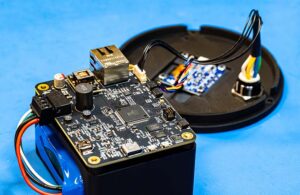
The radiation sensor developed by ORNL researchers supports safe, reliable operations of nuclear facilities and strengthen technical capabilities for U.S. energy security. Credit: Carlos Jones/ORNL, U.S. Dept. of Energy
The device is a cylinder about 12 inches tall that attaches to the side of a duct and runs on either battery power or power over the Ethernet. The battery lasts for about a month when sampling once a minute and can serve as a back-up mode in case the facility loses power. If powered over an ethernet connection, it can transmit data every second.
The design features a plastic scintillator that emits light in the form of photon particles when hit with radiation. A silicon photomultiplier translates the photons into electrical pulses that the detector counts to determine the level of nuclear material.
The research team has demonstrated the battery-powered mode of several generations of improvements to the detector, over several years, in several different nuclear facilities both within Tennessee and in other states. As the devices are deployed in more facilities near the lab, the team expects to use the data collected to train an AI-enhanced algorithm that can automatically alert operators when nuclear material builds up to a concerning level.

Brett Witherspoon works on a radiation monitoring system connected to cylindrical detection devices that can be placed in the air ducts of nuclear facilities. Credit: Carlos Jones/ORNL, U.S. Dept of Energy
When connected to the Ethernet, the devices can communicate with one another and with a central hub where operators can access all the data.
“Let’s say a bunch of detectors are in one area, and one is alarming and the rest aren’t. Maybe that detector is broken, or maybe there is something going on. There’s a lot more interesting information that you can tell when you combine them than just having each detector working alone off of that threshold,” Callie Goetz, the ORNL researcher who leads the overall project, told R&D World.
Additionally, simple threshold-based alerting is vulnerable to electronic drift, which produces false alarms, Goetz said. A networked, algorithm-driven approach can weigh readings from multiple detectors against each other rather than judging data from one detector in isolation.
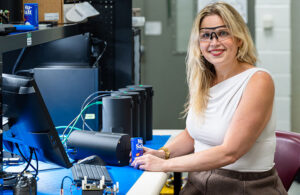
Callie Goetz with the radiation monitoring system for air ducts in nuclear facilities. Credit: Carlos Jones/ORNL, U.S. Dept of Energy
“An issue with radiation detectors is that thresholds change with things like temperature. Your threshold is based on electronic noise in your device, and that drifts. So, if you just have a dumb thresholding algorithm, that’s going to increase your false positive and negative alarm rate,” she said.
The team is installing detectors in nearby nuclear facilities during their pilot stages.
“We’re putting our detectors in and using them as a test bed, essentially, but they also get all the information back. So, they’re learning about their process from our detectors, and we’re learning about our detectors from their process,” Goetz said.
As the facilities increase their capabilities, the influx of data will help train the AI-enhanced algorithm, she added.
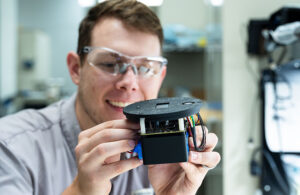
Jesse Davis fits together components of the affordable radiation monitor being tested in Tennessee nuclear facilities. Credit: Carlos Jones/ORNL, U.S. Dept. of Energy
“This next year is going to be a big algorithm development year, while we are continuing to improve the hardware as well. We’re going to have a lot of data,” she said. “In the full facilities, there will be hundreds of measurement points. That will be when we can actually really get going with some AI model, some algorithm that would be a more intelligent outcome. I very much look forward to it.”
Today, nuclear material monitoring is sporadic and depends on a person extending a radiation counter on a long pole through the air ducts, Brett Witherspoon, technical lead of the project, said in a press release. ORNL’s detector would provide continuous, low-cost monitoring, the lab said.




Tell Us What You Think!
You must be logged in to post a comment.