The Lasker Awards were recently granted to scientists studying cell biology and cystic fibrosis. Dick Gӧrlich and Steven L. McKnight won the Albert Lasker Basic Medical Research Award for their work studying low-complexity domains in protein sequences. Michael Welsh, Jesús González and Paul Negulescu were awarded the Lasker-DeBackey Clinical Medical Research Award for their roles in developing a new triple-drug combination for cystic fibrosis. Lucy Shapiro was awarded the Lasker-Koshland Special Achievement Award in Medical Science for her work on bacterial cells.
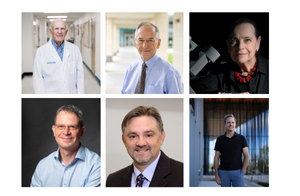
Top: Steven McKnight, Michael Welsh, Lucy Shapiro
Bottom: Dick Gӧrlich, Jesús González, Paul Negulescu
Discovering the role of LCDs
Gӧrlich and McKnight revealed new principles of intracellular transport and cellular organization. They discovered that a significant proportion of proteins with low-complexity domains (LCDs), about 15-20%, enable cells to build and dismantle reversible structures that regulate cell function.
LCDs are parts of a protein that do not have a stable structure. Additionally, these sections only contain a few amino acids in a repeating pattern.
Gӧrlich found that proteins in the central channel of nuclear membrane pores, nucleoporins, form a selective barrier that contains the amino acids phenylalanine (F) and glycine (G). He proposed that the FG interactions create a system for selective entry through the nucleoporin, an essential role of the nuclear transport process.
McKnight co-discovered activation domains in transcription factors. These domains had little variety in amino acids, but they are essential for activating the transcription of RNA. He found that proteins that bind to RNA contain LCDs that also form gels, as Gӧrlich suggested.
RNA granules are known to contain RNA-binding proteins. The granules form membraneless organelles that perform a variety of functions. These organelles can also be built and disassembled through cross-beta interactions. Gӧrlich and McKnight’s research shows that LCDs perform a vital role in the cell.
A new treatment for cystic fibrosis
Michael Welsh, Jesús González and Paul Negulescu won a Lasker Award for developing a triple-drug treatment for cystic fibrosis (CF), a genetic disease that affects at least 100,000 people worldwide.
The researchers worked together and shared research. Welsh discovered the cellular basis of the disease, González created elements of the drug discovery system and Negulescu led the development of drugs that target the root cause of cystic fibrosis.
Welsh identified the product of the cystic fibrosis gene CFTR as a chloride ion channel in the cell membrane. The CF genetic mutation causes the CFTR protein to misfold, after which it is destroyed by the cell’s quality control mechanisms. Without the CFTR, the cell can’t move chloride ions and water, which causes the buildup of mucus in the lungs.
Welsh discovered that incubating these cells at a low temperature allowed some of the misfolded proteins to reach the membrane and have partial function, hinting that the protein could be rescued.
González and his team developed a technology that could automate cell-based assays using voltage-sensitive dyes that were responsive to CFTR. This enabled them to screen thousands of molecules a day to discover which ones improved the function of the protein. González collaborated with scientists at Aurora Biosciences – which was acquired by Vertex Pharmaceuticals in 2001 – to use the technology to assess molecules for CFTR-modulating effects.
Negulescu led the CF project at Aurora, developing a triple-drug combination that can treat CF, transforming it into a more manageable disease for most eligible patients with access. The team had three drugs approved by the FDA, each one treating a greater proportion of CF patients, until the optimal triple-drug combination was developed.
Trikafta was approved in 2019, a combination of two correctors and one potentiator. Approximately 90% of CF patients are candidates for the therapy, which has an annual price tag of $311,503, according to an SEC filing.. Tens of thousands of individuals have been treated with Trikafta to date.
Uncovering the pathway from DNA to cell activity
Shapiro won a Lasker Award for her 55-year-long career in biomedical science, wherein she cofounded two biotech companies and advised presidents on global science issues. Shapiro earned her Ph.D. from the Albert Einstein College of Medicine, where she was quickly brought on as faculty.
Shapiro worked to discover how cells translate their genetic code into three-dimensional actions, focusing on a bacterium called Caulobacter crescentus, which divides into two cells that each have distinct features.
Shapiro founded the Department of Developmental Biology at Stanford in 1989, where she showed that Caulobacter organizes the location and timing of its internal components, making it a much more complicated organism than originally thought. Shapiro’s discovery changed how scientists thought about bacteria.
In 2011, Shapiro was awarded the National Medal of Science after advising presidents on bioterrorism, antibiotic resistance and infectious diseases. She also cofounded two biotech companies: Anacor and Boragen.
Honoring the Lasker legacy
In 1942, Albert and Mary Woodard Lasker founded the Albert and Mary Lasker Foundation to advance their mission of improving health through support for medical research. Three years later, they created the Lasker Awards to “shine a spotlight on fundamental biological discoveries and clinical advances that improve human health,” according to the website.
To date, 86 recipients of the Lasker Awards have gone on to receive a Nobel Prize.