Research & Development World

  • R&D World Home
  • Topics
    • Aerospace
    • Automotive
    • Biotech
    • Careers
    • Chemistry
    • Environment
    • Energy
    • Life Science
    • Material Science
    • R&D Management
    • Physics
  • Technology
    • 3D Printing
    • A.I./Robotics
    • Software
    • Battery Technology
    • Controlled Environments
      • Cleanrooms
      • Graphene
      • Lasers
      • Regulations/Standards
      • Sensors
    • Imaging
    • Nanotechnology
    • Scientific Computing
      • Big Data
      • HPC/Supercomputing
      • Informatics
      • Security
    • Semiconductors
  • R&D Market Pulse
  • R&D 100
    • 2025 R&D 100 Award Winners
    • 2025 Professional Award Winners
    • 2025 Special Recognition Winners
    • R&D 100 Awards Event
    • R&D 100 Submissions
    • Winner Archive
  • Resources
    • Research Reports
    • Digital Issues
    • Educational Assets
    • Subscribe
    • Video
    • Webinars
    • Content submission guidelines for R&D World
  • Global Funding Forecast
  • Top Labs
  • Advertise
  • SUBSCRIBE

Bioengineers utilize AI-driven protein modeling to reconstruct dinosaur leather

By Julia Rock-Torcivia | April 6, 2026

Bioengineers have successfully utilized AI-driven protein modeling to reconstruct Type I collagen from the Tyrannosaurus rex genome. 
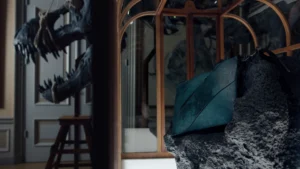
Credit: VML

Scientists and designers unveiled the world’s first handbag made from T-Rex Leather last week. The leather was engineered using reconstructed dinosaur collagen. The handbag will be on display beside a life-sized T. rex statue in Amsterdam. 

VML, a creative agency, announced its ambition to create T-Rex Leather in 2025. The company partnered with The Organoid Company, a genomic engineering company, and Lab-Grown Leather Ltd., a sustainable biotechnology company, to develop the material. 

Computational biology bridges the gap in fragmented ancient proteomics

The research team used fossilized T.rex collagen peptide sequences to create the material. They employed computational biology and AI modeling to predict and reconstruct the remaining genetic information for the dinosaur’s collagen. Computational biology was used to predict the missing sections of amino acid chains by comparing them to the collagen of T. rex’s closest living relatives: birds, specifically ostriches and chickens, and crocodiles. 

The synthesized DNA was inserted into a carrier cell line. Billions of engineered cells were then cultivated using Lab-Grown Leather’s Advanced Tissue Engineering Platform (ATEP) and integrated into its Elemental-X product line. 

Lab-Grown Leather uses a scaffold-free approach that allows the cells to create their own natural structure, resulting in a material that is structurally identical to traditional leather, the company says. The resulting leather is durable, repairable, biodegradable and fully traceable. It is also created without animal slaughter, deforestation or chromium-heavy tanning processes. 

Reducing the environmental footprint

Traditional leather production has significant environmental challenges, including deforestation and chemical-intensive tanning. One square meter of finished leather is associated with 22.48 kg of CO2e, reported the Leather Working Group. This is equivalent to the emissions of the average passenger vehicle driving approximately 56.2 miles. T-Rex Leather offers a new way to reduce these impacts while maintaining quality, VML said in a statement. 

Dinosaurs evolved to survive extreme environments, conditions that echo the climate challenges we face today, VML said. By studying and reconstructing ancient biology, this collaboration opens new possibilities for resilient, high-performance materials, the company added.

Some experts have raised concerns about claiming this material as a true reconstruction of “dinosaur leather.” The collagen used to produce the material originates from fossilized skeletal matter, not skin cells. The fossil collagen survived only in tiny, heavily degraded fragments that differ from the molecular structure of the fibrous layer used for conventional leather. 

After six weeks on display at Art Zoo in Amsterdam, the bag will be auctioned off. But this is only the beginning for T-Rex Leather. The material will be made commercially available to brands and designers, VML said. 

Related Articles Read More >

How Atomis is using AI simulations to commercialize MOFs
Claude Mythos by Anthropic mobile logo app on a screen smartphone. Claude is a family of large language models developed by Anthropic. Batumi, Georgia - March 26, 2026
How Opus 4.8 compares to Claude Mythos and GPT 5.5
AI workflow automation artificial intelligence agent software interface nodes triggers data tool dashboard coding icon flow process database technology 3d rendering.
How can organizations move AI from token maxxing to production value?
OpenAI launches Rosalind Biodefense, offers federal agencies early access to its life-sciences model
rd newsletter
EXPAND YOUR KNOWLEDGE AND STAY CONNECTED
Get the latest info on technologies, trends, and strategies in Research & Development.

R&D World Digital Issues

Fall 2025 issue

Browse the most current issue of R&D World and back issues in an easy to use high quality format. Clip, share and download with the leading R&D magazine today.

R&D 100 Awards
Research & Development World
  • Subscribe to R&D World Magazine
  • Sign up for R&D World’s newsletter
  • Contact Us
  • About Us
  • Drug Discovery & Development
  • Pharmaceutical Processing
  • Global Funding Forecast

Copyright © 2026 WTWH Media LLC. All Rights Reserved. The material on this site may not be reproduced, distributed, transmitted, cached or otherwise used, except with the prior written permission of WTWH Media
Privacy Policy | Advertising | About Us

Search R&D World

  • R&D World Home
  • Topics
    • Aerospace
    • Automotive
    • Biotech
    • Careers
    • Chemistry
    • Environment
    • Energy
    • Life Science
    • Material Science
    • R&D Management
    • Physics
  • Technology
    • 3D Printing
    • A.I./Robotics
    • Software
    • Battery Technology
    • Controlled Environments
      • Cleanrooms
      • Graphene
      • Lasers
      • Regulations/Standards
      • Sensors
    • Imaging
    • Nanotechnology
    • Scientific Computing
      • Big Data
      • HPC/Supercomputing
      • Informatics
      • Security
    • Semiconductors
  • R&D Market Pulse
  • R&D 100
    • 2025 R&D 100 Award Winners
    • 2025 Professional Award Winners
    • 2025 Special Recognition Winners
    • R&D 100 Awards Event
    • R&D 100 Submissions
    • Winner Archive
  • Resources
    • Research Reports
    • Digital Issues
    • Educational Assets
    • Subscribe
    • Video
    • Webinars
    • Content submission guidelines for R&D World
  • Global Funding Forecast
  • Top Labs
  • Advertise
  • SUBSCRIBE