Research & Development World

  • R&D World Home
  • Topics
    • Aerospace
    • Automotive
    • Biotech
    • Careers
    • Chemistry
    • Environment
    • Energy
    • Life Science
    • Material Science
    • R&D Management
    • Physics
  • Technology
    • 3D Printing
    • A.I./Robotics
    • Software
    • Battery Technology
    • Controlled Environments
      • Cleanrooms
      • Graphene
      • Lasers
      • Regulations/Standards
      • Sensors
    • Imaging
    • Nanotechnology
    • Scientific Computing
      • Big Data
      • HPC/Supercomputing
      • Informatics
      • Security
    • Semiconductors
  • R&D Market Pulse
  • R&D 100
    • 2025 R&D 100 Award Winners
    • 2025 Professional Award Winners
    • 2025 Special Recognition Winners
    • R&D 100 Awards Event
    • R&D 100 Submissions
    • Winner Archive
  • Resources
    • Research Reports
    • Digital Issues
    • Educational Assets
    • R&D Index
    • Subscribe
    • Video
    • Webinars
    • Content submission guidelines for R&D World
  • Global Funding Forecast
  • Top Labs
  • Advertise
  • SUBSCRIBE

Could Germanene Overtake Graphene?

By University of Twente | June 22, 2016

Graphene may currently be the best known “two-dimensional” material, but its new cousin germanene seems to have properties that are even more attractive for application in electronics. For this, germanene has to grow in a one atom layer on top of a proper carrier — substrate. Scientists of the MESA+ Institute for Nanotechnology of the University of Twente managed to grow germanene on a semiconductor material, preserving the unique properties. In two separate papers in the same edition of Physical Review Letters, they present calculations and experiments.

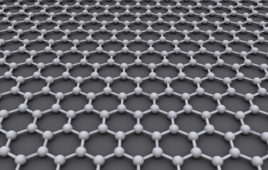
Germanene is a one atom-thick sheet of germanium, in a honeycomb structure. It has clear similarities with graphene, the material that induced massive research activity worldwide, especially after 2010’s Nobel Prize. A major difference between graphene and germanene is the “band gap,” a property well-known in semiconductor electronics: thanks to this “jump” of energy levels that electrons are allowed to have, it is possible to control, switch, and amplify currents. Graphene had a very small band gap that can only be measured at very low temperatures, germanene shows a band gap that is significantly larger. Previous attempts to grow germanene, however, show that these attractive properties seem to vanish when it is grown on a metal surface: a good conductor of current. To prevent this, the UT scientists chose the semiconductor MoS2 as the substrate material.

Under ultra-high vacuum conditions, germanene indeed grows on the semiconductor. At first, the scientists observed islands at the locations where MoS2 had crystal defects, after that the germanene is spreading out covering a larger surface. An exciting question is, if the desired properties remain intact. First measurements show that the typical 2D properties and band gap are present, further low temperature measurements are needed to confirm that germanene operates in the desired way: the inner part would work as an insulator, while conducting channels are formed at the edges.
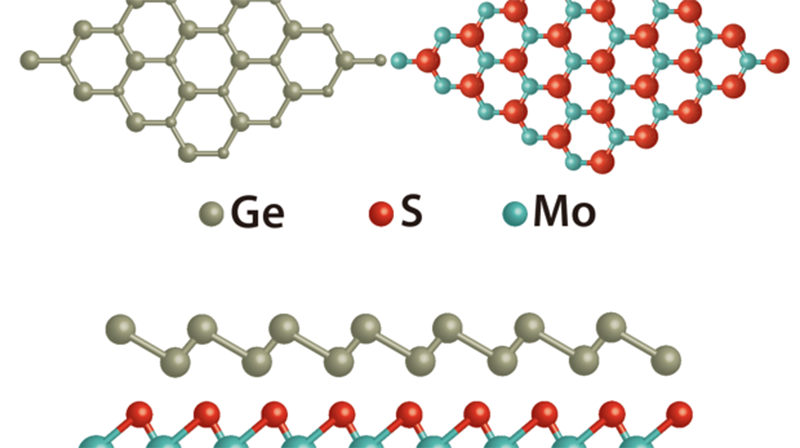
The other UT scientists did quantum mechanical calculations on the molybdenum-disulfide combination. They, for example, looked at the direction of growth, to be able to optimize the process. The theoretical group went one step further, by not only investigating the bilayer of molybdenum-disulfide, but also covering the germane with molybdeendisulfide. This prevents germanene from rapid oxidation. Calculations show that the sandwich construction has even better performance when it comes to the band gap.

Both publications show that germanene, grown on molybdenum-disulfide is an important first step towards new electronic devices or unsuspected combinations with conventional devices. “Spintronics,” based on the spin movement of electrons, seems to be an attractive application area for germanene. Electrons with spin up and electrons with spin down have separate conducting channels on the edges of germanene. Harold Zandvliet recently received a grant for further research on this promising effect.

Source: University of Twente
Related Articles Read More >

The emerging materials shaping next-generation semiconductor electronics
24 R&D trends that redefined 2024
Graphene-based flowmeter sensor measures nano-rate fluid flows, Part 3: The sensor
Graphene-based flowmeter sensor measures nano-rate fluid flows, Part 2: The graphene context
rd newsletter
EXPAND YOUR KNOWLEDGE AND STAY CONNECTED
Get the latest info on technologies, trends, and strategies in Research & Development.
RD 25 Power Index

R&D World Digital Issues

Fall 2024 issue

Browse the most current issue of R&D World and back issues in an easy to use high quality format. Clip, share and download with the leading R&D magazine today.

Research & Development World
  • Subscribe to R&D World Magazine
  • Sign up for R&D World’s newsletter
  • Contact Us
  • About Us
  • Drug Discovery & Development
  • Pharmaceutical Processing
  • Global Funding Forecast

Copyright © 2025 WTWH Media LLC. All Rights Reserved. The material on this site may not be reproduced, distributed, transmitted, cached or otherwise used, except with the prior written permission of WTWH Media
Privacy Policy | Advertising | About Us

Search R&D World

  • R&D World Home
  • Topics
    • Aerospace
    • Automotive
    • Biotech
    • Careers
    • Chemistry
    • Environment
    • Energy
    • Life Science
    • Material Science
    • R&D Management
    • Physics
  • Technology
    • 3D Printing
    • A.I./Robotics
    • Software
    • Battery Technology
    • Controlled Environments
      • Cleanrooms
      • Graphene
      • Lasers
      • Regulations/Standards
      • Sensors
    • Imaging
    • Nanotechnology
    • Scientific Computing
      • Big Data
      • HPC/Supercomputing
      • Informatics
      • Security
    • Semiconductors
  • R&D Market Pulse
  • R&D 100
    • 2025 R&D 100 Award Winners
    • 2025 Professional Award Winners
    • 2025 Special Recognition Winners
    • R&D 100 Awards Event
    • R&D 100 Submissions
    • Winner Archive
  • Resources
    • Research Reports
    • Digital Issues
    • Educational Assets
    • R&D Index
    • Subscribe
    • Video
    • Webinars
    • Content submission guidelines for R&D World
  • Global Funding Forecast
  • Top Labs
  • Advertise
  • SUBSCRIBE