 Countable Labs, a Palo Alto company built around direct single-molecule counting, has raised $26 million in an oversubscribed round to push its Countable PCR platform toward the clinic and global commercialization. Countable Labs’ twist on standard PCR doesn’t rely on microfluidics, physically isolating single DNA or RNA targets into over 30 million picoliter-sized compartments within a 3D gel-like matrix.
The inspiration for the approach traces back to the career-long work of co-founder and CTO Christina Fan, Ph.D., whose research has circled the same idea for nearly two decades. “Even my PhD thesis at Stanford has ‘molecular counting‘ in the title,” she said. That dissertation grew out of a 2008 collaboration with Stephen Quake, Ph.D., the Stanford bioengineer and microfluidics pioneer in whose lab she trained. Working with Quake, Fan helped show that counting DNA molecules in a pregnant woman’s blood could reveal the extra copy of chromosome 21 behind Down syndrome, an example of aneuploidy, or an abnormal chromosome count. Reading fetal DNA from a maternal blood draw instead of an invasive needle became a foundation of what is now called noninvasive prenatal testing, or NIPT.
That early success, counting molecules in blood to answer a clinical question, became the throughline for what followed. Fan went on to join single-cell analysis firm Cellular Research, acquired by Becton Dickinson in 2015, where she invented the high-throughput single-cell technique, built on molecular indexing, that BD developed into its Rhapsody system. Among the company’s co-founders was her longtime mentor Stephen Fodor, Ph.D., who co-founded and chaired Affymetrix, the DNA-microarray pioneer whose products Thermo Fisher Scientific now sells under its Applied Biosystems brand following a 2016 acquisition.
Fan and Fodor reunited to launch Countable Labs in 2019, originally named Enumerix, together with co-founder Ari Chaney. “I’ve always wanted to develop new tools for scientists to do their cool science,” Fan said.
Countable grew out of a limitation Fan kept hitting. Sequencing can count almost anything, she notes, but it leans on centralized labs, slow turnaround, and a bioinformatician to handle “more data than you really need for the question you’re asking.” Digital PCR looked like the simpler route, yet the field had gone quiet. The industry standard “maxed out around 20,000 compartments,” she says, leaving users to overload their reactions and lean on Poisson statistics, “so you end up estimating the number of molecules rather than truly counting them.” Fan and Fodor set about to offer “something simpler.” The answer drew on a centrifugation and light-sheet method from her former Quake Lab colleagues, which the team then spent years “rebuilding every piece of it to be manufacturable.”
In the following conversation, Fan expands on the counting work that runs through her whole career and how reading molecules in 3D breaks from digital PCR, while also getting into where Countable PCR is winning customers in cell and gene therapy and minimal residual disease, and why she believes a simple PCR readout can now stand in for sequencing on many counting jobs. The exchange has been edited for brevity.
The Countable PCR platform uses 30 million compartments, far more than digital PCR. For someone who isn’t a bench scientist, how big a shift is that?

Christian Fan, Ph.D.
Fan: Digital PCR uses compartmentalization too, but because of microfabrication and chemistry limits, it maxes out around 20,000 compartments per reaction, and it reads them either one by one or as a flat image of an array. That poses a ceiling on how many compartments you can get. Our approach is three-dimensional. There’s a lot of chemistry and physics behind making the matrix and making it clear, and doing it in 3D is what gets you the scale. Generating the compartments is one problem; reading what’s inside them is another. We had to solve both.
The optics and the instrument build address the scattering, and the matrix itself is clear, so scattering isn’t a precision issue. The system is designed as a whole, not just the instrument but the matrix. If you put the matrix in the fridge and rescan it months later, our data shows you get the same counts, so the system is stable, and the scanning is very repeatable. Our CV, the variation between replicates, is very low compared with other PCR systems.
You cite at least 10 times the sensitivity of conventional PCR. What does that gain mean in practice, and what is it measured against?
Fan: It matters most in applications like minimal residual disease, where you want to catch the disease earlier, so you want a higher-sensitivity assay. With sequencing, the error rate and the library prep introduce noise that limits your limit of detection. With Countable PCR, you load your DNA, there’s no manipulation, and you just measure. We also measure a relatively large volume, so you maximize the use of a precious sample. With 30 million compartments, you can find one molecule out of a million. To benchmark it, we spike synthetic variant molecules into a background of normal DNA and show we can measure down to single molecules in a million-molecule background. That is well below 0.1%, which is roughly what digital PCR claims, basically one in 10,000. For a clean assay we can do single digits in a million, so it is orders of magnitude.
The reason comes back to compartments. Digital PCR has a limited number, so users often overload, then count the negative compartments and estimate concentration with Poisson statistics, which depends on how consistent your compartment sizes are. We isolate molecules in 3D space and count the positives, what you literally see in the tube, with no estimation involved. That is why we call it Countable PCR. In that sense it moves away from what digital PCR actually does, since we are counting single molecules directly.
Where is the platform gaining the most traction?
Fan: The platform can do a lot. Sensitivity and multiplexing are what resonate. Multiplexing is straightforward for us because every molecule sits by itself, with no competition, so you don’t get the drop-off you see in digital PCR or qPCR when targets compete. You can design a multiplex assay in a couple of days instead of the months it usually takes to optimize one. The other differentiator is that we are always looking at a single molecule, so we can ask whether targets along the same molecule are linked. One application is genome integrity in AAV gene therapy, where developers need to know whether what they intend to integrate into the viral genome actually integrated. We can also look at RNA integrity, like how full-length an mRNA vaccine molecule is. We have talked to customers doing integrity work on nanopore sequencing who have to send it out; with a PCR-based readout they can get the same measurement in house, without the sequencing and the downstream informatics. A lot of what long-read sequencing is used for, we can address with a very simple PCR reaction.
How hard is it for a new lab to get up and running with Countable Labs technology?
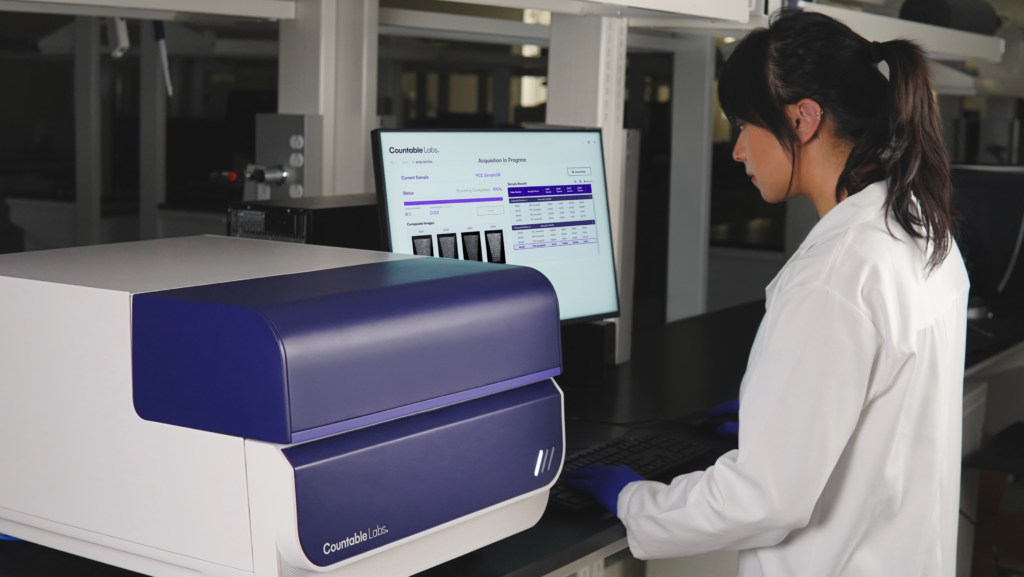
Fan: Usually very straightforward. Customers are typically running on their own after the first demonstration from our field application scientists. If you know PCR, it is simple. You prepare a master mix like any qPCR or digital PCR workflow, and our consumables come in a familiar format, a spin column with strip tubes. You spin it on a benchtop for about 20 minutes, run it on a thermal cycler, and load it onto the instrument. There is not much hands-on processing. We have had interns, even a high school intern, running it in a day.
You helped lay the groundwork for NIPT using sequencing. How do you see PCR fitting alongside sequencing now?
Fan: It is all about counting. Back then we used sequencing to count chromosomal molecules, and now my view is that we should use something simpler than sequencing where we can. Some applications still belong to sequencing, but people often reach for it even for small panels, two or ten targets. If you are batching samples that can make sense, but in decentralized settings it does not. In Europe, for instance, labs have trouble shipping samples across borders, so they want a method they can deploy in the hospital lab instead of sending it to a central facility. That is where a PCR-based approach has a place over sequencing.
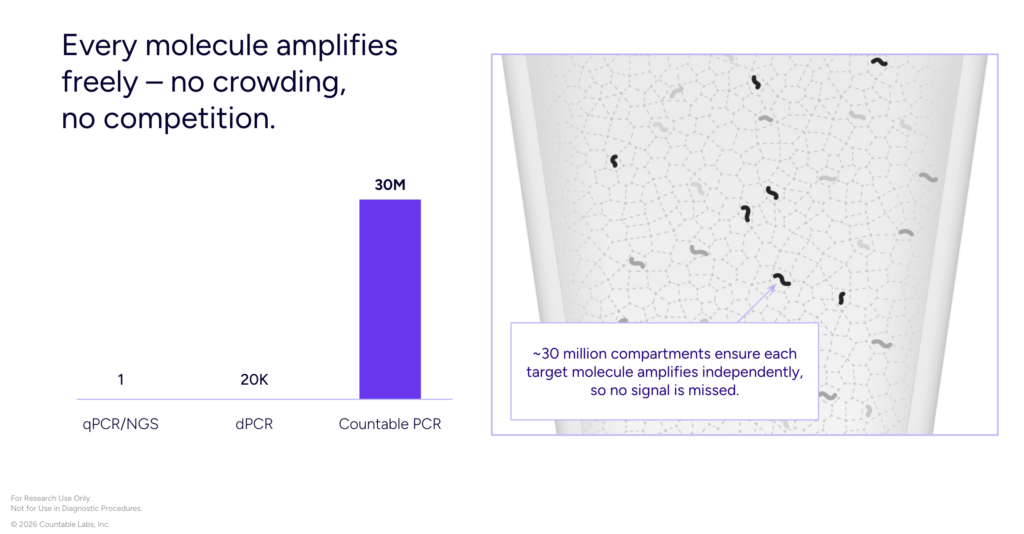
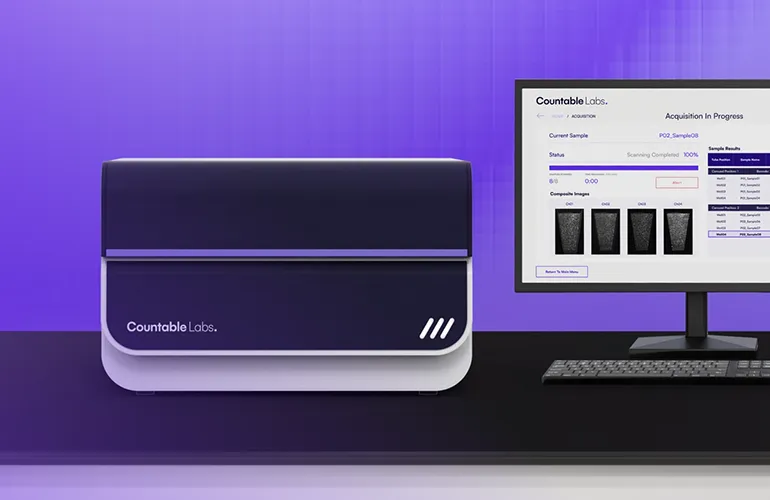
Countable Labs says its ~30 million compartments, versus roughly 20,000 for digital PCR, let every target molecule amplify on its own. Image courtesy of Countable Labs.