Research & Development World

  • R&D World Home
  • Topics
    • Aerospace
    • Automotive
    • Biotech
    • Careers
    • Chemistry
    • Environment
    • Energy
    • Life Science
    • Material Science
    • R&D Management
    • Physics
  • Technology
    • 3D Printing
    • A.I./Robotics
    • Software
    • Battery Technology
    • Controlled Environments
      • Cleanrooms
      • Graphene
      • Lasers
      • Regulations/Standards
      • Sensors
    • Imaging
    • Nanotechnology
    • Scientific Computing
      • Big Data
      • HPC/Supercomputing
      • Informatics
      • Security
    • Semiconductors
  • R&D Market Pulse
  • R&D 100
    • 2025 R&D 100 Award Winners
    • 2025 Professional Award Winners
    • 2025 Special Recognition Winners
    • R&D 100 Awards Event
    • R&D 100 Submissions
    • Winner Archive
  • Resources
    • Research Reports
    • Digital Issues
    • Educational Assets
    • Subscribe
    • Video
    • Webinars
    • PharmSci360
    • Content submission guidelines for R&D World
  • Global Funding Forecast
  • Top Labs
  • Advertise
  • SUBSCRIBE

Electronics of the Future: A New Energy-Efficient Mechanism Using the Rashba Effect

By Tokyo Institute of Technology | December 27, 2018

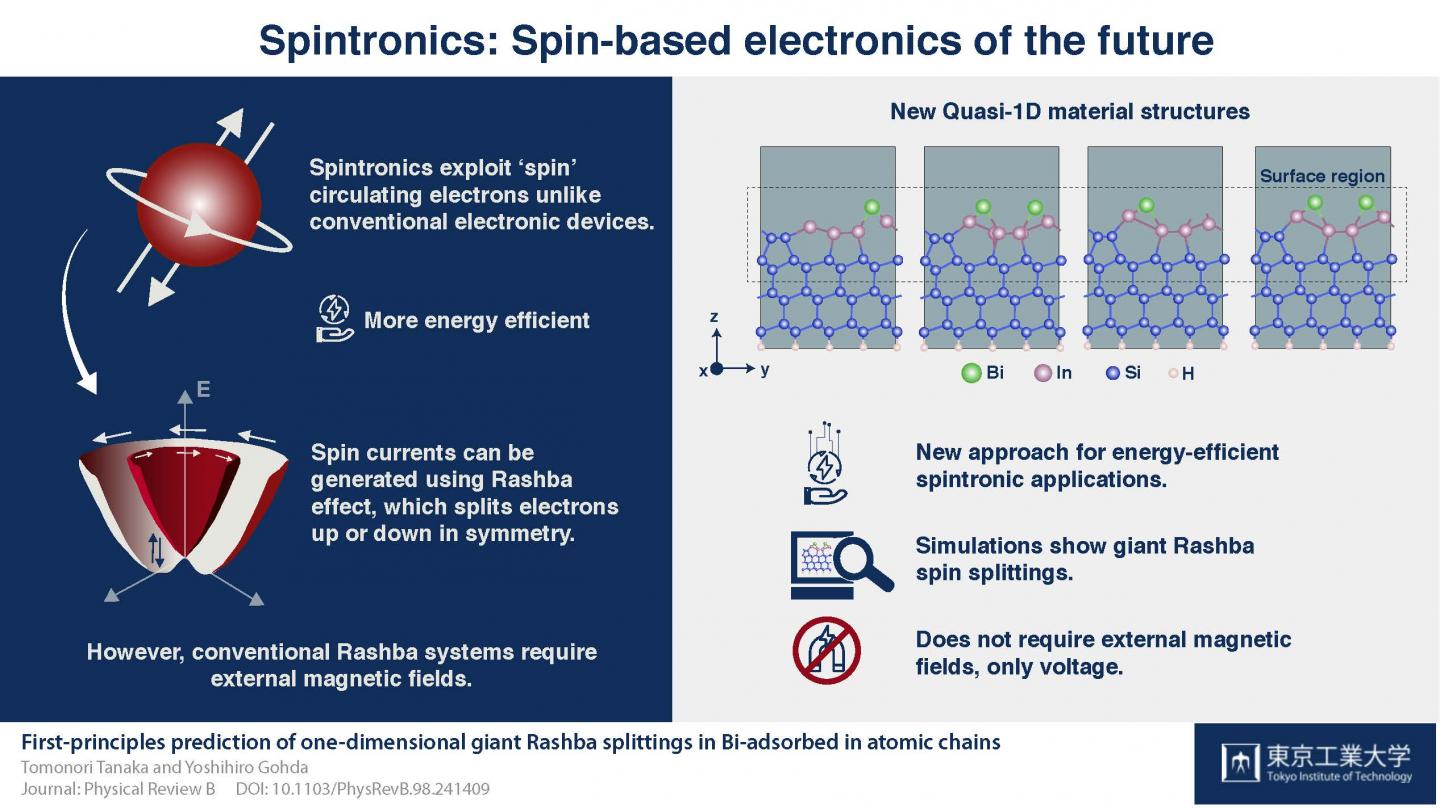
First-principles prediction of one-dimensional giant Rashba splittings. Credit: Yoshihiro Goda and Tokyo Institute of Technology

Scientists at Tokyo Institute of Technology proposed new quasi-1D materials for potential spintronic applications, an upcoming technology that exploits the spin of electrons. They performed simulations to demonstrate the spin properties of these materials and explained the mechanisms behind their behavior.

Conventional electronics is based on the movement of electrons and mainly concerns their electric charge; unfortunately, we are close to reaching the physical limits for improving electronic devices. However, electrons bear another intrinsic quantum-physical property called “spin”, which can be interpreted as a type of angular momentum and can be either “up” or “down”. While conventional electronic devices do not deploy the spin of the electrons that they employ, spintronics is a field of study in which the spin of the conducting electrons is crucial. Serious improvements in performance and new applications can be attained through “spin currents”.

As promising as spintronics sound, researchers are still trying to find convenient ways of generating spin currents with material structures that possess electrons with desirable spin properties. The Rashba-Bychkov effect (or simply Rashba effect), which involves a splitting of spin-up and spin-down electrons due to breakings in symmetry, could potentially be exploited for this purpose. A pair of researchers from Tokyo Institute of Technology, including Associate Professor Yoshihiro Gohda, have proposed a new mechanism to generate a spin current without energy loss from a series of simulations for new quasi-1D materials based on bismuth-adsorbed indium that exhibit a giant Rashba effect. “Our mechanism is suitable for spintronic applications, having an advantage that it does not require an external magnetic field to generate nondissipative spin current,” explains Gohda. This advantage would simplify potential spintronic devices and would allow for further miniaturization.

The researchers conducted simulations based on these materials to demonstrate that the Rashba effect in them can be large and only requires applying a certain voltage to generate spin currents. By comparing the Rashba properties of multiple variations of these materials, they provided explanations for the observed differences in the materials’ spin properties and a guide for further materials exploration.

This type of research is very important as radically new technologies are required if we intend to further improve electronic devices and go beyond their current physical limits. “Our study should be important for energy-efficient spintronic applications and stimulating further exploration of different 1D Rashba systems,” concludes Gohda. From faster memories to quantum computers, the benefits of better understanding and exploiting Rashba systems will certainly have enormous implications.


Related Articles Read More >

Speaker Giving a Talk at Business Meeting. Audience in the conference hall. Business and Entrepreneurship. Panoramic composition suitable for banners.
BioPharma Supply Chain & Logistics Nexus returns to San Diego in November
How Cypris evolved from selling patent reports to agentic R&D intelligence
New video series: Travel for engineers
Advanced Manufacturing and Process Innovation Special Report: When you can’t hire, you automate
rd newsletter
EXPAND YOUR KNOWLEDGE AND STAY CONNECTED
Get the latest info on technologies, trends, and strategies in Research & Development.

R&D World Digital Issues

Fall 2025 issue

Browse the most current issue of R&D World and back issues in an easy to use high quality format. Clip, share and download with the leading R&D magazine today.

R&D 100 Awards
Research & Development World
  • Subscribe to R&D World Magazine
  • Sign up for R&D World’s newsletter
  • Contact Us
  • About Us
  • Drug Discovery & Development
  • Pharmaceutical Processing
  • Global Funding Forecast

Copyright © 2026 Arrowfly LLC. All Rights Reserved. The material on this site may not be reproduced, distributed, transmitted, cached or otherwise used, except with the prior written permission of Arrowfly
Privacy Policy | Advertising | About Us

Search R&D World

  • R&D World Home
  • Topics
    • Aerospace
    • Automotive
    • Biotech
    • Careers
    • Chemistry
    • Environment
    • Energy
    • Life Science
    • Material Science
    • R&D Management
    • Physics
  • Technology
    • 3D Printing
    • A.I./Robotics
    • Software
    • Battery Technology
    • Controlled Environments
      • Cleanrooms
      • Graphene
      • Lasers
      • Regulations/Standards
      • Sensors
    • Imaging
    • Nanotechnology
    • Scientific Computing
      • Big Data
      • HPC/Supercomputing
      • Informatics
      • Security
    • Semiconductors
  • R&D Market Pulse
  • R&D 100
    • 2025 R&D 100 Award Winners
    • 2025 Professional Award Winners
    • 2025 Special Recognition Winners
    • R&D 100 Awards Event
    • R&D 100 Submissions
    • Winner Archive
  • Resources
    • Research Reports
    • Digital Issues
    • Educational Assets
    • Subscribe
    • Video
    • Webinars
    • PharmSci360
    • Content submission guidelines for R&D World
  • Global Funding Forecast
  • Top Labs
  • Advertise
  • SUBSCRIBE