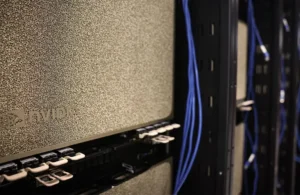
 Eli Lilly celebrated the go-live of LillyPod on Wednesday, cutting the ribbon on what the company calls the most powerful supercomputer in the pharmaceutical industry. The system, an NVIDIA DGX SuperPOD powered by 1,016 Blackwell GPUs, is now in production-scale use at Lilly’s Indianapolis campus, with workloads spanning genomics, molecule design, single-cell biology, imaging, and manufacturing operations.
“Compute is a means to an end. It is that scientific instrument you can then wield,” Thomas Fuchs, Lilly’s chief AI officer, told R&D World in a January interview. The comparison is deliberate. Lilly leaders framed LillyPod not as IT infrastructure but as a new kind of research instrument, one that lets scientists explore billions of molecular hypotheses in parallel, compared to the roughly 2,000 a productive wet-lab team can test per target per year.
The ribbon-cutting follows a string of announcements that began last October, when Lilly first disclosed the supercomputer buildout, and accelerated in January at the J.P. Morgan Healthcare Conference with a co-innovation lab planned for South San Francisco as part of an up-to-$1 billion, five-year NVIDIA partnership.
NVIDIA’s AI infrastructure has become ubiquitous across the biopharma sector, the company partners with Recursion, the Chan Zuckerberg Initiative, and Alphabet’s Isomorphic Labs, among others. The question for Lilly is whether owning the hardware, rather than renting cloud compute, creates a durable advantage or just early access to a capability competitors will eventually match.
In an NYSE interview last fall, Fuchs said Lilly aims to “leapfrog the whole sector” with AI, an ambition that extends well beyond drug discovery. In a January conversation with R&D World, he described a company where AI touches everything from self-driving forklifts and industrial robotics to digital twins of manufacturing lines. But he stressed there are hard limits. “You cannot accelerate a cancer trial or a neuro trial, the bottleneck is biology,” he said.
The applications already running on LillyPod on day one hint at the breadth of the bet. Lilly said workloads span genomics, peptide design, single-cell biology, imaging, and manufacturing, a range that reflects Fuchs’s insistence that AI at Lilly isn’t a single-use tool aimed at discovery alone. “The scope of AI applications within Lilly is very broad and very diverse,” he told R&D World. “That differentiates us from companies where you have one task, like optimizing social media.”
One piece of the strategy is outward-facing. Lilly TuneLab, an AI and machine learning drug discovery platform, is designed to give smaller biotechs access to models trained on Lilly’s internal data, including, Fuchs noted, lessons learned from millions of molecules that didn’t succeed. The platform uses federated learning, which keeps proprietary data private while allowing shared model training. The strategic calculus is counterintuitive: by seeding the broader ecosystem with better tools, Lilly may surface external compounds and targets it can later partner on or acquire.
Internally, the company is pushing toward what it calls scientific AI agents: digital assistants that can help researchers plan experiments, reason through problems, and coordinate across computational and physical labs. Fuchs has described the long-term vision as replacing the “artisanal approach” to discovery with something more industrialized, though he estimated it could be a decade before AI can generate, validate, and advance drug candidates end-to-end.