Research & Development World

  • R&D World Home
  • Topics
    • Aerospace
    • Automotive
    • Biotech
    • Careers
    • Chemistry
    • Environment
    • Energy
    • Life Science
    • Material Science
    • R&D Management
    • Physics
  • Technology
    • 3D Printing
    • A.I./Robotics
    • Software
    • Battery Technology
    • Controlled Environments
      • Cleanrooms
      • Graphene
      • Lasers
      • Regulations/Standards
      • Sensors
    • Imaging
    • Nanotechnology
    • Scientific Computing
      • Big Data
      • HPC/Supercomputing
      • Informatics
      • Security
    • Semiconductors
  • R&D Market Pulse
  • R&D 100
    • 2025 R&D 100 Award Winners
    • 2025 Professional Award Winners
    • 2025 Special Recognition Winners
    • R&D 100 Awards Event
    • R&D 100 Submissions
    • Winner Archive
  • Resources
    • Research Reports
    • Digital Issues
    • Educational Assets
    • R&D Index
    • Subscribe
    • Video
    • Webinars
    • Content submission guidelines for R&D World
  • Global Funding Forecast
  • Top Labs
  • Advertise
  • SUBSCRIBE

First impressions of Google’s Gemini 3 for creating scientific visualizations

By Brian Buntz | November 18, 2025

Google’s Gemini 3 promises a leap in reasoning, math and scientific accuracy. While its leaderboard scores are high, its real value depends on how well it plugs into daily workflows whether in the lab or in coding.

First impressions? It excels at rapid visualization.

The interactive model below was generated from a single prompt asking for a 3D view of GLP-1 receptor activation. In just two minutes, Gemini generated working HTML and Three.js code featuring 4,000 animated lipid particles and cinematic lighting. While the result is visually striking, it prioritizes aesthetics over molecular perfection—note the artificial flatness of the lipids—but the speed of creation is undeniable.

Gemini 3.0’s speed and accuracy speed (or at least my first impressions of them — I did spot some inconsistent performance) could matter for scientific communication. Traditional molecular visualization tools require specialized training, and hiring a 3D animator for educational content can take weeks and significant budget. If Gemini 3 can deliver publication-ready graphics from natural language prompts, it compresses what used to be a multi-step workflow involving multiple specialists into a single conversation.

But according to a read of Google’s own material, three items that could matter most for R&D teams: stronger performance on reasoning-heavy benchmarks such as GPQA Diamond and ARC-AGI; better results on multimodal tasks that mix diagrams, images, video and text; and a very large context window, on the order of one million tokens (like its predecessor Gemini-2.5-Pro), paired with an optional Deep Think mode.

Early reports paint a mixed picture. Gemini 3 appears to push state of the art on hard reasoning tests such as Humanity’s Last Exam, a PhD-level benchmark where Google reports a new high score. Launch coverage also highlights strong multimodal results, and Google is pairing the model with Antigravity, an “agent-first” coding environment that gives AI agents direct access to an editor, terminal and browser.

At the same time, Alphabet chief executive Sundar Pichai is telling users not to “blindly trust” answers from Gemini and similar systems. Much media coverage will focus on benchmark charts and usage numbers. Here’s how the numbers stack up against other recent models:
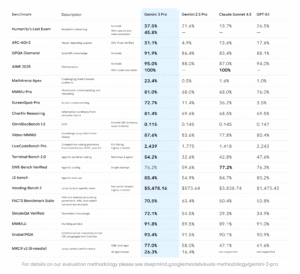
Google’s reported benchmarks for Gemini 3.0

Here is another visualization related to GLP-1 that Gemini 3.0 made.

Related Articles Read More >

Avnet study: Engineers are shipping more AI products, but confidence in them remains uneven
Google DeepMind partners with U.K. for its first automated lab
How GPT-5.2 stacks up against Gemini 3.0 and Claude Opus 4.5
Octopus-inspired robot can change color, grab objects
rd newsletter
EXPAND YOUR KNOWLEDGE AND STAY CONNECTED
Get the latest info on technologies, trends, and strategies in Research & Development.
RD 25 Power Index

R&D World Digital Issues

Fall 2025 issue

Browse the most current issue of R&D World and back issues in an easy to use high quality format. Clip, share and download with the leading R&D magazine today.

R&D 100 Awards
Research & Development World
  • Subscribe to R&D World Magazine
  • Sign up for R&D World’s newsletter
  • Contact Us
  • About Us
  • Drug Discovery & Development
  • Pharmaceutical Processing
  • Global Funding Forecast

Copyright © 2025 WTWH Media LLC. All Rights Reserved. The material on this site may not be reproduced, distributed, transmitted, cached or otherwise used, except with the prior written permission of WTWH Media
Privacy Policy | Advertising | About Us

Search R&D World

  • R&D World Home
  • Topics
    • Aerospace
    • Automotive
    • Biotech
    • Careers
    • Chemistry
    • Environment
    • Energy
    • Life Science
    • Material Science
    • R&D Management
    • Physics
  • Technology
    • 3D Printing
    • A.I./Robotics
    • Software
    • Battery Technology
    • Controlled Environments
      • Cleanrooms
      • Graphene
      • Lasers
      • Regulations/Standards
      • Sensors
    • Imaging
    • Nanotechnology
    • Scientific Computing
      • Big Data
      • HPC/Supercomputing
      • Informatics
      • Security
    • Semiconductors
  • R&D Market Pulse
  • R&D 100
    • 2025 R&D 100 Award Winners
    • 2025 Professional Award Winners
    • 2025 Special Recognition Winners
    • R&D 100 Awards Event
    • R&D 100 Submissions
    • Winner Archive
  • Resources
    • Research Reports
    • Digital Issues
    • Educational Assets
    • R&D Index
    • Subscribe
    • Video
    • Webinars
    • Content submission guidelines for R&D World
  • Global Funding Forecast
  • Top Labs
  • Advertise
  • SUBSCRIBE