Research & Development World

  • R&D World Home
  • Topics
    • Aerospace
    • Automotive
    • Biotech
    • Careers
    • Chemistry
    • Environment
    • Energy
    • Life Science
    • Material Science
    • R&D Management
    • Physics
  • Technology
    • 3D Printing
    • A.I./Robotics
    • Software
    • Battery Technology
    • Controlled Environments
      • Cleanrooms
      • Graphene
      • Lasers
      • Regulations/Standards
      • Sensors
    • Imaging
    • Nanotechnology
    • Scientific Computing
      • Big Data
      • HPC/Supercomputing
      • Informatics
      • Security
    • Semiconductors
  • R&D Market Pulse
  • R&D 100
    • 2026 R&D 100 Award Winners
    • 2026 Professional Award Winners
    • 2026 Special Recognition Winners
    • R&D 100 Awards Event
    • R&D 100 Submissions
    • Winner Archive
  • Resources
    • Research Reports
    • Digital Issues
    • Educational Assets
    • Subscribe
    • Video
    • Webinars
    • PharmSci360
    • Content submission guidelines for R&D World
  • Global Funding Forecast
  • Top Labs
  • Advertise
  • SUBSCRIBE

Google’s Gemini 4 Carbon takes benchmark lead with access limited to cyber defenders

By Brian Buntz | October 28, 2026

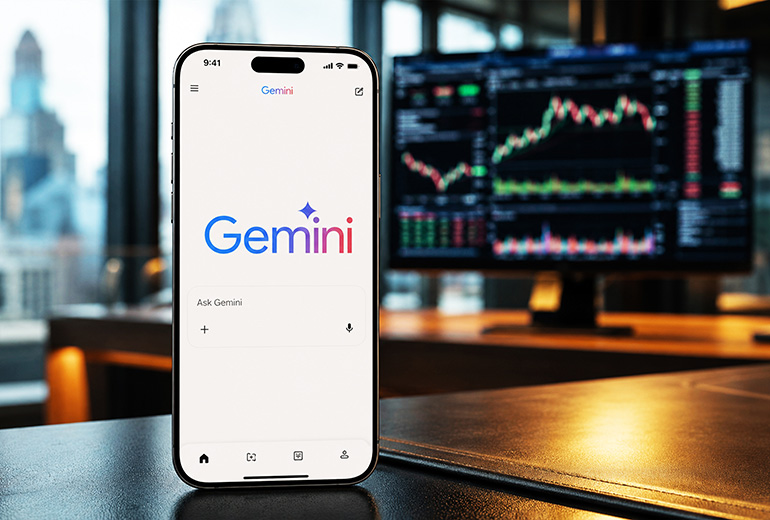
[Adobe Stock]

Google is apparently making up for lost time. Four weeks after its overdue frontier model finally surfaced as Gemini 4 Argon, the company unveiled a successor on October 28 that it calls its strongest model yet: Gemini 4 Carbon. Its first focus area is finding software flaws. The model currently takes first place on Artificial Analysis’s updated Intelligence Index with a score of 59, narrowly ahead of Anthropic and OpenAI. Opus 5.5 has a score of 58.

The gap Carbon follows opened in May. At its I/O conference, Google promised Gemini 3.5 Pro in June. That model slipped repeatedly, and Bloomberg reported its coding performance fell short of internal goals. When Google announced Argon on September 30, a spokesperson told Reuters that the company no longer plans to release 3.5 Pro and that Argon is larger than Google’s earlier Pro models. Cheaper Flash models filled in, from 3.5 Flash at I/O to 3.8 Flash on September 2, and Gemini 3.1 Pro Preview stayed Google’s newest Pro model until Argon arrived on September 30.

Carbon scores 59 at its high reasoning setting on version 5.0 of the independent evaluator’s index. In the same Artificial Analysis ranking, GPT-6 Astra scores 57 and GPT-6.1 Sol 55 in their listed maximum-reasoning configurations. The index combines nine evaluations spanning coding, scientific reasoning, knowledge and other tasks, among them Terminal-Bench 4.0, FrontierCode 2.0, HLE-Diamond and Terminal-Bench-Science 0.1. Argon scores 50 on the same version, nine points below Carbon. Artificial Analysis had scored Argon at 53 on the earlier v4.3.2 index, so scores carry over only within one index version.

Google reports Carbon scores 88.2% on SEC-bench Pro for vulnerability discovery, 54.8% on ExploitGym for exploitation and 71.0% on CWE-bench (a defensive cybersecurity and AI evaluation benchmark from Collinear AI) for patching. Google evaluated these external benchmarks with guardrails disabled, a condition that limits direct extrapolation to the safeguarded product. In its own testing, Google says Carbon more than doubles Argon’s success rate at generating secure code, and its Chrome team found Carbon “more than 10X better” at high-quality patches than another lab’s large frontier model, which Google leaves unnamed. The company also reports fourth place on WebDev Arena at 1,768 Elo, an 89-point improvement.

Google built Carbon for long-horizon engineering work and says its internal teams have seen the model run for days, persisting through dead ends on multi-step tasks. On Gray Swan’s indirect prompt-injection benchmark, which Argon previously led at a 0.7% attack success rate, Google reports 0.0% for Carbon.
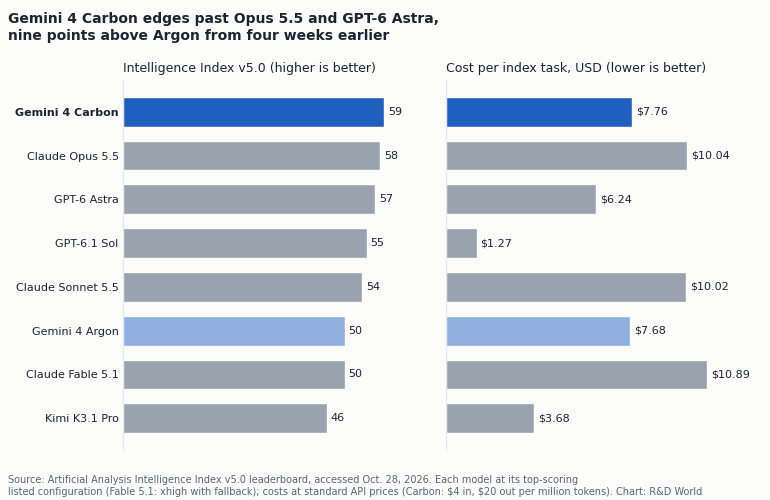
Bar charts of Artificial Analysis Intelligence Index v5.0 scores and cost per index task for eight AI models, with Gemini 4 Carbon first at 59 and $7.76 per task.

Credit: R&D World, from Artificial Analysis data

The performance lead comes with substantial token consumption, a trait Carbon shares with Argon, which generated 110 million output tokens on the same index, about 1.7 times the median. For Carbon, Artificial Analysis recorded 200 million output tokens across its index evaluation, about three times the 64 million median for comparable models, and calculated a weighted average cost of $7.76 per task using standard pricing. That puts Carbon below Opus 5.5 at maximum reasoning ($10.04) and above GPT-6 Astra ($6.24) and GPT-6.1 Sol ($1.27). Artificial Analysis measured a median 97.5 seconds before Carbon’s first output token on Google’s API, against a 3.6-second median for comparable models. Google plans introductory rates of $2 per million input tokens and $10 per million output tokens, the same as Argon’s, rising to $4 and $20 after the promotion. Cached inputs receive a 95% discount.

The release extends the restricted cyber-defender rollout that accompanied Argon, which Google opened first to its Fairwind Program, launched September 2 for government authorities, critical infrastructure operators and software maintainers. Google plans to give selected defenders access to Carbon this week and expand through Fairwind to more trusted partners. Broader developer, business and consumer access remains a future phase, which Google says will follow feedback and further work on guardrails. Google also says it is taking part in the U.S. government’s voluntary process for pre-release model testing.
Tell Us What You Think! Cancel reply

You must be logged in to post a comment.

Related Articles Read More >

Illustration of a folded protein with three amino acid substitutions labeled: leucine to glycine, cysteine to aspartate and serine to phenylalanine.
Twist adds cell-free antibody screening for AI-designed candidates
OpenAI logo glowing on a smartphone screen resting on a laptop keyboard
OpenAI says its AI models produced major proofs in mathematics, computer science and physics
Anthropic acquires a one-person biotech that used Claude to coordinate 11 labs
Jellyfish: Claude Code bills hit $252 a month per developer as software factories automate code production among early adopters
rd newsletter
EXPAND YOUR KNOWLEDGE AND STAY CONNECTED
Get the latest info on technologies, trends, and strategies in Research & Development.

R&D World Digital Issues

Fall 2026 issue

Browse the most current issue of R&D World and back issues in an easy to use high quality format. Clip, share and download with the leading R&D magazine today.

R&D 100 Awards
Research & Development World
  • Subscribe to R&D World Magazine
  • Sign up for R&D World’s newsletter
  • Contact Us
  • About Us
  • Drug Discovery & Development
  • Pharmaceutical Processing
  • Global Funding Forecast

Copyright © 2026 Arrowfly LLC. All Rights Reserved. The material on this site may not be reproduced, distributed, transmitted, cached or otherwise used, except with the prior written permission of Arrowfly
Privacy Policy | Advertising | About Us

Search R&D World

  • R&D World Home
  • Topics
    • Aerospace
    • Automotive
    • Biotech
    • Careers
    • Chemistry
    • Environment
    • Energy
    • Life Science
    • Material Science
    • R&D Management
    • Physics
  • Technology
    • 3D Printing
    • A.I./Robotics
    • Software
    • Battery Technology
    • Controlled Environments
      • Cleanrooms
      • Graphene
      • Lasers
      • Regulations/Standards
      • Sensors
    • Imaging
    • Nanotechnology
    • Scientific Computing
      • Big Data
      • HPC/Supercomputing
      • Informatics
      • Security
    • Semiconductors
  • R&D Market Pulse
  • R&D 100
    • 2026 R&D 100 Award Winners
    • 2026 Professional Award Winners
    • 2026 Special Recognition Winners
    • R&D 100 Awards Event
    • R&D 100 Submissions
    • Winner Archive
  • Resources
    • Research Reports
    • Digital Issues
    • Educational Assets
    • Subscribe
    • Video
    • Webinars
    • PharmSci360
    • Content submission guidelines for R&D World
  • Global Funding Forecast
  • Top Labs
  • Advertise
  • SUBSCRIBE