Research & Development World

  • R&D World Home
  • Topics
    • Aerospace
    • Automotive
    • Biotech
    • Careers
    • Chemistry
    • Environment
    • Energy
    • Life Science
    • Material Science
    • R&D Management
    • Physics
  • Technology
    • 3D Printing
    • A.I./Robotics
    • Software
    • Battery Technology
    • Controlled Environments
      • Cleanrooms
      • Graphene
      • Lasers
      • Regulations/Standards
      • Sensors
    • Imaging
    • Nanotechnology
    • Scientific Computing
      • Big Data
      • HPC/Supercomputing
      • Informatics
      • Security
    • Semiconductors
  • R&D Market Pulse
  • R&D 100
    • 2025 R&D 100 Award Winners
    • 2025 Professional Award Winners
    • 2025 Special Recognition Winners
    • R&D 100 Awards Event
    • R&D 100 Submissions
    • Winner Archive
  • Resources
    • Research Reports
    • Digital Issues
    • Educational Assets
    • R&D Index
    • Subscribe
    • Video
    • Webinars
    • Content submission guidelines for R&D World
  • Global Funding Forecast
  • Top Labs
  • Advertise
  • SUBSCRIBE

Graphene Floating on Water Attracts Water

By University of Leiden | December 21, 2017

Graphene floating on water does not repel water, as many researchers believe, but rather attracts it. This has been demonstrated by chemists Liubov Belyaeva and Pauline van Deursen and their supervisor Grégory F. Schneider, and published in Advanced Materials.

Graphene is made up of the same material as graphite — found in pencils, for example — which is why it was assumed for a long time that, like graphite, graphene is water repellant. A key difference from graphite is that graphene is no more than a single atom thick.

The studies on graphene gave rise to differing ideas about its wetting properties. The Leiden researchers have now discovered that the surface of graphene on water, provided it is clean and smooth, is hydrophilic. In other words, graphene in water attracts water.

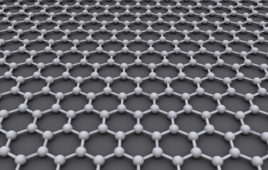
This insight is very significant for the future applications of graphene. Its thin atomic layer of carbon atoms, arranged in a honeycomb structure, make the material suitable for use in biosensors to decode DNA. This ultra-thin material can also be used in sensors, water filtration and membranes of fuel cells. In all these cases, a graphene layer is exposed to water on both sides.

For a long time, graphene was believed to be hydrophobic, or water repellant. The researchers assume that this is because graphene is generally produced on a metal surface and is later transferred to a solid support such as a silicon wafer. During this transfer process, however, the graphene can become damaged or contaminated, which can influence the wetting behavior.

To determine whether or not the surface of an intact layer of graphene is hydrophilic, a droplet of water has to be introduced onto the layer. It is then possible to determine from the curvature of the droplet whether the surface is water repellent, just like a raincoat, or whether it attracts water. So much for the theory, because in practice such a droplet will immediately tear the thin graphene layer, resulting in cracks, after which there is not much left to measure.

The researchers resolved this problem by using ice or hydrogel instead of water as the support layer. Ice and hydrogel are much stronger and are good imitators of water. The researchers were then able to introduce minuscule droplets of water onto the graphene and measure the contact angle between the graphene surface and the outside of the droplet. They also repeated the measurements using other liquids with a different polarity. They were then able to determine that all molecular interactions of the underlying water are felt by the water molecules in the droplet above. This complete transparency is the consequence of graphene’s extreme thinness, and it explains why graphene is hydrophilic on water.

This discovery has a great impact on applications of graphene in sensors, water filtration, and membrane-based fuel cells, all of which feature graphene exposed to water. Developers will have to consider a completely different starting point, namely that the graphene they work with is not hydrophobic, but hydrophilic.

Source: University of Leiden
Related Articles Read More >

The emerging materials shaping next-generation semiconductor electronics
24 R&D trends that redefined 2024
Graphene-based flowmeter sensor measures nano-rate fluid flows, Part 3: The sensor
Graphene-based flowmeter sensor measures nano-rate fluid flows, Part 2: The graphene context
rd newsletter
EXPAND YOUR KNOWLEDGE AND STAY CONNECTED
Get the latest info on technologies, trends, and strategies in Research & Development.
RD 25 Power Index

R&D World Digital Issues

Fall 2025 issue

Browse the most current issue of R&D World and back issues in an easy to use high quality format. Clip, share and download with the leading R&D magazine today.

R&D 100 Awards
Research & Development World
  • Subscribe to R&D World Magazine
  • Sign up for R&D World’s newsletter
  • Contact Us
  • About Us
  • Drug Discovery & Development
  • Pharmaceutical Processing
  • Global Funding Forecast

Copyright © 2025 WTWH Media LLC. All Rights Reserved. The material on this site may not be reproduced, distributed, transmitted, cached or otherwise used, except with the prior written permission of WTWH Media
Privacy Policy | Advertising | About Us

Search R&D World

  • R&D World Home
  • Topics
    • Aerospace
    • Automotive
    • Biotech
    • Careers
    • Chemistry
    • Environment
    • Energy
    • Life Science
    • Material Science
    • R&D Management
    • Physics
  • Technology
    • 3D Printing
    • A.I./Robotics
    • Software
    • Battery Technology
    • Controlled Environments
      • Cleanrooms
      • Graphene
      • Lasers
      • Regulations/Standards
      • Sensors
    • Imaging
    • Nanotechnology
    • Scientific Computing
      • Big Data
      • HPC/Supercomputing
      • Informatics
      • Security
    • Semiconductors
  • R&D Market Pulse
  • R&D 100
    • 2025 R&D 100 Award Winners
    • 2025 Professional Award Winners
    • 2025 Special Recognition Winners
    • R&D 100 Awards Event
    • R&D 100 Submissions
    • Winner Archive
  • Resources
    • Research Reports
    • Digital Issues
    • Educational Assets
    • R&D Index
    • Subscribe
    • Video
    • Webinars
    • Content submission guidelines for R&D World
  • Global Funding Forecast
  • Top Labs
  • Advertise
  • SUBSCRIBE