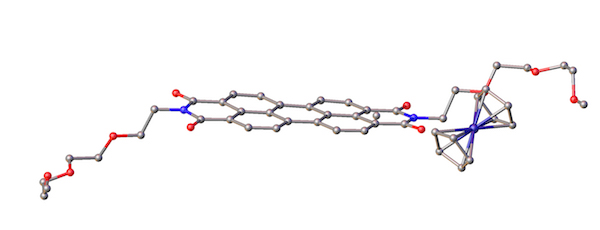
The crystal structure of PEG-PDI is achieved using cobaltocene as a reducing agent and omitting solvents and hydrogen atoms for clarity. Carbon atoms are gray, nitrogens are blue, oxygens red and cobalts purple. The molecules created by scientists at Rice University, the McGovern Medical School at the University of Texas Health Science Center at Houston and Baylor College of Medicine are efficient antioxidants and help scientists understand how larger nanoparticles quench damaging reactive oxygen species in the body. Image: Courtesy of the Tour Group
Treated particles of graphene derived from carbon nanotubes have demonstrated remarkable potential as life-saving antioxidants, but as small as they are, something even smaller had to be created to figure out why they work so well.
Researchers at Rice University, the McGovern Medical School at the University of Texas Health Science Center at Houston (UTHealth), and Baylor College of Medicine created single-molecule compounds that also quench damaging reactive oxygen species (ROS) but are far easier to analyze using standard scientific tools. The molecules may become the basis for new antioxidant therapies in their own right.
The research appears in the American Chemical Society journal ACS Nano.
The original compounds are hydrophilic carbon clusters functionalized with polyethylene glycol, known as PEG-HCCs and created by Rice and Baylor scientists five years ago. The particles help neutralize ROS molecules overexpressed by the body’s cells in response to an injury before they damage cells or cause mutations.
PEG-HCCs show promise for treating cancer, rebooting blood flow in the brain after traumatic injury and controlling chronic diseases.
The new particles, called PEG-PDI, consist of polyethylene glycol and perylene diimide, a compound used as a dye, the color in red car paint and in solar cells for its light-absorbing properties. Their ability to accept electrons from other molecules makes them functionally similar to PEG-HCCs. They’re close enough to serve as an analog for experiments, according to Rice chemist James Tour, who led the study with University of Texas biochemist Ah-Lim Tsai.
The researchers wrote that the molecule is not only the first example of a small molecular analogue of PEG-HCCs, but also represents the first successful isolation of a PDI radical anion as a single crystal, which allows its structure to be captured with X-ray crystallography.
“This allows us to see the structure of these active particles,” Tour says. “We can get a view of every atom and the distances between them, and get a lot of information about how these molecules quench destructive oxidants in biological tissue.
“Lots of people get crystal structures for stable compounds, but this is a transient intermediate during a catalytic reaction,” he says. “To be able to crystallize a reactive intermediate like that is amazing.”
PEG-HCCs are about 3 nanometers wide and 30 to 40 nanometers long. By comparison, much simpler PEG-PDI molecules are less than a nanometer in width and length.
PEG-PDI molecules are true mimics of superoxide dismutase enzymes, protective antioxidants that break down toxic superoxide radicals into harmless molecular oxygen and hydrogen peroxide. The molecules pull electrons from unstable ROS and catalyze their transformation into less-reactive species.
Testing the PEG-PDI molecules can be as simple as putting them in a solution that contains reactive oxygen species molecules like potassium superoxide and watching the solution change color. Further characterization with electron paramagnetic resonance spectroscopy was more complicated, but the fact that it’s even possible makes them powerful tools in resolving mechanistic details, the researchers said.
Tour says adding polyethylene glycol makes the molecules soluble and also increases the amount of time they remain in the bloodstream. “Without PEG, they just go right out of the system through the kidneys,” he says. When the PEG groups are added, the molecules circulate longer and continue to catalyze reactions.
He says PEG-PDI is just as effective as PEG-HCCs if measured by weight. “Because they have so much more surface area, PEG-HCC particles probably catalyze more parallel reactions per particle,” Tour says. “But if you compare them with PEG-PDI by weight, they are quite similar in total catalytic activity.”
Understanding the structure of PEG-PDI should allow researchers to customize the molecule for applications. “We should have a tremendous ability to modify the molecule’s structure,” he says. “We can add anything we want, exactly where we want, for specific therapies.”
The researchers say PEG-PDI may also be efficient metal- and protein-free catalysts for oxygen reduction reactions used in industry and essential to fuel cells. They are intrinsically more stable than enzymes and can function in much a wider pH range, Tsai says.
Co-author Thomas Kent, a professor of neurology at Baylor who has worked on the project from the start, noted small molecules have a better chance to get on the fast track to approval for therapy by the Food and Drug Administration than nanotube-based agents. “A small molecule that is not derived from larger nanomaterial may have a better chance of approval to use in humans, assuming it is safe and effective,” he says.
Tour says PEG-PDI serves as a precise model for other graphene derivatives like graphene oxide and permits a more detailed study of graphene-based nanomaterials. “Making nanomaterials smaller, from well-defined molecules, permits 150 years of synthetic chemistry methods to address the mechanistic questions within nanotechnology,” he says.
Almaz Jalilov, a Rice alumnus and now a professor at King Fahd University of Petroleum and Minerals, Saudi Arabia, is lead author of the study. Co-authors are graduate students Lizanne Nilewski and Chenhao Zhang of Rice; senior research scientist Vladimir Berka and instructor Wu Gang of the McGovern Medical School at UTHealth; and assistant chemist Andrey Yakovenko of Argonne National Laboratory. Tour is the T.T. and W.F. Chao Chair in Chemistry as well as a professor of computer science and of materials science and nanoengineering at Rice. Tsai is a professor at UTHealth.
The National Institutes of Health and the Dunn Foundation supported the research.
Source: Rice University