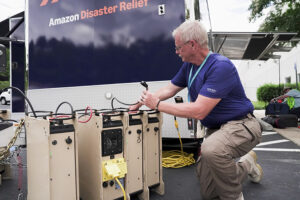
 When Hurricane Melissa hit Jamaica as a record-strength Category 5 storm, Amazon activated its Disaster Relief Hub near Atlanta, one of 15 global disaster relief hubs, and flew in 2,500 pounds of solar power and connectivity gear.
The November 5 flight marked the first time Amazon has delivered its new disaster relief technology kits outside the U.S. The tech payload included solar-fueled batteries and satellite powered Wi-Fi connectors designed to restore power and communications for hospitals, police stations and community centers.
“Almost no building in Black River is standing or protected by a roof after the storm, including homes, the library, and the school,” said Abe Diaz, Amazon’s head of disaster relief, in a statement. The tech kits are designed to be deployed quickly by first responders with minimal technical expertise, with Amazon describing them as being as simple as flipping a light switch.
Growing disaster infrastructure
Behind that flight is an infrastructure Amazon has been building since it launched its Disaster Relief program in 2017: a network of 15 hubs embedded within existing warehouses in six countries and kept stocked year round. When a storm like Melissa hits, the company can pull tarps, generators, water filters, hygiene kits and other essentials from its disaster relief hubs, load them onto Amazon Air aircraft, and move them into staging areas in a matter of hours using the same routing and warehouse systems that normally move consumer goods.
The technology kits themselves bundle three kinds of capability in a single field deployable package: power, connectivity and basic situational awareness. Each kit includes solar panels and battery storage to provide off grid power, networking gear that can deliver Wi-Fi and satellite links when cell towers are down, and sensor modules that help responders map damaged areas and coordinate search and rescue. Amazon engineers have tried to abstract away most of the complexity into preassembled modules and step by step guides, with an operating concept summed up internally as “On. Up. Down. Off.” so that local firefighters, police, or non-governmental organization (NGO) staff can bring a system online without a dedicated IT team.
More than 150,000 emergency items
On the ground in Jamaica, that technology layer sits alongside more conventional aid. Amazon says it has shipped more than 150,000 emergency items such as tarps, generators, water filters and hygiene kits from its Atlanta hub, along with more than 8,800 solar lights and power banks for neighborhoods that remain without electricity. The company also donated warehouse space near Tampa, plus more than 67,000 shelf stable food items, to Operation BBQ Relief, which is preparing more than 180,000 meals for hurricane impacted families in Jamaica toward a goal of sending more than 228,000 meals, in coordination with partners like the World Food Programme, World Central Kitchen, the Information Technology Disaster Resource Center and others that are responsible for getting supplies into the hardest hit communities.
Since 2017, Amazon says it has donated and delivered more than 26 million relief items in response to more than 200 disasters worldwide. The Jamaica deployment suggests the company is treating disaster response less as a corporate social responsibility sidecar and more as an applied R&D problem, one where the same investments in logistics automation and renewable power that serve e-commerce can be repackaged for humanitarian use.