Researchers at Mass General Brigham have reported that high-dose inhaled nitric oxide (iNO) demonstrates potential antimicrobial activity in preclinical models and is safe and feasible in early human studies in Science Translational Medicine.
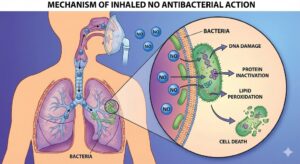
Generated with Gemini
“This study provides a translational foundation rather than a definitive clinical solution,” Binglan Yu, of the Mass General Brigham Department of Anesthesia, Critical Care and Pain Medicine and first author of the paper, said in a statement. “Our findings demonstrate strong preclinical antipseudomonal effects together with reassuring human safety data.”
“These results justify the careful design of phase 2 and phase 3 clinical trials to formally assess clinical efficacy,” added co-first author Bijan Safaee Fakhr, also of the MGB Department of Anesthesia, Critical Care and Pain Medicine.
The researchers demonstrated dose-dependent killing of Pseudomonas aeruginosa using nitric oxide-releasing compounds in vitro. They then showed that pigs with experimental P. aeruginosa pneumonia treated with 300 parts per million iNO exhibited reduced bacterial burden, improved oxygenation and lung compliance, as well as reduced histopathological lung injury compared to untreated pigs.
The team evaluated repeated high-dose iNO exposure in 10 healthy volunteers and two critically ill patients with multidrug-resistant bacterial infections to assess the safety of this method in humans. The treatment was well-tolerated, and no serious safety concerns were observed. A retrospective analysis of patients who received high-dose iNO in clinical settings during the COVID-19 pandemic further supported the safety assessment, showing no adverse outcomes.
“These results suggest a promising strategy that could complement existing treatments,” said senior author Lorenzo Berra, of the MGB Department of Anesthesia, Critical Care and Pain Medicine. “However, rigorous clinical trials are essential before this approach can be considered for routine clinical use.”
Multiple mechanisms diminish bacterial resistance
Nitric oxide kills bacteria through multiple oxidative and nitrosative pathways, including lipid peroxidation, nitrosation of membrane proteins and DNA damage via reactive nitrogen species. At high concentrations, NO covalently binds DNA, proteins and lipids, inhibiting or killing target pathogens.
NO reacts with environmental species such as oxygen or superoxide to produce reactive oxygen and nitrogen species that induce oxidative and nitrosative stress on microbes. The reactive nitrogen species combat pathogens through DNA deamination, S-nitrosylation of thiol groups and lipid peroxidation, disrupting microbial cell membranes and vital protein functions.
These mechanisms attack all aspects of the microbe, deactivating essential enzymes, breaking down the bacterial membrane and directly attacking DNA and its repair systems. The multiple mechanism approach significantly diminishes the risk of bacterial resistance. Serial exposure of NO to five bacteria species at sub-biocidal doses did not result in acquired resistance.