High-power lasers allow researchers to study matter under extreme conditions, pursue fusion energy and support applications from national security to advanced manufacturing. However, the lenses, mirrors and other optical components that guide and shape their beams can be damaged by extreme laser fluence, the amount of laser energy delivered across a given area, or harsh operating environments. Designers reduce the fluence by spreading the energy across larger optical surfaces, but that requires increasingly large and costly components.
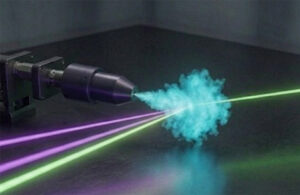
An artist’s rendering shows laser beams creating a transient optical structure in gas that can redirect and shape high-power laser light without relying on damage-prone solid components. (Illustration courtesy of LLNL)
At Lawrence Livermore National Laboratory (LLNL), together with our collaborators at Stanford University, UC Berkeley and LULI Laboratory in France, my colleagues and I are exploring another approach: creating transient optical elements by imprinting diffractive patterns within plasma or gas using a low-energy auxiliary laser. These patterns can then turn the gas or plasma into a diffractive optical element, such as a grating which can deflect a high-power laser, or a holographic lens which can both deflect and focus a laser beam.
This work grew from LLNL research on laser-plasma interactions and cross-beam energy transfer at the National Ignition Facility (NIF). Those studies showed that plasma could be structured to control the flow of laser energy inside a fusion target. The technique helped tune the symmetry of NIF implosions and was crucial to achieving fusion ignition in 2022. We later focused on optical elements that could solve specific problems in high-power laser systems, leading us to gas optics, which in many cases have proved easier to create and control than plasma optics.
The two approaches rely on similar principles, but researchers create the structures differently. In a plasma optic, a laser selectively ionizes portions of a gas, producing a rapidly evolving pattern suited to short-pulse, high-intensity lasers. For gas optics, however, the method pursued by our team uses ultraviolet beams to create patterned heating in an ozone-doped gas. The heating launches waves that modulate the gas density and refractive index, a measure of how much light slows as it passes through a material. The patterned structure can then diffract, or redirect, a high-power laser beam. These gas optics can last from nanoseconds to microseconds, making them better suited to longer, higher-energy pulses.
The transient nature of these elements provides a central advantage. A conventional solid optic exposed to intense laser light, heat or target debris can permanently lose its optical quality. By contrast, gas or plasma optics only need to exist while the laser passes through it; it can then dissipate and be recreated before the next pulse. Solid optics typically withstand fluences on the order of 10 joules per square centimeter, while gas optics have been shown to operate above a kilojoule per square centimeter, more than 100 times that level.
One promising plasma-optics application is replacing the final grating in a chirped-pulse amplification system for ultrashort laser pulses. This technique stretches a laser pulse in time so it can be amplified safely, then compresses it to produce extremely high peak power. The final grating used in that compression receives the full fluence of the beam and limits the intensity the system can deliver. A plasma grating could enable intensities several orders of magnitude beyond those available today.
For gas optics, a compelling application is the final optic that directs laser beams toward a target in a future inertial fusion energy facility. A solid optic in that location would face extreme radiation levels and repeated exposure to debris. A renewable gas optic could perform the same function without accumulating damage. Similar benefits could apply to industrial laser machining and welding, where debris can contaminate conventional lenses.

Pierre Michel, a physicist at Lawrence Livermore National Laboratory, studies how plasma and gas can be structured to control high-power laser light. (Photo courtesy of LLNL)
Drawing on LLNL expertise in laser science, optics, plasma physics, physical chemistry, hydrodynamics and high-energy experimentation, this technology has advanced rapidly. Stanford University experiments have demonstrated gas gratings with greater than 99% diffraction efficiency, comparable to high-quality solid gratings. Researchers also created more than 80,000 gratings during two hours of continuous operation at 10 hertz (10 times per second). More recently, LLNL’s Jupiter Laser Facility demonstrated gas-optics operation in vacuum with laser energies exceeding 100 joules and measured an ionization-related damage threshold near 1.5 to 2 kilojoules per square centimeter.
The next step is to move from individual demonstrations toward integrated prototypes, which will require collaboration with laser developers and commercial partners. For gas optics, one leading application involves testing a final-optics concept at a scale relevant to inertial fusion energy. For plasma optics, the goal is to combine the elements of a pulse compressor into a complete proof-of-principle system. Industry collaborators can help advance these prototype systems and identify applications where transient optics offer the greatest advantage. Success could remove a fundamental constraint on high-power lasers and influence how future laser facilities are designed.

Tell Us What You Think!
You must be logged in to post a comment.