The Artemis II crew has completed its lunar flyby and is embarking on its return trajectory to Earth after setting a new record for the farthest distance humans have ever traveled from our home planet, 252,760 miles.
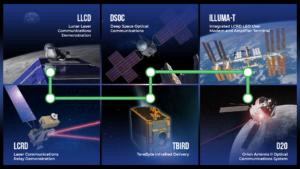
NASA’s Laser Communications Roadmap. Credits: NASA / Dave Ryan
Artemis II is the first crewed mission to the lunar vicinity in over 50 years, since Apollo 17 in 1972. Unlike the Apollo missions, the crew of the Artemis II is using laser communications in addition to radio-frequency (RF) systems. The new system converts data into infrared laser pulses, enabling high-bandwidth throughput, allowing for live 4K video and higher quality images.
O2O: the optical communications system
The mission is testing a new communication system: the Orion Artemis II Optical Communications system, or O2O. The system uses infrared lasers to achieve a downlink rate of 260 Mbps, marking an impressive leap from the kilobit speeds of the Apollo era. O2O also enabled the first live 4K Earthrise and Moonrise broadcasts.
“At 260 megabits per second, O2O is capable of sending down 4K high-definition video from the Moon,” said Steve Horowitz, O2O project manager. “In addition to video and pictures, O2O will transmit and receive procedures, pictures, flight plans, and be a link between Orion and mission control on Earth.”
The system uses the MAScOT terminal: Modular, Agile, Scalable Optical Terminal, which was developed by MIT Lincoln Laboratory in collaboration with NASA Goddard Space Flight Center. O2O is capable of higher-bandwidth data transmissions from space compared to traditional radio-frequency (RF) systems. During the Artemis II mission, O2O is using laser beams to send high-resolution video and images of the lunar surface down to Earth.
“Space-based communications has always been a big challenge,” lead systems engineer Farzana Khatri, a senior staff member in the Laboratory’s Optical and Quantum Communications Group, said in a statement. “RF communications have served their purpose well. However, the RF spectrum is highly congested now, and RF does not scale well to longer distances across space. Laser communication [lasercom] is a solution that could solve this problem, and the Laboratory is an expert in the field, which was really pioneered here.”
The MAScOT Terminal
MAScOT is about the size of a house cat, the lab says, with a 4-inch telescope mounted on a two-axis pivoted support with fixed backend optics. The gimbal precisely points the telescope and tracks the laser beam through which communications signals are emitted and received in the direction of the desired data recipient or sender. Underneath the gimbal, in a separate assembly, are the backend optics, which contain light-focusing lenses, tracking sensors, fast-steering mirrors, and other components to finely point the laser beam.
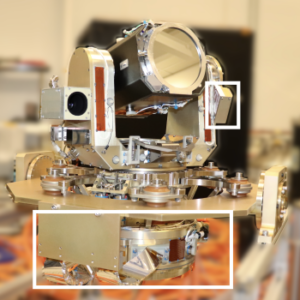
The MAScOT Terminal. Credit: Steven Gillmer/Lincoln Laboratory
The terminal is fixed to the Crew Module Adapter (CMA), which is the ring connecting the Orion capsule to the Service Module. It uses a Master-Oscillator Power-Amplifier (MOPA) architecture with a 1W output and erbium-ytterbium (Er-Yb) co-doped fiber amplifiers (EYDFAs) for high-efficiency signal boosting in the 1.55-micron band.
By day four of the mission, O2O successfully downlinked over 100 GB of data, including the mission’s first 4K ultra-high-definition video tests. The system runs in parallel with the Deep Space Network (DSN) S-band radio.
By the time the crew splashes down off the coast of San Diego on April 10, the terabytes of telemetry downlinked through the O2O laser system, combined with the physical sensor arrays aboard the capsule, will represent the most comprehensive dataset ever gathered on a human-crewed deep-space mission.
Engineers will use the crew’s proximity operations and docking telemetry to refine the interfaces for the Artemis III lunar lander. Furthermore, the high-bandwidth, low-SWaP (Size, Weight, and Power) lasercom infrastructure proven by the MAScOT terminal could establish the new baseline for the Lunar Gateway station and future crewed architectures bound for Mars.