 Not long ago, femtosecond and picosecond lasers were fragile laboratory curiosities that required constant alignment and delicate handling. Today, they are the backbone of a nearly $3 billion market (Mordor Intelligence, Ultrafast Lasers Market Size & Share Analysis). Driven by a shift from legacy Ti:Sapphire systems toward Yb-doped fiber and thin-disk architectures, modern ultrafast sources have become turnkey industrial tools — with leading platforms now rated for continuous 24/7 operation (Ekspla, FemtoLux Industrial Femtosecond Lasers).
That industrial-grade reliability has made high-volume “cold ablation” practical. Burst-mode femtosecond systems can increase cutting speeds by 35–57% on battery electrode foils while producing zero-burr edges on 6 μm material — critical for preventing internal shorts in EV cells (Spectra-Physics/MKS, Lithium-Ion Battery Foil Cutting with Ultrafast Lasers). The same non-thermal precision is equally indispensable for machining sub-20 μm features in semiconductor fabs, cutting foldable OLED displays, and processing heat-sensitive biomaterials like nitinol.
But rapid growth means an overwhelming array of hardware choices. To cut through the noise, we analyzed 86 models from 19 vendors — from 100 W+ kilowatt-class amplifiers to compact, air-cooled oscillators. Whether you’re upgrading a semiconductor line or outfitting a two-photon microscopy lab, this guide maps the competitive landscape and helps you pinpoint the right source.
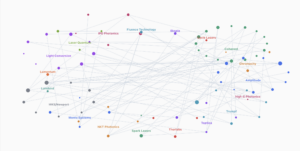
Competitive network map of 86 ultrafast laser models across 19 vendors. Node size reflects the number of competitive relationships; edges represent head-to-head overlaps identified from manufacturer specs and application targeting.
This analysis covers 86 models from 19 vendors, spanning kilowatt-class industrial amplifiers down to compact air-cooled oscillators for two-photon microscopy. All specifications are sourced from manufacturer datasheets and product pages. The full interactive version includes filterable tables, competitive network visualization, and parametric charts.
Market Snapshot
| Subcategory | Models | What They Do |
|---|---|---|
| Amplifiers | 40 | High-power industrial workhorses for cutting, welding, micromachining |
| Oscillators | 25 | Tunable sources for microscopy, spectroscopy, and research |
| Fiber Lasers | 18 | Maintenance-free compact sources; growing fast in biophotonics |
| OEM Modules | 2 | Embeddable laser engines for system integrators |
| Frequency Combs | 1 | Precision metrology and optical clock applications |
In our dataset, Coherent is the most frequently represented vendor, with 16 distinct models captured. Amplitude follows with 11, then MKS/Newport and Light Conversion with 9 each, and Trumpf with 7. Examples include Ekspla with the air-cooled FemtoLux 50, Fluence Technology with the Jasper X1 JX60, Chromacity with lower-cost 920 nm oscillator offerings, and Lumentum with the PicoBlade Core. Taken together, the distribution suggests where our sourcing was richest and where catalogs were broadest in the material we gathered, while also highlighting a widening field of suppliers and product positioning in ultrafast and short-pulse lasers.
Power leaders: Who’s pushing the envelope
| Product | Vendor | Power (W) | Type |
|---|---|---|---|
| Dira 1000-5 | Trumpf | 1,000 | Amplifier |
| TruMicro 9010 | Trumpf | 1,000 | Amplifier |
| Dira 500-10 | Trumpf | 500 | Amplifier |
| TruMicro 6030 | Trumpf | 300 | Amplifier |
| Tangor 300 | Amplitude | 300 | Amplifier |
| YLPP-R Series 200W | IPG Photonics | 200 | Fiber Laser |
| IceFyre FS IR200 | MKS/Newport | 200 | Amplifier |
Trumpf dominates the high-power tier with four models above 200W, including two kilowatt-class platforms (Dira 1000-5 and TruMicro 9010) targeting EV battery and semiconductor applications.
The 920 nm battleground: Two-photon microscopy
The 920 nm wavelength sits at the center of modern two-photon calcium imaging because it efficiently excites common GCaMP indicators while still penetrating relatively deeply through scattering tissue. In practice, that makes 920 nm a common configuration for many neuroscience labs, so competition here is less about novelty and more about who can deliver the most usable photons at the sample, with the least operational friction, day after day.
That emphasis on usability explains why this has become one of the most crowded segments in our dataset: 9 models from 7 vendors now overlap at 920 nm. This category spans everything from high-power “workhorse” boxes designed to push imaging speed and depth, to lower-cost systems aimed at labs replacing aging Ti:Sapphire setups. The raw power spread is wide, but average power alone is not the whole story.
| Product | Vendor | Power (W) | Cooling | Positioning |
|---|---|---|---|---|
| ALCOR 920 v9 | Spark Lasers | 5.0 | Air | Workhorse |
| CRONUS-2P | Light Conversion | 3.0 | Water | Flagship |
| Axon 920-2 | Coherent | 2.5 | Air | Workhorse |
| FemtoFiber ultra 920 | Toptica | 1.5 | Air | Workhorse |
| FOCUS 920 | Amplitude | 1.3 | Air | Niche |
| Axon 920-1 | Coherent | 1.2 | Air | Value |
| Axon 920 FP | Coherent | 1.0 | Air | Workhorse |
| Chromacity 920 | Chromacity | 1.0 | Air | Value |
| FemtoFiber ultra FD | Toptica | 0.5 | Air | Value |
Spark Lasers’ ALCOR 920 v9 leads on power (5W air-cooled) in the dataset, while Chromacity’s 920, launched at Photonics West 2023, targets budget-conscious labs at a fraction of traditional Ti:Sapph pricing. Notably, 8 of 9 models are air-cooled, reflecting the biophotonics market’s demand for maintenance-free operation.
UV femtosecond
Six models in our dataset provide UV output below 400 nm, a capability increasingly sought for micromachining tasks where longer wavelengths struggle, such as thin-film patterning, glass and transparent polymer processing, and scribing on sensitive multilayer stacks. Moving into the UV tightens the interaction volume and can boost absorption in materials that are partially transparent at 1030 nm or 1064 nm, which helps enable cleaner edges and smaller features with less heat-affected damage.
| Product | Vendor | Wavelength | Power (W) |
|---|---|---|---|
| IceFyre FS UV50 | MKS/Newport | 343 nm | 50 |
| CARBIDE-CB3-UV-50W | Light Conversion | 343 nm | 50 |
| ULPF/ULPP-R Series 50W | IPG Photonics | 343 nm | 50 |
| Monaco UV 345-38-30 | Coherent | 345 nm | 30 |
| TruMicro 6320 | Trumpf | 343 nm | 30 |
| IPG 10W Deep UV 266nm | IPG Photonics | 266 nm | 10 |
2025–2026: 23 New Launches
The pace of new introductions underscores the market’s momentum. Key launches include:
- Trumpf TruMicro 9010 — kilowatt-class (1,000W) amplifier targeting high-volume EV battery and semiconductor production
- Amplitude Satsuma X-50 — 50W platform with GHz Burst and FemtoBurst modes; won the Secret Light Innovation Award in June 2025
- Light Conversion CARBIDE-CB3-UV-50W — 50W UV at 343 nm, expanding the CARBIDE platform into UV processing
- Ekspla FemtoLux 50 — 50W air-cooled amplifier with Direct Refrigerant Cooling, >90,000 hr MTBF
- Fluence Technology Jasper X1 JX60 — 60W newcomer from a Trumpf spin-off
- Lumentum PicoBlade Core — 150W amplifier, Lumentum’s first dedicated ultrafast industrial platform
- MKS/Newport Solstice APX — 7W Ti:Sapphire regenerative amplifier with 7 mJ pulse energy for attosecond science
Methodology
Specifications are primarily sourced from manufacturer datasheets, product pages, and published technical documentation. Where noted, a small number of values are inferred from predecessor models or procurement records. Pricing data is available for only 3 models, typical of quote-based B2B laser markets. Data current as of February 2026.
Explore the full dataset: The interactive version includes filterable product tables with 86 models, competitive network visualization showing 105 COMPETES_WITH relationships, power vs. pulse energy scatter plots, and expandable product cards with full specs and source links.
Sources: Mordor Intelligence (market sizing), Ekspla (MTBF data), Spectra-Physics/MKS (battery foil cutting data). Full provenance tracking available in the interactive guide.