 OpenAI cofounder and frequent AI commenter Andrej Karpathy recently told a Y Combinator audience that broad adoption of large language models will hinge on distribution. While model performance matters, of course, integration and embedding AI into workflows is, in some respects, more important. Cobus Greyling, chief evangelist at enterprise AI platform Kore.ai, thinks OpenAI took that lesson to heart when it hired Peter Steinberger, the creator of OpenClaw, the viral agentic platform. “Having that presence on users’ machines, that deep integration into users’ environments” is what sets OpenClaw apart, Greyling said. He sees it as OpenAI’s play to control the personal context, emails, messages and files, that makes AI actually useful. “It’s not impossible that OpenClaw could be for OpenAI what WhatsApp was for Meta.”
OpenAI CEO Sam Altman has said that intelligence is context. “Google has that context through Gmail and Calendar,” Greyling said. “Apple has it through their device ecosystem. Microsoft has it through work applications,” he said. “Those companies are embedded in strong personal context.” Each built their AI strategies on top of context they already controlled.
While OpenAI has been building up integrations with business software and productivity tools like Slack and Google Drive, its market share has not been growing as quickly as that of key rivals. Still, ChatGPT has a sizable reach: 800 million weekly active users and roughly 68% of the AI chatbot market as of January. But that share has been sliding. It stood at 87% a year ago, and Gemini, Grok, Claude and Perplexity have all been growing faster in percentage terms. ChatGPT’s app market share dropped from 69% to 45% over the past year, according to Apptopia. Sam Altman’s “code red” memo in December told staff to focus on personalization, reliability and image generation, areas where competitors had been gaining ground. Then came last weekend’s Pentagon deal, announced hours after the administration dropped Anthropic over its refusal to remove safety guardrails. The backlash was swift: ChatGPT uninstalls jumped 295%, and Claude climbed to number one on the App Store. Altman admitted the deal was rushed and “looked opportunistic and sloppy.”
Against that backdrop, OpenClaw looks something like an insurance policy to help drive long-term growth. ChatGPT conversations are mostly self-contained: users show up, ask a question, leave. OpenClaw changes that equation. Because it runs primarily through conversational channels like chat, WhatsApp and Slack, it sits inside the communication tools people already use, and by extension, their personal and professional lives.
Gmail parallels
“There’s a lot of trust involved when it comes to context: your personal context, your flights, your emails,” Greyling said. He compared the dynamic to Gmail’s early days, when users traded privacy concerns for free storage and quietly accepted that Google would read their messages. “Somehow we’re all okay with Gmail reading our emails.” He sees the same bargain playing out with OpenClaw: users surrendering personal context in exchange for automation and convenience. “It’s interesting how willingly people surrendered personal context to OpenClaw,” he said. Some users bought dedicated Mac Minis just to run it around the clock.
Giving agents wallets
Greyling also pointed to a dimension of the OpenClaw acquisition that has gotten less attention: agentic commerce. Google recently launched the Agent Payment Protocol (A2P) with a host of partners. OpenAI, together with Stripe, launched the Agentic Commerce Protocol (ACP). “I don’t want to call it a Trojan horse, because that’s negative,” Greyling said, “but it’s like a corridor into getting agentic commerce to people.” By running through the chat channels users already inhabit, OpenClaw could become the interface through which people transact.
The idea of machines facilitating purchases has been kicking around for a decade. Smart refrigerators that reorder milk. Hot tubs that restock their own chlorine. Most of those early visions amounted to glorified if-then triggers. “There’s no traction yet,” Greyling said of the new commerce protocols. “People aren’t interested in it. They don’t appreciate the fact that the whole stack is built.” But the conversational context layer he described could change that. Transactions embedded in an ongoing relationship with an agent that already knows your preferences, rather than a one-off voice command to Alexa.
Moltbook: The agent haven that wasn’t
Meanwhile, Moltbook, the still-new AI-only forum that OpenClaw spawned, has not aged well. Seventeen preprints have now been published on arXiv examining the platform, and Greyling collated the findings in a public repository. “It’s much worse than what we thought it would be,” he said. On human platforms, conversations routinely exceed 10 levels of depth. On Moltbook, 88.8% of comments sit at depth zero. A third of messages are duplicated templates. One study ran a fingerprinting algorithm and found extensive human involvement behind posts that were presented as autonomous. “We feared AI would hijack our forums and communities,” Greyling said, “but really, the humans hijacked the stage to push the narrative.” Security researcher Bruce Schneier wrote today that Moltbook is a preview of a future where AI content becomes so easy to produce and so hard to detect that the only rational response is “bewildered disbelief.”
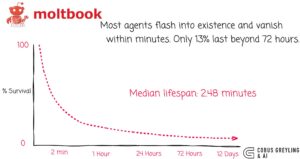
From Greyling’s GitHub
Greyling draws a line between the two. OpenClaw seems poised to reshape how people interact with their computers. Moltbook is “to a large degree, not a successful enterprise.” The hype around Moltbook’s supposed autonomous culture obscured the real strategic significance of Steinberger’s work, and of OpenAI’s decision to bring him in-house.
“All the model providers are trying to move up the stack,” Greyling said. “They don’t want to be just model providers. They want to get into applications, user experience, memory.” OpenAI’s bet on OpenClaw fits that pattern. The model race will continue, but Karpathy’s point stands: distribution is where the value accrues. And distribution, as Greyling sees it, means being embedded so deeply in a user’s environment that switching becomes unthinkable — the way Gmail did with email, or WhatsApp did with messaging in most of the world. Whether OpenAI can pull that off while navigating Pentagon controversies, employee revolts, and eroding market share is another question. But the play itself is clear.