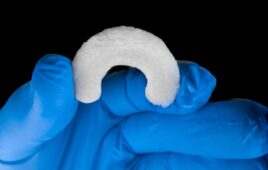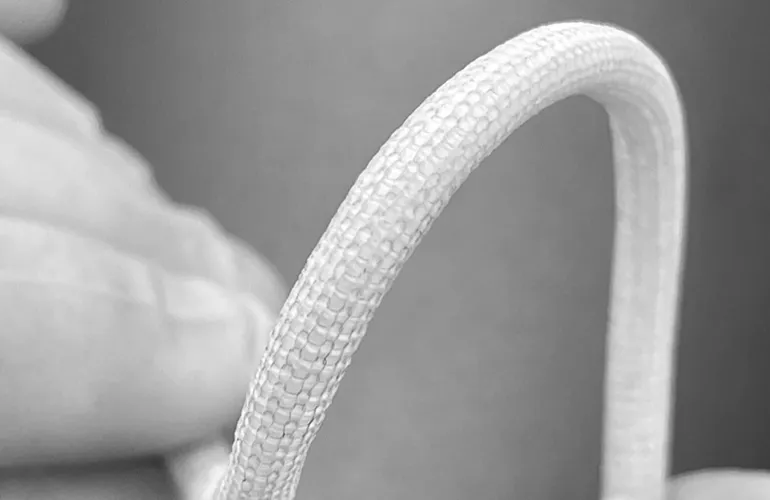
Medical 21’s MAVERICS artificial artery graft, featuring a nitinol wire matrix and resorbable polymer. [Photo courtesy of Medical 21]
The free, three-day series pairs Arrowfly editors with industry leaders, plus live audience Q&A. Each session runs 9–10 a.m. Pacific (noon–1 p.m. Eastern).
- August 18: Manny Villafaña, founder of Cardiac Pacemakers Inc. and ATS Medical, will speak with MDO Associate Editor Skyler Rivera about identifying unmet needs, regulatory strategy and what a five-decade run of company building taught him about R&D. His current venture, Medical 21, is developing a resorbable polymer and nitinol artificial artery intended to eliminate vessel harvesting in bypass surgery. Villafaña was also pivotal in introducing a long-life, lithium-iodine pacemaker, which is still widely used today. In 1976, he founded St. Jude Medical, where his team developed the first bileaflet mechanical heart valve. In a recent interview with MDO, Villafaña said his novel Maverics artificial graft could have a total addressable market in the range of $15 billion to $20 billion.
- August 19: MDO Managing Editor Jim Hammerand will interview Dopl Technologies co-founder and CEO Ryan James, who was a software engineer at Microsoft and Nvidia before teaming up with two physicians to build teleprocedure robotics. Dopl is developing a platform that lets a remotely located sonographer operate a robotic arm and ultrasound probe on a patient elsewhere, using haptic feedback to sense probe pressure. The system runs on off-the-shelf robots and probes rather than proprietary hardware. The company started in minimally invasive cardiac ablation, pivoted to remote ultrasound and closed a $6.3 million seed round in July, with plans to submit for FDA review in 2027.
- August 20: DeviceTalks Editorial Director Tom Salemi will sit down with LEM Surgical CEO Yossi Bar for a discussion on autonomous surgical robotics, touching on what it will take to get there and which surgical field will lead. Bern, Switzerland-based LEM won FDA clearance in 2025 for Dynamis, a multi-arm robotic platform for spine and other hard-tissue procedures. Two of its three arms handle surgical guidance, while the third carries the navigation camera. All are deployed from a single cart that sits partially under the operating table. The system remains surgeon-controlled.
Full session details and free registration are available at Medical Design & Outsourcing.