Research & Development World

  • R&D World Home
  • Topics
    • Aerospace
    • Automotive
    • Biotech
    • Careers
    • Chemistry
    • Environment
    • Energy
    • Life Science
    • Material Science
    • R&D Management
    • Physics
  • Technology
    • 3D Printing
    • A.I./Robotics
    • Software
    • Battery Technology
    • Controlled Environments
      • Cleanrooms
      • Graphene
      • Lasers
      • Regulations/Standards
      • Sensors
    • Imaging
    • Nanotechnology
    • Scientific Computing
      • Big Data
      • HPC/Supercomputing
      • Informatics
      • Security
    • Semiconductors
  • R&D Market Pulse
  • R&D 100
    • 2025 R&D 100 Award Winners
    • 2025 Professional Award Winners
    • 2025 Special Recognition Winners
    • R&D 100 Awards Event
    • R&D 100 Submissions
    • Winner Archive
  • Resources
    • Research Reports
    • Digital Issues
    • Educational Assets
    • Subscribe
    • Video
    • Webinars
    • Content submission guidelines for R&D World
  • Global Funding Forecast
  • Top Labs
  • Advertise
  • SUBSCRIBE

Brain implant lets paralyzed patients type with their thoughts at near-able-bodied speeds

By Julia Rock-Torcivia | March 17, 2026

A new brain implant is helping people type using their minds. A study published in Nature Neuroscience by investigators from Mass General Brigham Neuroscience Institute and Brown University describes an investigational implantable brain-computer interface (iBCI) typing neuroprosthesis. 
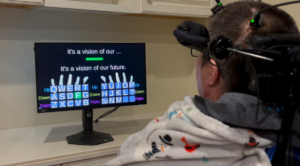
A patient using the iBCI to type. Credit: Brown University

The tool uses a QWERTY keyboard and attempted finger movements, which are decoded accurately with as few as 30 calibration sentences, according to the paper. Sentence decoding is improved using a five-gram language model. 

From motor cortex to keyboard

The typing neuroprosthesis performed well for two iBCI clinical trial participants with tetraplegia, one with amyotrophic lateral sclerosis (ALS) and one with a spinal cord injury. The participants calibrated their devices with as few as 30 sentences; one participant was able to reach a top typing speed of 110 characters or 22 words per minute, with a word error rate of 1.6%. This resembles able-bodied typing accuracy and provides higher throughput than current state-of-the-art hand motor iBCI decoding.

“For many people with paralysis, when losing use of both the hands and the muscles of speech, communication can become difficult or impossible,” said senior author Dr. Daniel Rubin, a critical care neurologist with the Center for Neurotechnology and Neurorecovery at Mass General Brigham Neuroscience Institute. “Often, people with severe speech and motor impairments end up relying on things like eye-gaze technology — spelling words out one letter at a time by using an eye movement tracking system. Those systems take far too long for many users. BCIs are on track to become an important new alternative to what’s currently offered.”

The new BrainGate iBCI typing neuroprosthesis starts with microelectrode sensors placed in the motor cortex, a part of the brain that controls movement. Next, a QWERTY keyboard is displayed in front of the participant, with each letter mapped onto fingers and finger positions — up, down or curled. As the participant intuitively attempts these finger movements, the electrodes sense the brain’s electrical activity, then send a signal to a computer system that can translate the neural activity into letters. This output is then processed through a final predictive language model to ensure a cohesive, accurate communication result.

What’s next for the technology

“Decoding these finger movements is also a big step toward being able to restore complex reach and grasp movements for people with upper extremity paralysis,” said first and corresponding author Justin Jude, a postdoctoral researcher at Mass General Brigham. “And there’s also room to make this communication tool better — like implementing a stenography or otherwise personalized keyboard to make typing even faster. Our BCI is a great example of how modern neuroscience and artificial intelligence technology can combine to create something capable of restoring communication and independence for people with paralysis.”

Related Articles Read More >

Boltz built its drug-discovery API ‘for agents as much as for people’
NVIDIA Announces BioNeMo Agent Toolkit with traction from nearly 50 partners, including Lilly, Thermo Fisher and Dassault
MilliporeSigma’s CTO on AI retrosynthesis, the Merck KGaA–Siemens deal and the chemistry that runs the autonomous lab
Medable’s Digital Data Flow Agent focuses on protocol translation as the agentic race accelerates
rd newsletter
EXPAND YOUR KNOWLEDGE AND STAY CONNECTED
Get the latest info on technologies, trends, and strategies in Research & Development.

R&D World Digital Issues

Fall 2025 issue

Browse the most current issue of R&D World and back issues in an easy to use high quality format. Clip, share and download with the leading R&D magazine today.

R&D 100 Awards
Research & Development World
  • Subscribe to R&D World Magazine
  • Sign up for R&D World’s newsletter
  • Contact Us
  • About Us
  • Drug Discovery & Development
  • Pharmaceutical Processing
  • Global Funding Forecast

Copyright © 2026 WTWH Media LLC. All Rights Reserved. The material on this site may not be reproduced, distributed, transmitted, cached or otherwise used, except with the prior written permission of WTWH Media
Privacy Policy | Advertising | About Us

Search R&D World

  • R&D World Home
  • Topics
    • Aerospace
    • Automotive
    • Biotech
    • Careers
    • Chemistry
    • Environment
    • Energy
    • Life Science
    • Material Science
    • R&D Management
    • Physics
  • Technology
    • 3D Printing
    • A.I./Robotics
    • Software
    • Battery Technology
    • Controlled Environments
      • Cleanrooms
      • Graphene
      • Lasers
      • Regulations/Standards
      • Sensors
    • Imaging
    • Nanotechnology
    • Scientific Computing
      • Big Data
      • HPC/Supercomputing
      • Informatics
      • Security
    • Semiconductors
  • R&D Market Pulse
  • R&D 100
    • 2025 R&D 100 Award Winners
    • 2025 Professional Award Winners
    • 2025 Special Recognition Winners
    • R&D 100 Awards Event
    • R&D 100 Submissions
    • Winner Archive
  • Resources
    • Research Reports
    • Digital Issues
    • Educational Assets
    • Subscribe
    • Video
    • Webinars
    • Content submission guidelines for R&D World
  • Global Funding Forecast
  • Top Labs
  • Advertise
  • SUBSCRIBE