Research & Development World

  • R&D World Home
  • Topics
    • Aerospace
    • Automotive
    • Biotech
    • Careers
    • Chemistry
    • Environment
    • Energy
    • Life Science
    • Material Science
    • R&D Management
    • Physics
  • Technology
    • 3D Printing
    • A.I./Robotics
    • Software
    • Battery Technology
    • Controlled Environments
      • Cleanrooms
      • Graphene
      • Lasers
      • Regulations/Standards
      • Sensors
    • Imaging
    • Nanotechnology
    • Scientific Computing
      • Big Data
      • HPC/Supercomputing
      • Informatics
      • Security
    • Semiconductors
  • R&D Market Pulse
  • R&D 100
    • 2026 R&D 100 Award Winners
    • 2026 Professional Award Winners
    • 2026 Special Recognition Winners
    • R&D 100 Awards Event
    • R&D 100 Submissions
    • Winner Archive
  • Resources
    • Research Reports
    • Digital Issues
    • Educational Assets
    • Subscribe
    • Video
    • Webinars
    • PharmSci360
    • Content submission guidelines for R&D World
  • Global Funding Forecast
  • Top Labs
  • Advertise
  • SUBSCRIBE

Mapping Species Range Shifts Under Recent Climatic Changes

By Hokkaido University | July 12, 2018

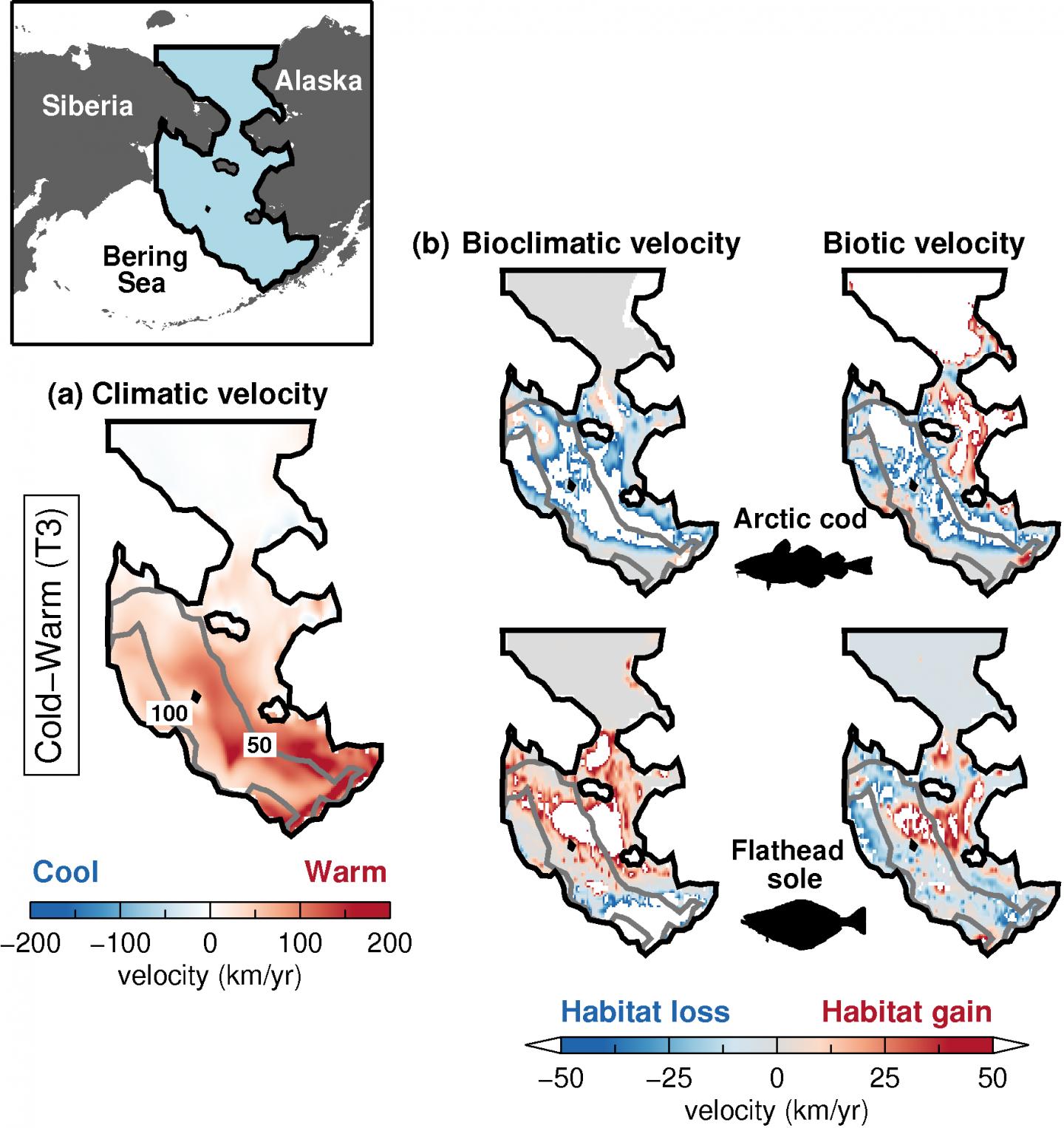
(a) Rates of local climatic change, (b) expected (bioclimatic velocity) and observed (biotic velocity) distribution responses for the Arctic cod (cold-adapted species) and Flathead sole (warm-water species) across a cold to warm climate transition in the eastern Bering Sea (inset map for geographic reference). Cold to warm transition provides favorable conditions for warm-adapted species while creates unsuitable environment for cold-water taxon. Credit: Hokkaido University

The inclusion of taxon-specific sensitivity to a shifting climate helps us understand species distributional responses to changes in climate.

Marine species in the eastern Bering Sea are not shifting their distribution ranges fast enough to keep track of current changes in climate, according to a study led by researchers at Hokkaido University.

As global climate change alters sea temperatures and environmental conditions, marine species need to track these signals at a sufficient pace to remain within their climatic habitat. However, lags in distributional responses to temperature shifts have been documented in terrestrial and aquatic taxa, as species range dynamics are also influenced by factors other than climate.

Irene Alabia, a fisheries oceanographer at Hokkaido University’s Arctic Research Center, led a study to evaluate multi-taxa responses to contrasting climatic regimes in the eastern Bering Sea, defined by persistent stanzas of regional warming and cooling. She worked with colleagues at Hokkaido University and the University of Alaska Fairbanks to examine potential distributions of 21 fish and invertebrate species in the eastern Bering Sea between 1993 and 2016. These were generated from multi-ensemble habitat models correlating taxon-specific occurrences to suite of climatic (winter sea surface temperature) and environmental factors (winter sea ice cover and depth).

Using satellite-derived environmental data and species data from bottom trawl surveys, the team compared rates of local climatic change (climatic velocity) to both observed (data-driven) and expected (model-driven) species distributional responses. They found that the climatic velocities were poorly correlated with observed and expected distributional responses, underpinning the importance of incorporating species-specific sensitivity to climate variation when predicting rates of range shifts in response to climatic changes. Further, most of the species examined were trailing behind climate change, potentially increasing their vulnerability to future climate fluctuations.

“Our results can be useful for reinforcing current conservation and management efforts, and help develop adaptive management strategies to deal with varying impacts of climate changes to marine resources in the region,” says Irene Alabia of Hokkaido University. The study was published in the journal Diversity and Distributions.

Related Articles Read More >

Big Tech now spends almost 3x more on R&D than Big Pharma 
Inside the Lab: NARI’s Ga-68 Dolacga measures liver function CT scans can’t see
Verily secures new investment from Nvidia
How Lantern Med Digital is helping build the digital layer of Costa Rica’s medtech boom
rd newsletter
EXPAND YOUR KNOWLEDGE AND STAY CONNECTED
Get the latest info on technologies, trends, and strategies in Research & Development.

R&D World Digital Issues

Fall 2025 issue

Browse the most current issue of R&D World and back issues in an easy to use high quality format. Clip, share and download with the leading R&D magazine today.

R&D 100 Awards
Research & Development World
  • Subscribe to R&D World Magazine
  • Sign up for R&D World’s newsletter
  • Contact Us
  • About Us
  • Drug Discovery & Development
  • Pharmaceutical Processing
  • Global Funding Forecast

Copyright © 2026 Arrowfly LLC. All Rights Reserved. The material on this site may not be reproduced, distributed, transmitted, cached or otherwise used, except with the prior written permission of Arrowfly
Privacy Policy | Advertising | About Us

Search R&D World

  • R&D World Home
  • Topics
    • Aerospace
    • Automotive
    • Biotech
    • Careers
    • Chemistry
    • Environment
    • Energy
    • Life Science
    • Material Science
    • R&D Management
    • Physics
  • Technology
    • 3D Printing
    • A.I./Robotics
    • Software
    • Battery Technology
    • Controlled Environments
      • Cleanrooms
      • Graphene
      • Lasers
      • Regulations/Standards
      • Sensors
    • Imaging
    • Nanotechnology
    • Scientific Computing
      • Big Data
      • HPC/Supercomputing
      • Informatics
      • Security
    • Semiconductors
  • R&D Market Pulse
  • R&D 100
    • 2026 R&D 100 Award Winners
    • 2026 Professional Award Winners
    • 2026 Special Recognition Winners
    • R&D 100 Awards Event
    • R&D 100 Submissions
    • Winner Archive
  • Resources
    • Research Reports
    • Digital Issues
    • Educational Assets
    • Subscribe
    • Video
    • Webinars
    • PharmSci360
    • Content submission guidelines for R&D World
  • Global Funding Forecast
  • Top Labs
  • Advertise
  • SUBSCRIBE