Research & Development World

  • R&D World Home
  • Topics
    • Aerospace
    • Automotive
    • Biotech
    • Careers
    • Chemistry
    • Environment
    • Energy
    • Life Science
    • Material Science
    • R&D Management
    • Physics
  • Technology
    • 3D Printing
    • A.I./Robotics
    • Software
    • Battery Technology
    • Controlled Environments
      • Cleanrooms
      • Graphene
      • Lasers
      • Regulations/Standards
      • Sensors
    • Imaging
    • Nanotechnology
    • Scientific Computing
      • Big Data
      • HPC/Supercomputing
      • Informatics
      • Security
    • Semiconductors
  • R&D Market Pulse
  • R&D 100
    • 2025 R&D 100 Award Winners
    • 2025 Professional Award Winners
    • 2025 Special Recognition Winners
    • R&D 100 Awards Event
    • R&D 100 Submissions
    • Winner Archive
  • Resources
    • Research Reports
    • Digital Issues
    • Educational Assets
    • R&D Index
    • Subscribe
    • Video
    • Webinars
    • Content submission guidelines for R&D World
  • Global Funding Forecast
  • Top Labs
  • Advertise
  • SUBSCRIBE

Microscopy Advance Reveals Unexpected Role for Water in Energy Storage Material

By North Carolina State University | May 24, 2018

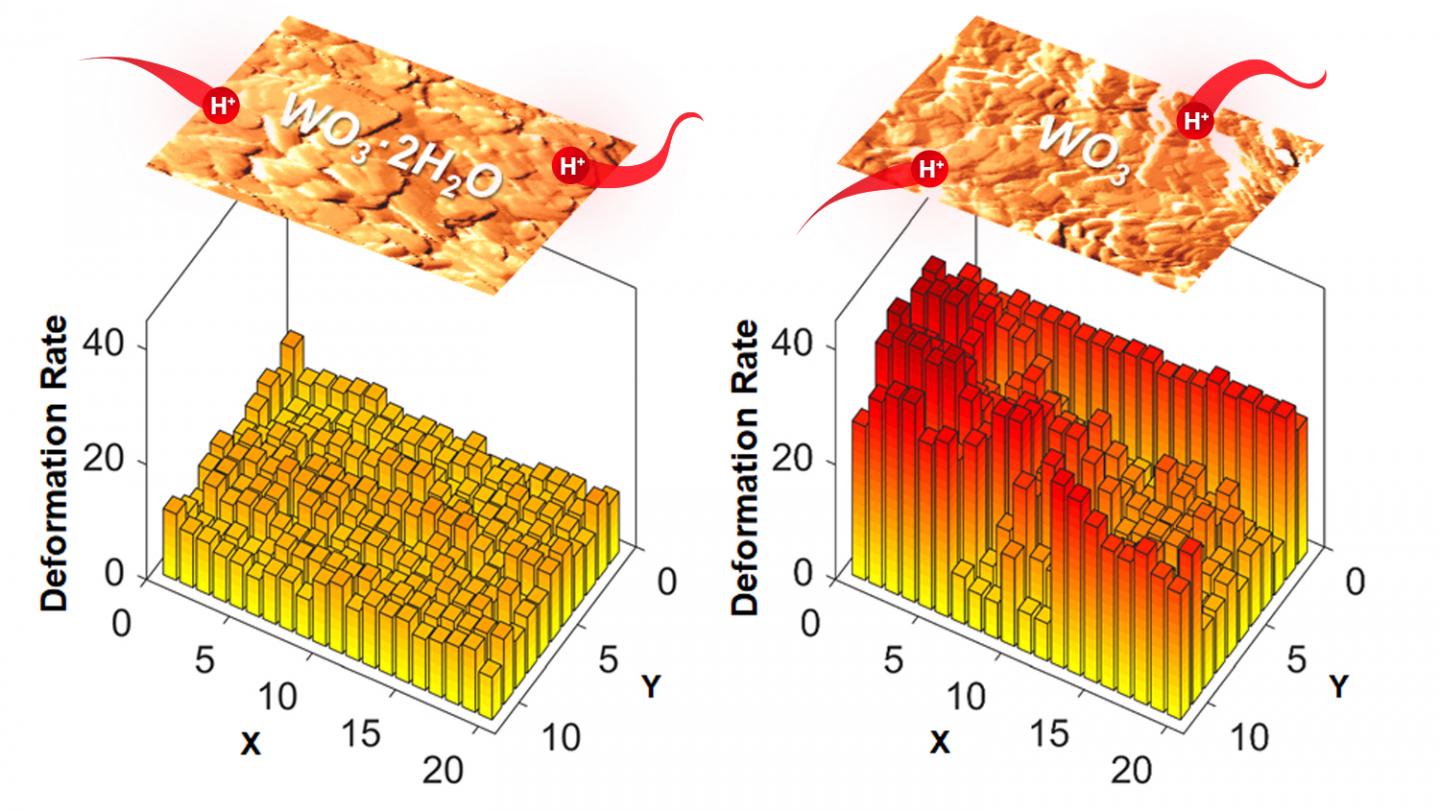
Atomic force microscopy reveals that structural water in tungsten oxide results in smaller deformation rates from ion intercalation, an unexpected finding on the role of structural water that can enable materials with higher power and efficiency energy storage devices.

A material with atomically thin layers of water holds promise for energy storage technologies, and researchers have now discovered that the water is performing a different role than anyone anticipated. The finding was possible due to a new atomic force microscopy (AFM) method that measures the sub-nanoscale deformation rate in the material in response to changes in the material caused by energy storage.

The researchers studied crystalline tungsten oxide dihydrate, which consists of crystalline tungsten oxide layers separated by atomically thin layers of water. The material is of interest because it holds promise for helping to store and release energy quickly and efficiently. However, it has not been clear what role the water plays in this process.

To address this question, researchers from North Carolina State University, the Oak Ridge National Laboratory (ORNL) and Texas A&M University used a new methodology. The new technique relies on AFM to track the expansion and contraction of the material at the atomic scale and in real time as an electronic instrument called a potentiostat moves charge in and out of the material. This technique allowed the team to detect even minor deformations in the material as charge moved through it.

“We tested both crystalline tungsten oxide dihydrate and crystalline tungsten oxide – which lacks the water layers,” says Veronica Augustyn, an assistant professor of materials science and engineering at NC State and corresponding author of a paper on the work. “And we found that the water layers appear to play a significant role in how the material responds mechanically to energy storage.”

“Specifically, we found that the water layers do two things,” says Ruocun “John” Wang, a Ph.D. student in Augustyn’s lab and lead author of the paper. “One, the water layers minimize deformation, meaning that the material expands and contracts less as ions move in and out of the material when there are water layers. Two, the water layers make the deformation more reversible, meaning that the material returns to its original dimensions more easily.”

“In practical terms, this means that the material with water layers is more efficient at storing charge, losing less energy,” Augustyn says.


Related Articles Read More >

Gadolyn names Jack Lifton advisory board chair, adds Gareth Hatch
Lead-free piezoelectric material converts motion to power without lead
R&D 100 Winners protecting nuclear materials
R&D Winners turn fruit waste into ‘leather’
rd newsletter
EXPAND YOUR KNOWLEDGE AND STAY CONNECTED
Get the latest info on technologies, trends, and strategies in Research & Development.
RD 25 Power Index

R&D World Digital Issues

Fall 2025 issue

Browse the most current issue of R&D World and back issues in an easy to use high quality format. Clip, share and download with the leading R&D magazine today.

Research & Development World
  • Subscribe to R&D World Magazine
  • Sign up for R&D World’s newsletter
  • Contact Us
  • About Us
  • Drug Discovery & Development
  • Pharmaceutical Processing
  • Global Funding Forecast

Copyright © 2025 WTWH Media LLC. All Rights Reserved. The material on this site may not be reproduced, distributed, transmitted, cached or otherwise used, except with the prior written permission of WTWH Media
Privacy Policy | Advertising | About Us

Search R&D World

  • R&D World Home
  • Topics
    • Aerospace
    • Automotive
    • Biotech
    • Careers
    • Chemistry
    • Environment
    • Energy
    • Life Science
    • Material Science
    • R&D Management
    • Physics
  • Technology
    • 3D Printing
    • A.I./Robotics
    • Software
    • Battery Technology
    • Controlled Environments
      • Cleanrooms
      • Graphene
      • Lasers
      • Regulations/Standards
      • Sensors
    • Imaging
    • Nanotechnology
    • Scientific Computing
      • Big Data
      • HPC/Supercomputing
      • Informatics
      • Security
    • Semiconductors
  • R&D Market Pulse
  • R&D 100
    • 2025 R&D 100 Award Winners
    • 2025 Professional Award Winners
    • 2025 Special Recognition Winners
    • R&D 100 Awards Event
    • R&D 100 Submissions
    • Winner Archive
  • Resources
    • Research Reports
    • Digital Issues
    • Educational Assets
    • R&D Index
    • Subscribe
    • Video
    • Webinars
    • Content submission guidelines for R&D World
  • Global Funding Forecast
  • Top Labs
  • Advertise
  • SUBSCRIBE