Research & Development World

  • R&D World Home
  • Topics
    • Aerospace
    • Automotive
    • Biotech
    • Careers
    • Chemistry
    • Environment
    • Energy
    • Life Science
    • Material Science
    • R&D Management
    • Physics
  • Technology
    • 3D Printing
    • A.I./Robotics
    • Software
    • Battery Technology
    • Controlled Environments
      • Cleanrooms
      • Graphene
      • Lasers
      • Regulations/Standards
      • Sensors
    • Imaging
    • Nanotechnology
    • Scientific Computing
      • Big Data
      • HPC/Supercomputing
      • Informatics
      • Security
    • Semiconductors
  • R&D Market Pulse
  • R&D 100
    • 2026 R&D 100 Award Winners
    • 2026 Professional Award Winners
    • 2026 Special Recognition Winners
    • R&D 100 Awards Event
    • R&D 100 Submissions
    • Winner Archive
  • Resources
    • Research Reports
    • Digital Issues
    • Educational Assets
    • Subscribe
    • Video
    • Webinars
    • PharmSci360
    • Content submission guidelines for R&D World
  • Global Funding Forecast
  • Top Labs
  • Advertise
  • SUBSCRIBE

Modified ‘White Graphene’ For Eco-Friendly Energy

By Tomsk Polytechnic University | April 22, 2019

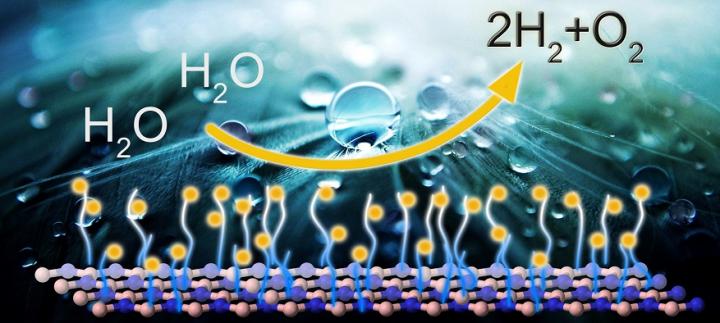
This is a catalyst with functionalized hexagonal boron nitride and nickel nanoparticles. Credit: Tomsk Polytechnic University

Scientists from TPU, Germany, and the United States have found a new way to functionalize a dielectric, otherwise known as ‘white graphene’, i.e. hexagonal boron nitride (hBN), without destroying it or changing its properties. Thanks to the new method, the researchers synthesized a ‘polymer nano carpet’ with strong covalent bond on the samples.

Prof Raul Rodriguez from the TPU Research School of Chemistry & Applied Biomedical Sciences explains:

‘For the first time, we have managed to covalently functionalize hexagonal boron nitride without strong chemical compositions and the introduction of new defects into the material. In fact, earlier approaches had resulted in a different material with altered properties, i.e. hydrolyzed boron nitride. In our turn, we used nanodefects existing in the material without increasing their number, and eco-friendly photopolymerization.’

One of the promising options for using the new material, according to researchers, is catalysts for splitting water in hydrogen and oxygen. With this in view, ‘polymer carpets’ functioned as carriers of active substances, i.e. matrices. Nickel nanoparticles were integrated into the matrix. Catalysts obtained were used for electrocatalysis. Studies showed that they could be successfully used as an alternative to expensive platinum or gold.

‘One of the important challenges in catalysis is forcing the starting material to reach active centers of the catalyst. ‘Polymer carpets’ form a 3D structure that helps to increase the area of contact of the active centers of the catalyst with water and makes hydrogen acquisition more efficient. It is very promising for the production of environmentally friendly hydrogen fuel,’ – says the scientist.

Boron nitride is a binary compound of boron and nitrogen. While, hexagonal boron nitride or ‘white graphene’ is a white talc-like powder with hexagonal, graphene-like lattice. It is resistant to high temperatures and chemical substances, nontoxic, has a very low coefficient of friction, and functions both as a perfect dielectric and as a good heat conductor. Boron-nitride materials are widely used in the reactions of industrial organic synthesis, in the cracking of oil, for the manufacturing of products of high-temperature technology, the production of semiconductors, means for extinguishing fires, and so on.

Previously, a number of studies were devoted to functionalization of hexagonal boron nitride. Typically, this process uses strong chemical oxidants that not only destroy the material but also significantly change its properties. The method, which TPU scientists and their foreign colleagues use, allows them to avoid this.

‘Studies have shown that we obtained homogenous and durable ‘polymer carpets’ which can be removed from the supporting substrate and used separately. What is more, this is a fairly universal technology since for functionalization we used different monomers which allow obtaining materials with properties optimal for use in various devices,’ – says Prof Raul Rodriguez.

Related Articles Read More >

INL’s $60 million nuclear AI project will spend the first year testing where AI agents can help and where they might hurt 
The Space Systems Division (05)-developed Parallelogram Synchronized Truss Assembly (PaSTA), seen Aug. 12, 2025, is a mechanism that will be integrated into the Life-Extension In-orbit Servicer (LEXI) and Astroscale Prototype Servicer for Refueling (APS-R) spacecrafts.
One SwRI R&D 100 winner turns buckled fiberglass into a spacecraft truss. The other models freight rail with 900 hours of BNSF field data
Inside the Lab: NETL’s Oil and Gas Center of Excellence focuses on technologies to enhance production   
Inside S&C Electric’s and Argonne National Lab’s CRADA partnership
rd newsletter
EXPAND YOUR KNOWLEDGE AND STAY CONNECTED
Get the latest info on technologies, trends, and strategies in Research & Development.

R&D World Digital Issues

Fall 2025 issue

Browse the most current issue of R&D World and back issues in an easy to use high quality format. Clip, share and download with the leading R&D magazine today.

R&D 100 Awards
Research & Development World
  • Subscribe to R&D World Magazine
  • Sign up for R&D World’s newsletter
  • Contact Us
  • About Us
  • Drug Discovery & Development
  • Pharmaceutical Processing
  • Global Funding Forecast

Copyright © 2026 Arrowfly LLC. All Rights Reserved. The material on this site may not be reproduced, distributed, transmitted, cached or otherwise used, except with the prior written permission of Arrowfly
Privacy Policy | Advertising | About Us

Search R&D World

  • R&D World Home
  • Topics
    • Aerospace
    • Automotive
    • Biotech
    • Careers
    • Chemistry
    • Environment
    • Energy
    • Life Science
    • Material Science
    • R&D Management
    • Physics
  • Technology
    • 3D Printing
    • A.I./Robotics
    • Software
    • Battery Technology
    • Controlled Environments
      • Cleanrooms
      • Graphene
      • Lasers
      • Regulations/Standards
      • Sensors
    • Imaging
    • Nanotechnology
    • Scientific Computing
      • Big Data
      • HPC/Supercomputing
      • Informatics
      • Security
    • Semiconductors
  • R&D Market Pulse
  • R&D 100
    • 2026 R&D 100 Award Winners
    • 2026 Professional Award Winners
    • 2026 Special Recognition Winners
    • R&D 100 Awards Event
    • R&D 100 Submissions
    • Winner Archive
  • Resources
    • Research Reports
    • Digital Issues
    • Educational Assets
    • Subscribe
    • Video
    • Webinars
    • PharmSci360
    • Content submission guidelines for R&D World
  • Global Funding Forecast
  • Top Labs
  • Advertise
  • SUBSCRIBE