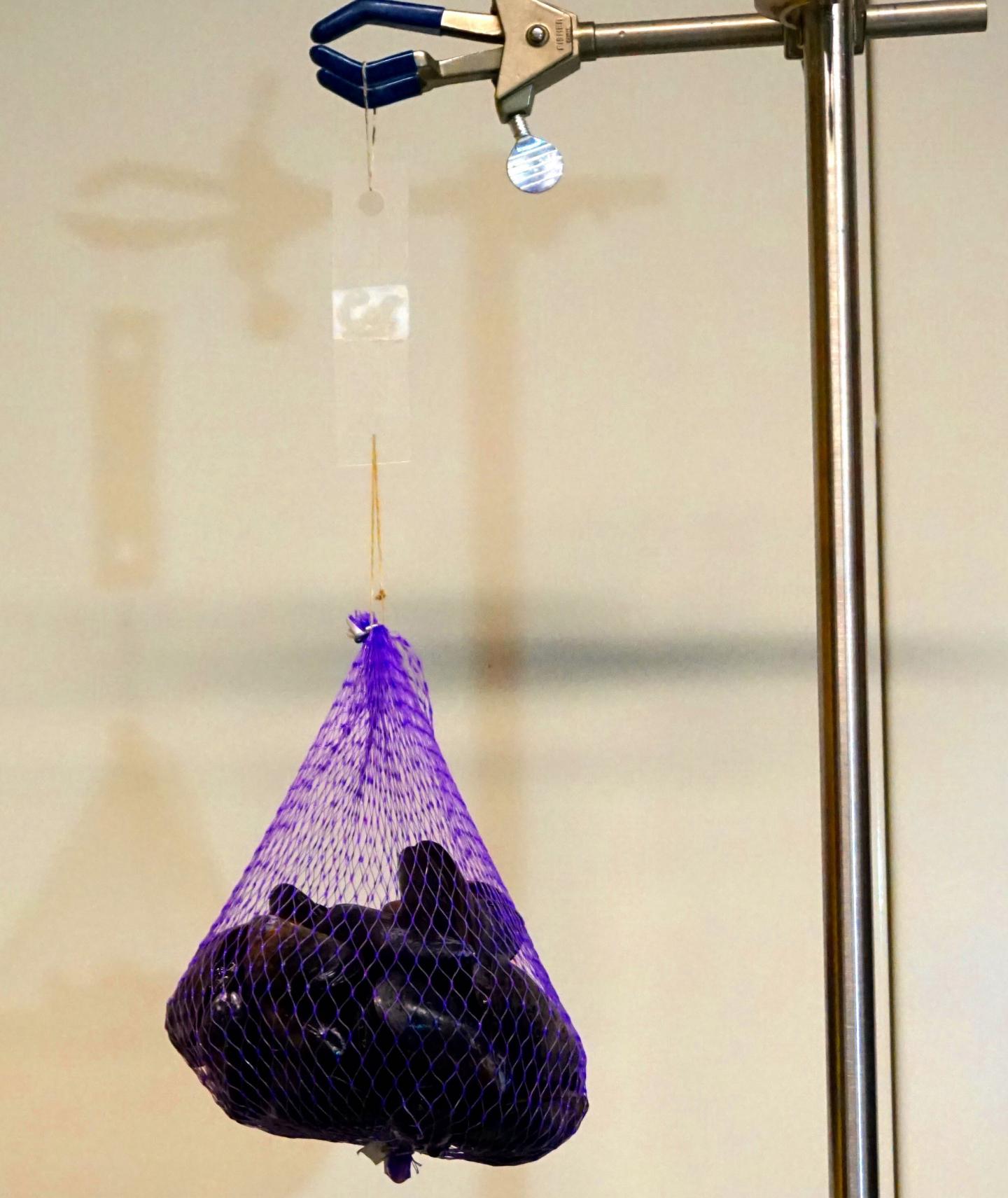
A glue based on a mussel adhesive is strong enough to suspend a bag of shellfish. Credit: Diederik Balkenende
Whether to perform surgery on a fetus is a heart-wrenching decision. This type of surgery involves penetrating the highly delicate amniotic sac, increasing health risks to the fetus. Now researchers report the development of a glue, inspired by the tenacious grip of mussels on slippery rocks, that could one day help save the lives of the youngest patients.
The researchers are presenting their findings today at the 254th National Meeting & Exposition of the American Chemical Society (ACS). ACS, the world’s largest scientific society, is holding the meeting here through Thursday. It features nearly 9,400 presentations on a wide range of science topics.
“One of the biggest risks in performing surgery on fetuses is not the surgical procedure itself, but the insertion of a fetal scope through the amniotic sac, which is very fragile,” Diederik Balkenende, Ph.D., says. “After the surgery, the small hole where the scope penetrated the membrane can start to tear. If it tears completely, premature labor is likely. Because these operations are often done in the second trimester well before the fetus is fully developed, early delivery increases the risk of fetal morbidity. An adhesive that can prevent the amniotic sac from tearing could help the fetus remain in the womb longer, which would potentially lead to a healthier future for the baby.”
A well-known example of a severe birth defect that would make a fetus a candidate for surgery is spina bifida. It’s a condition in which the neural tube — the part that becomes the baby’s brain and spinal cord — doesn’t develop or close properly.
To fix such problems a few decades ago, surgeons had to cut open a woman’s abdomen and womb. Now, doctors can use skinny endoscopic tools to perform operations through a small hole. Still, to reach the fetus, the instruments must penetrate the amniotic sac, which cannot heal or easily be sewn shut because it is so fragile. Sealing it with an adhesive is a challenge because the membrane is wet; additionally, delivering a surgical glue post-operation is a major hurdle.
To address the problem of wet adhesion, researchers have turned to mussels for inspiration. Mussels produce sticky substances that allow them to cling to rocks and ship hulls in wet environments, even under pounding waves. Developing mimics of these substances for surgical use involves turning them into hydrogels. But this conversion so far has required chemical crosslinkers that could be toxic to fetuses.
Balkenende, a postdoctoral researcher in the lab of Philip Messersmith, Ph.D., at the University of California, Berkeley wanted to eliminate the crosslinkers. So he infused an adhesive ingredient from the mussel foot called dihydroxyphenylalanine, or DOPA, into a special polymer that can dissolve in a biocompatible solvent. The solution can then be drawn into a syringe. To test their material, the researchers used pieces of a membrane that surrounds a cow’s heart as a model of the amniotic sac. They applied the solution with the syringe to overlapping pieces of the wet, filmy tissues. On contact with moisture on the tissues, the mixture immediately became rubbery. After about an hour, the glue set and held the pieces together.
But even with the right polymer and solvent, the researchers still needed to figure out how the solution might work in a real surgery.
“Repairing a hole in the amniotic sac is a daunting engineering challenge,” Messersmith says. “So in addition to the novel polymer that we’re making, we’re approaching its delivery from a new angle, which is what we call pre-sealing. Injecting the liquid polymer between the inner wall of the uterus and the amniotic sac and letting it harden before surgery could provide the mechanical support needed to prevent the hole from tearing and causing a catastrophic rupture.”
Getting the adhesive into clinical practice will take additional work. The researchers are still perfecting their glue and examining biocompatibility. Preclinical testing in animals also has to be completed, Balkenende says.