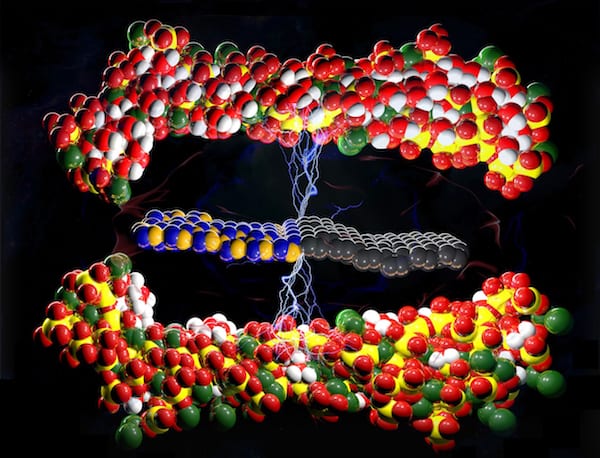
Ceramics with networked nanosheets of graphene and white graphene would have the unique ability to alter their electrical properties when strained, according to a researcher at Rice University. The surprising ability could lead to new types of structural sensors. Image: Illustration by Rouzbeh Shahsavari
A ceramic that becomes more electrically conductive under elastic strain and less conductive under plastic strain could lead to a new generation of sensors embedded into structures like buildings, bridges and aircraft able to monitor their own health.
The electrical disparity fostered by the two types of strain was not obvious until Rice University’s Rouzbeh Shahsavari, an assistant professor of civil and environmental engineering and of materials science and nanoengineering, and his colleagues modeled a novel two-dimensional compound, graphene-boron-nitride (GBN).
Under elastic strain, the internal structure of a material stretched like a rubber band does not change. But the same material under plastic strain—caused in this case by stretching it far enough beyond elasticity to deform—distorts its crystalline lattice. GBN, it turns out, shows different electrical properties in each case, making it a worthy candidate as a structural sensor.
Shahsavari had already determined that hexagonal-boron nitride—aka white graphene—can improve the properties of ceramics. He and his colleagues have now discovered that adding graphene makes them even stronger and more versatile, along with their surprising electrical properties.
The magic lies in the ability of two-dimensional, carbon-based graphene and white graphene to bond with each other in a variety of ways, depending on their relative concentrations. Though graphene and white graphene naturally avoid water, causing them to clump, the combined nanosheets easily disperse in a slurry during the ceramic’s manufacture.
The resulting ceramics, according to the authors’ theoretical models, would become tunable semiconductors with enhanced elasticity, strength and ductility.
The research led by Shahsavari and Asghar Habibnejad Korayem, an assistant professor of structural engineering at Iran University of Science and Technology and a research fellow at Monash University in Melbourne, Australia, appears in the American Chemical Society journal Applied Materials and Interfaces.
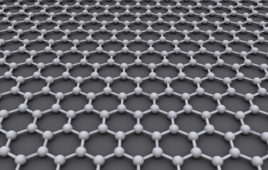
Graphene is a well-studied form of carbon known for its lack of a band gap—the region an electron has to leap to make a material conductive. With no band gap, graphene is a metallic conductor. White graphene, with its wide band gap, is an insulator. So the greater the ratio of graphene in the 2D compound, the more conductive the material will be.
Mixed into the ceramic in a high enough concentration, the 2D compound dubbed GBN would form a network as conductive as the amount of carbon in the matrix allows. That gives the overall composite a tunable band gap that could lend itself to a variety of electrical applications.
“Fusing 2D materials like graphene and boron nitride in ceramics and cements enables new compositions and properties we can’t achieve with either graphene or boron nitride by themselves,” Shahsavari said.
The team used density functional theory calculations to model variations of the 2D compound mixed with tobermorite, a calcium silicate hydrate material commonly used as cement for concrete. They determined the oxygen-boron bonds formed in the ceramic would turn it into a p-type semiconductor.
Tobermorite by itself has a large band gap of about 4.5 electron volts, but the researchers calculated that when mixed with GBN nanosheets of equal parts graphene and white graphene, that gap would shrink to 0.624 electron volts.
When strained in the elastic regime, the ceramic’s band gap dropped, making the material more conductive, but when stretched beyond elasticity—that is, in the plastic regime—it became less conductive. That switch, the researchers said, makes it a promising material for self-sensing and structural health monitoring applications.
The researchers suggested other 2D sheets with molybdenum disulfide, niobium diselenide or layered double hydroxides may provide similar opportunities for the bottom-up design of tunable, multifunctional composites.
“This would provide a fundamental platform for cement and concrete reinforcement at their smallest possible dimension,” Shahsavari said.
Co-authors of the paper are graduate students Ehsan Hosseini and Mohammad Zakertabrizi of the Iran University of Science and Technology. The National Science Foundation and the Australian Research Council supported the research.