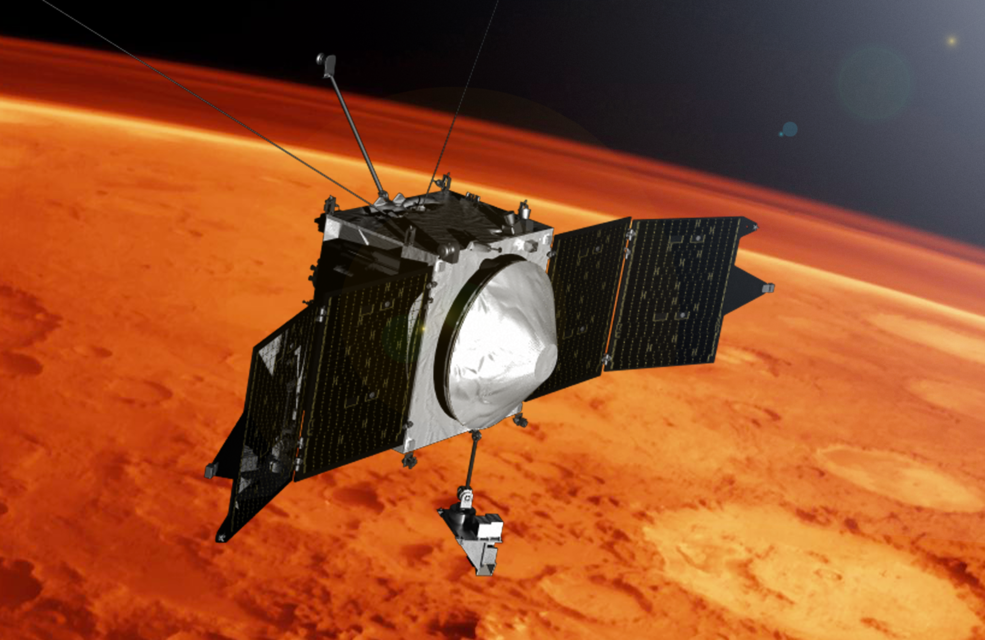
There is metal in the atmosphere of the Red Planet, according to new NASA research.
Using NASA’s MAVEN (Mars Atmosphere and Volatile Evolution Mission) spacecraft, astronomers have discovered that Mars has electrically charged metal atoms (ions) high in its atmosphere that can reveal previously invisible activity in the mysterious electrically charged upper atmosphere or ionosphere of Mars.
“MAVEN has made the first direct detection of the permanent presence of metal ions in the ionosphere of a planet other than Earth,” Joseph Grebowsky of NASA’s Goddard Space Flight Center in Greenbelt, Maryland, said in a statement. “Because metallic ions have long lifetimes and are transported far from their region of origin by neutral winds and electric fields, they can be used to infer motion in the ionosphere, similar to the way we use a lofted leaf to reveal which way the wind is blowing.”
MAVEN is exploring the Martian upper atmosphere to better understand how Mars lost the majority of its air, transforming from a world that could have supported life billions of years ago into a cold desert planet today. By understanding ionosphere activity researchers can better explain how the Martian atmosphere is being lost to space.
The researchers said that metal comes from a constant rain of tiny meteoroids onto Mars, and when a high-speed meteoroid hits the Martian atmosphere it vaporizes.
According to the researchers, metal atoms in the vapor trail get some of their electrons torn away by other charged atoms and molecules in the ionosphere, which transforms the metal atoms into electrically charged ions.
Astronomers have detected iron, magnesium and sodium in the upper atmosphere of Mars over the last two years using MAVEN’s Neutral Gas and Ion Mass Spectrometer instrument. This has given the team the confidence that the metal ions are a permanent feature.
“We detected metal ions associated with the close passage of Comet Siding Spring in 2014, but that was a unique event and it didn’t tell us about the long-term presence of the ions,” Grebowsky said.
The interplanetary dust that causes the meteor showers is common throughout the solar system, making it likely that all solar system planets and moons with substantial atmospheres have metal ions, according to the researchers.
They have detected metal ion layers high in the atmosphere above Earth using sounding rockets, radar and satellite measurements. There has also been indirect evidence for metal ions above other planets in the solar system and when spacecraft are exploring these worlds from orbit, sometimes their radio signals pass through the planet’s atmosphere on the way to Earth and sometimes portions of the signals have been blocked.
The researchers believe this is interference from electrons in the ionosphere, some of which are thought to be associated with metal ions but long-term direct detection of the metal ions by MAVEN is the first conclusive evidence that these ions exist on another planet and that they are permanent feature there.
The team also found that the metal ions behaved different on Mars than on Earth, where they were surrounded by a global magnetic field generated in its interior. This magnetic field together with ionospheric winds forces the metal ions into layers.
However, Mars has only local magnetic fields fossilized in certain regions of its crust and the researchers only saw the layers near these areas.