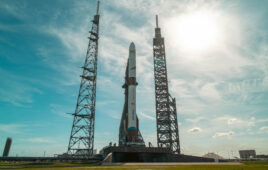
NASA’s Artemis II mission is scheduled to launch this Wednesday evening from the Kennedy Space Center in Florida. The mission is a 10-day journey around the moon, marking the first launch towards the moon since 1972.
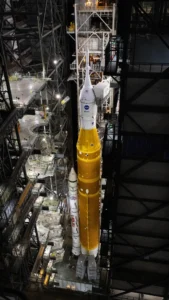
NASA’s crawler-transporter 2, carrying the agency’s Artemis II SLS (Space Launch System) rocket with the Orion spacecraft, arrives Feb. 25, 2026, inside the Vehicle Assembly Building at NASA’s Kennedy Space Center in Florida to troubleshoot the flow of helium to the rocket’s upper stage, the interim cryogenic propulsion stage. Once complete, the SLS rocket will roll back to Launch Complex 39B to prepare to launch four astronauts around the Moon and back for the Artemis II test flight.
Credit: NASA/Cory Huston
The crew includes three NASA astronauts: Reid Wiseman, Christina Koch and Victor Glover and one Canadian astronaut: Jeremy Hansen. They will not land on the lunar surface, but the mission is designed as a step toward a lunar landing in 2028.
The crew will be the first people aboard NASA’s giant Space Launch System moon rocket and Orion capsule. The technology has been tested with an uncrewed mission, Artemis I, around the moon in 2022.
NASA plans to livestream the launch on its YouTube channel, starting at 12:50 p.m. ET.
Countdown logistics and weather prospects
The astronauts arrived in Florida on Friday and have been in medical quarantine in preparation for the mission. Forecasters are predicting an 80% chance of acceptable weather, with a 20% chance of high winds and thick clouds that could pose problems.
The countdown is set to start this evening, with the launch team arriving at their stations at L-49 hours, 50 minutes and the countdown beginning at L-49 hours, 40 minutes.
The rocket and spacecraft will then be prepared for launch, with propellant loading beginning at around L-9 hours, 55 minutes. At the four-hour mark, the crew is strapped into the Orion capsule and, if all goes to plan, at T-6.36 seconds, the RS-25 engines start up, followed by the solid rocket boosters.
Testing life-support systems in Earth orbit
The astronauts will spend the first day of the mission orbiting Earth and testing Orion’s life-support systems, which regulate temperature, air quality, drinking water, food and waste systems. On the second day, the spacecraft’s main engines will fire to put it on a path towards the moon.
Over the next four days, the astronauts will test how well the Orion capsule protects against space radiation and demonstrate procedures for emergencies and other situations to prepare for future Artemis missions. Artemis III was originally planned as a lunar landing, but has been repurposed as a low Earth orbit test of lunar landing technologies. Artemis IV is set to be the first landing mission, scheduled for 2028.
The Artemis II crew is scheduled to circle the moon on April 6, coming within about 6,000 miles of the lunar surface. As they swing around the moon, the crew could travel farther from Earth than humans ever have before, possibly besting the Apollo 13 record of 248,655 miles. They will also lose communications with Earth for anywhere from 30 to 50 minutes.
During the mission, the crew will become the first people to see some parts of the moon up close and in person, spending most of the day taking photos and videos and recording observations.
The capsule will then spend the next several days journeying back to Earth, landing in the Pacific Ocean off the coast of San Diego on April 10.
The mission was originally supposed to launch in February, but hydrogen fuel leaks and trouble pressurizing the rocket’s upper stage propulsion system caused the launch to be pushed to April 1.
“I will tell you, the four of us, we are ready to go. The team is ready to go, and the vehicle is ready to go,” Wiseman said in a press conference on Sunday.