Research & Development World

  • R&D World Home
  • Topics
    • Aerospace
    • Automotive
    • Biotech
    • Careers
    • Chemistry
    • Environment
    • Energy
    • Life Science
    • Material Science
    • R&D Management
    • Physics
  • Technology
    • 3D Printing
    • A.I./Robotics
    • Software
    • Battery Technology
    • Controlled Environments
      • Cleanrooms
      • Graphene
      • Lasers
      • Regulations/Standards
      • Sensors
    • Imaging
    • Nanotechnology
    • Scientific Computing
      • Big Data
      • HPC/Supercomputing
      • Informatics
      • Security
    • Semiconductors
  • R&D Market Pulse
  • R&D 100
    • 2025 R&D 100 Award Winners
    • 2025 Professional Award Winners
    • 2025 Special Recognition Winners
    • R&D 100 Awards Event
    • R&D 100 Submissions
    • Winner Archive
  • Resources
    • Research Reports
    • Digital Issues
    • Educational Assets
    • Subscribe
    • Video
    • Webinars
    • Content submission guidelines for R&D World
  • Global Funding Forecast
  • Top Labs
  • Advertise
  • SUBSCRIBE

New AI model offers faster, adaptive CO₂ retrieval from satellite data

By Heather Hall | March 21, 2025

A team of researchers from Shanghai Jiao Tong University and the Chinese Academy of Sciences has developed a new artificial intelligence-based model for retrieving atmospheric carbon dioxide (CO₂) concentrations from satellite data. The Spectrum Transformer (SpT) model is designed to address long-standing challenges in real-time global CO₂ monitoring.
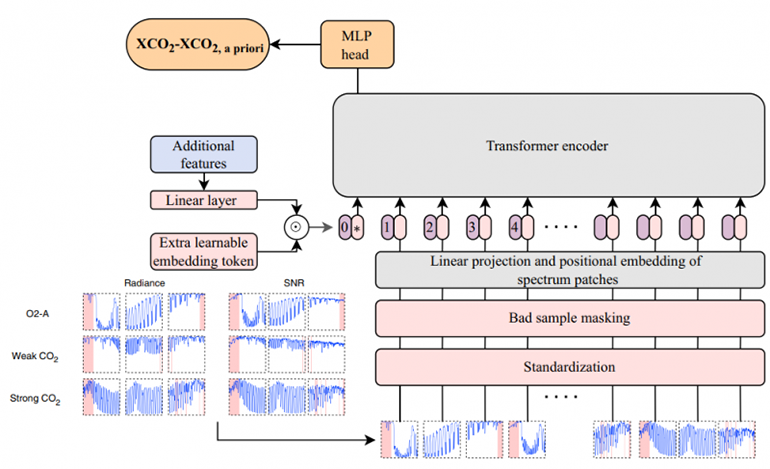
Credit: Journal of Remote Sensing
The architecture of the SpT model. The red background of the spectral block is used to indicate the corresponding position of the bad spectral element.

Published in the Journal of Remote Sensing, the work presents an alternative to conventional CO₂ retrieval methods, which typically rely on iterative radiative transfer simulations. While physically rigorous, these traditional approaches are computationally intensive and often struggle to adapt to the long-term rise in global atmospheric CO₂ levels. This results in slower processing and accuracy drift over time.

The SpT model uses a Transformer-based deep learning architecture to extract CO₂ concentrations from satellite spectral data. Transformer models, which have been widely adopted in natural language processing, can identify complex patterns across large datasets. However, they have only recently been applied to remote sensing problems.

Trained on NASA’s OCO-2 satellite observations from 2017 to 2019, the model could generalize beyond the training period with a root mean square error (RMSE) of approximately 1.5 parts per million (ppm). Fine-tuning the model with a limited updated data set reduced the error to around 1.2 ppm. The model’s output was validated using ground-based measurements from the Total Carbon Column Observing Network (TCCON), showing strong agreement and capturing seasonal and regional variability.

One of the model’s key features is its processing efficiency. According to the authors, SpT reduces retrieval times for each data point from several minutes to milliseconds, making it suitable for near-real-time global analysis. The model processes radiance and signal-to-noise ratio (SNR) measurements by dividing them into spectral blocks and incorporating additional environmental parameters such as solar zenith angle and surface pressure.

The study emphasizes the potential role of SpT in future satellite missions, where increased spatial and spectral resolution will place greater demands on computational performance. “By reducing computational costs and improving accuracy, we can now provide near-real-time data that is crucial for climate policy and carbon cycle studies,” said Dr. Tao Ren, who led the research.

The SpT model was implemented in PyTorch and trained using the Adam optimizer with a cosine annealing learning rate schedule. A Huber loss function was used to account for potential outliers. Data processing, training, and evaluation scripts are publicly available to support reproducibility.

While several research groups have explored machine learning methods for retrieving greenhouse gases, this study appears to be the first to apply a full Transformer architecture for real-time CO₂ estimation at global scales. The authors suggest extending the approach to other greenhouse gases in future work.

The project was funded by the National Natural Science Foundation of China (Grants No. 52276077 and 52120105009). The full study is available at DOI: 10.34133/remotesensing.0470.

Related Articles Read More >

How Atomis is using AI simulations to commercialize MOFs
Claude Mythos by Anthropic mobile logo app on a screen smartphone. Claude is a family of large language models developed by Anthropic. Batumi, Georgia - March 26, 2026
How Opus 4.8 compares to Claude Mythos and GPT 5.5
AI workflow automation artificial intelligence agent software interface nodes triggers data tool dashboard coding icon flow process database technology 3d rendering.
How can organizations move AI from token maxxing to production value?
OpenAI launches Rosalind Biodefense, offers federal agencies early access to its life-sciences model
rd newsletter
EXPAND YOUR KNOWLEDGE AND STAY CONNECTED
Get the latest info on technologies, trends, and strategies in Research & Development.

R&D World Digital Issues

Fall 2025 issue

Browse the most current issue of R&D World and back issues in an easy to use high quality format. Clip, share and download with the leading R&D magazine today.

R&D 100 Awards
Research & Development World
  • Subscribe to R&D World Magazine
  • Sign up for R&D World’s newsletter
  • Contact Us
  • About Us
  • Drug Discovery & Development
  • Pharmaceutical Processing
  • Global Funding Forecast

Copyright © 2026 WTWH Media LLC. All Rights Reserved. The material on this site may not be reproduced, distributed, transmitted, cached or otherwise used, except with the prior written permission of WTWH Media
Privacy Policy | Advertising | About Us

Search R&D World

  • R&D World Home
  • Topics
    • Aerospace
    • Automotive
    • Biotech
    • Careers
    • Chemistry
    • Environment
    • Energy
    • Life Science
    • Material Science
    • R&D Management
    • Physics
  • Technology
    • 3D Printing
    • A.I./Robotics
    • Software
    • Battery Technology
    • Controlled Environments
      • Cleanrooms
      • Graphene
      • Lasers
      • Regulations/Standards
      • Sensors
    • Imaging
    • Nanotechnology
    • Scientific Computing
      • Big Data
      • HPC/Supercomputing
      • Informatics
      • Security
    • Semiconductors
  • R&D Market Pulse
  • R&D 100
    • 2025 R&D 100 Award Winners
    • 2025 Professional Award Winners
    • 2025 Special Recognition Winners
    • R&D 100 Awards Event
    • R&D 100 Submissions
    • Winner Archive
  • Resources
    • Research Reports
    • Digital Issues
    • Educational Assets
    • Subscribe
    • Video
    • Webinars
    • Content submission guidelines for R&D World
  • Global Funding Forecast
  • Top Labs
  • Advertise
  • SUBSCRIBE