Research & Development World

  • R&D World Home
  • Topics
    • Aerospace
    • Automotive
    • Biotech
    • Careers
    • Chemistry
    • Environment
    • Energy
    • Life Science
    • Material Science
    • R&D Management
    • Physics
  • Technology
    • 3D Printing
    • A.I./Robotics
    • Software
    • Battery Technology
    • Controlled Environments
      • Cleanrooms
      • Graphene
      • Lasers
      • Regulations/Standards
      • Sensors
    • Imaging
    • Nanotechnology
    • Scientific Computing
      • Big Data
      • HPC/Supercomputing
      • Informatics
      • Security
    • Semiconductors
  • R&D Market Pulse
  • R&D 100
    • 2025 R&D 100 Award Winners
    • 2025 Professional Award Winners
    • 2025 Special Recognition Winners
    • R&D 100 Awards Event
    • R&D 100 Submissions
    • Winner Archive
  • Resources
    • Research Reports
    • Digital Issues
    • Educational Assets
    • Subscribe
    • Video
    • Webinars
    • Content submission guidelines for R&D World
  • Global Funding Forecast
  • Top Labs
  • Advertise
  • SUBSCRIBE

New evidence suggests Einstein’s cosmological constant isn’t actually constant

By Brian Buntz | March 24, 2025

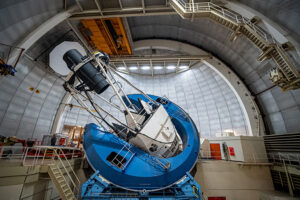
The DESI instrument and can capture light from up to 5,000 celestial objects simultaneously.

The DESI instrument and can capture light from up to 5,000 celestial objects simultaneously. (Image courtesy of Marilyn Sargent/Berkeley Lab)

For decades, cosmologists have treated dark energy, an elusive force driving the universe’s accelerated expansion, as a constant, static entity, represented by Einstein’s cosmological constant (Λ). New findings, however, now challenge this assumption. Multiple analyses, including data from the Dark Energy Spectroscopic Instrument (DESI), suggest dark energy’s influence may have changed over cosmic time. The DESI results hint that dark energy was stronger in the past and has weakened as the universe aged. This conclusion would directly contradict the idea of a fixed Λ and raising the possibility that dark energy is dynamic.

Scientists arrived at this idea by comparing the universe’s expansion history across two landmark surveys: DESI mapped 15 million galaxies, and the Dark Energy Survey (DES), which analyzed supernovae and galaxy clustering. Both teams found mismatches with predictions from a constant dark energy model, but when allowing for dark energy to vary over time, the data aligned neatly. “We’re guided by Occam’s razor, and the simplest explanation for what we see is shifting,” said Will Percival, co-spokesperson for DESI was quoted as saying in a Berkeley Lab press release. “It’s looking more and more like we may need to modify our standard model of cosmology to make these different datasets make sense together — and evolving dark energy seems promising.”

The statistical significance of the dark energy evolution signal is in the range of roughly 3–4σ (sigma) depending on the data combination, which is strong evidence but just shy of the roughly 5σ threshold typically required to declare a discovery in physics. (See: Is Dark Energy Getting Weaker? New Evidence Strengthens the Case. | Quanta Magazine)

The case for evolving dark energy gains credibility through multiple independent sources converging on the same conclusion. Despite using fundamentally different methods, both DES analyzing supernovae explosions and galaxy clustering patterns, and DESI creating a map stretching back 11 billion years, with similar findings. This convergence strengthens the findings, reducing the likelihood of systematic errors or observational flukes, as a post from UT Dallas noted. Both teams continue gathering data to potentially push beyond the 5σ threshold, which would firmly establish the discovery.

Related Articles Read More >

Senate largely hearing splits on party lines over proposed $5.6 billion NASA cut
Days after Artemis II, White House seeks 23% NASA cut that would slash science 47%
NASA is making an explicit systems engineering bet with Artemis: if you want a reliable landing, you do not skip the integrated tests.
This black hole’s jet is already a trillion Death Stars strong. Scientists say it won’t peak until 2027.
rd newsletter
EXPAND YOUR KNOWLEDGE AND STAY CONNECTED
Get the latest info on technologies, trends, and strategies in Research & Development.

R&D World Digital Issues

Fall 2025 issue

Browse the most current issue of R&D World and back issues in an easy to use high quality format. Clip, share and download with the leading R&D magazine today.

R&D 100 Awards
Research & Development World
  • Subscribe to R&D World Magazine
  • Sign up for R&D World’s newsletter
  • Contact Us
  • About Us
  • Drug Discovery & Development
  • Pharmaceutical Processing
  • Global Funding Forecast

Copyright © 2026 WTWH Media LLC. All Rights Reserved. The material on this site may not be reproduced, distributed, transmitted, cached or otherwise used, except with the prior written permission of WTWH Media
Privacy Policy | Advertising | About Us

Search R&D World

  • R&D World Home
  • Topics
    • Aerospace
    • Automotive
    • Biotech
    • Careers
    • Chemistry
    • Environment
    • Energy
    • Life Science
    • Material Science
    • R&D Management
    • Physics
  • Technology
    • 3D Printing
    • A.I./Robotics
    • Software
    • Battery Technology
    • Controlled Environments
      • Cleanrooms
      • Graphene
      • Lasers
      • Regulations/Standards
      • Sensors
    • Imaging
    • Nanotechnology
    • Scientific Computing
      • Big Data
      • HPC/Supercomputing
      • Informatics
      • Security
    • Semiconductors
  • R&D Market Pulse
  • R&D 100
    • 2025 R&D 100 Award Winners
    • 2025 Professional Award Winners
    • 2025 Special Recognition Winners
    • R&D 100 Awards Event
    • R&D 100 Submissions
    • Winner Archive
  • Resources
    • Research Reports
    • Digital Issues
    • Educational Assets
    • Subscribe
    • Video
    • Webinars
    • Content submission guidelines for R&D World
  • Global Funding Forecast
  • Top Labs
  • Advertise
  • SUBSCRIBE