Research & Development World

  • R&D World Home
  • Topics
    • Aerospace
    • Automotive
    • Biotech
    • Careers
    • Chemistry
    • Environment
    • Energy
    • Life Science
    • Material Science
    • R&D Management
    • Physics
  • Technology
    • 3D Printing
    • A.I./Robotics
    • Software
    • Battery Technology
    • Controlled Environments
      • Cleanrooms
      • Graphene
      • Lasers
      • Regulations/Standards
      • Sensors
    • Imaging
    • Nanotechnology
    • Scientific Computing
      • Big Data
      • HPC/Supercomputing
      • Informatics
      • Security
    • Semiconductors
  • R&D Market Pulse
  • R&D 100
    • 2025 R&D 100 Award Winners
    • 2025 Professional Award Winners
    • 2025 Special Recognition Winners
    • R&D 100 Awards Event
    • R&D 100 Submissions
    • Winner Archive
  • Resources
    • Research Reports
    • Digital Issues
    • Educational Assets
    • R&D Index
    • Subscribe
    • Video
    • Webinars
    • Content submission guidelines for R&D World
  • Global Funding Forecast
  • Top Labs
  • Advertise
  • SUBSCRIBE

New findings in the transmission of viruses

By R&D Editors | August 12, 2013

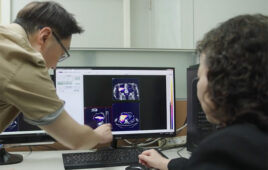
From left: LLNL scientist Monica Borucki from the Lab's Biosciences and Biotechnology Div. looks at cell lines used for viral propagation as members of her multidisciplinary research team, Jonathan Allen and Haiyin Chen look on.  Photo: Jamie Douglas/LLNLOutbreaks such as the severe acute respiratory syndrome (SARS) and Middle East respiratory syndrome coronavirus (MERS) have afflicted people around the world, yet many people think these trends are on the decline.

Quite the opposite is true.

The efforts to combat this epidemic are being spearheaded by a team of Lawrence Livermore National Laboratory (LLNL) scientists. Led by Monica Borucki of LLNL’s Biosciences and Biotechnology Div., the Laboratory researchers have made promising new discoveries that provide insight into the emergence of inter-species transmittable viruses.

They discovered that the genetic diversity of a viral population within a host animal could allow a virus to adapt to certain conditions, which could help it reach a human host. This discovery advances the scientific understanding of how new viruses produced from animal reservoirs can infect people. An animal reservoir is an animal species that harbors an infectious agent, which then goes on to potentially infect humans or other species. Borucki’s team is investigating viruses related to SARS and MERS, but not the actual viruses themselves.

“The team’s findings are the first steps in developing methods for predicting which viral species are most likely to jump from animals to humans and potentially cause outbreaks of diseases,” Borucki said.

Coronaviruses are one of the groups of viruses that most commonly jump to new host species as evidenced by SARS and MERS, according to Borucki. These viruses appear to have jumped from animals to humans and are capable of causing severe diseases in humans.

“Our discoveries indicate that the next generation of genetic sequencing technology, combined with advance computational analysis, can be used to characterize the dynamics of certain viral populations,” she said.

The team’s work on coronaviruses received funding from LLNL’s Laboratory Directed Research and Development (LDRD) program and the Defense Threat Reduction Agency (DTRA).

In June, a research paper published in the Journal of General Virology by other scientists cited the Borucki team’s findings as pioneering, and it recommended their methodology for studying viral evolution.

Borucki said her team’s research findings eventually could be used to influence how vaccines and antivirals are designed and tested.

“Deep Illumina sequencing (a type of genetic sequencing that involves sequencing reads in parallel) is already being used extensively to understand HIV and hepatitis C resistance to antivirals,” she said. “We plan to follow up our findings by examining how animal host traits such as nutritional status (being malnourished or obese) influence how viruses evolve.”

This latest discovery is part of a string of achievements for Borucki’s team.

In 2010, they secured a three-year, $1.4 million contract from DTRA to fund a research project to study how to better determine the origins of a virus.

Source: Lawrence Livermore National Laboratory

Related Articles Read More >

JWST spots a 6-mile moon hiding in Uranus’ rings
DNA microscope offers new 3D view of organisms from the inside out
A tale of two industries: How manufacturing and medical imaging experts can learn from each other
Dark energy camera captures the glittering galaxies of the Antlia Cluster
rd newsletter
EXPAND YOUR KNOWLEDGE AND STAY CONNECTED
Get the latest info on technologies, trends, and strategies in Research & Development.
RD 25 Power Index

R&D World Digital Issues

Fall 2024 issue

Browse the most current issue of R&D World and back issues in an easy to use high quality format. Clip, share and download with the leading R&D magazine today.

Research & Development World
  • Subscribe to R&D World Magazine
  • Sign up for R&D World’s newsletter
  • Contact Us
  • About Us
  • Drug Discovery & Development
  • Pharmaceutical Processing
  • Global Funding Forecast

Copyright © 2025 WTWH Media LLC. All Rights Reserved. The material on this site may not be reproduced, distributed, transmitted, cached or otherwise used, except with the prior written permission of WTWH Media
Privacy Policy | Advertising | About Us

Search R&D World

  • R&D World Home
  • Topics
    • Aerospace
    • Automotive
    • Biotech
    • Careers
    • Chemistry
    • Environment
    • Energy
    • Life Science
    • Material Science
    • R&D Management
    • Physics
  • Technology
    • 3D Printing
    • A.I./Robotics
    • Software
    • Battery Technology
    • Controlled Environments
      • Cleanrooms
      • Graphene
      • Lasers
      • Regulations/Standards
      • Sensors
    • Imaging
    • Nanotechnology
    • Scientific Computing
      • Big Data
      • HPC/Supercomputing
      • Informatics
      • Security
    • Semiconductors
  • R&D Market Pulse
  • R&D 100
    • 2025 R&D 100 Award Winners
    • 2025 Professional Award Winners
    • 2025 Special Recognition Winners
    • R&D 100 Awards Event
    • R&D 100 Submissions
    • Winner Archive
  • Resources
    • Research Reports
    • Digital Issues
    • Educational Assets
    • R&D Index
    • Subscribe
    • Video
    • Webinars
    • Content submission guidelines for R&D World
  • Global Funding Forecast
  • Top Labs
  • Advertise
  • SUBSCRIBE