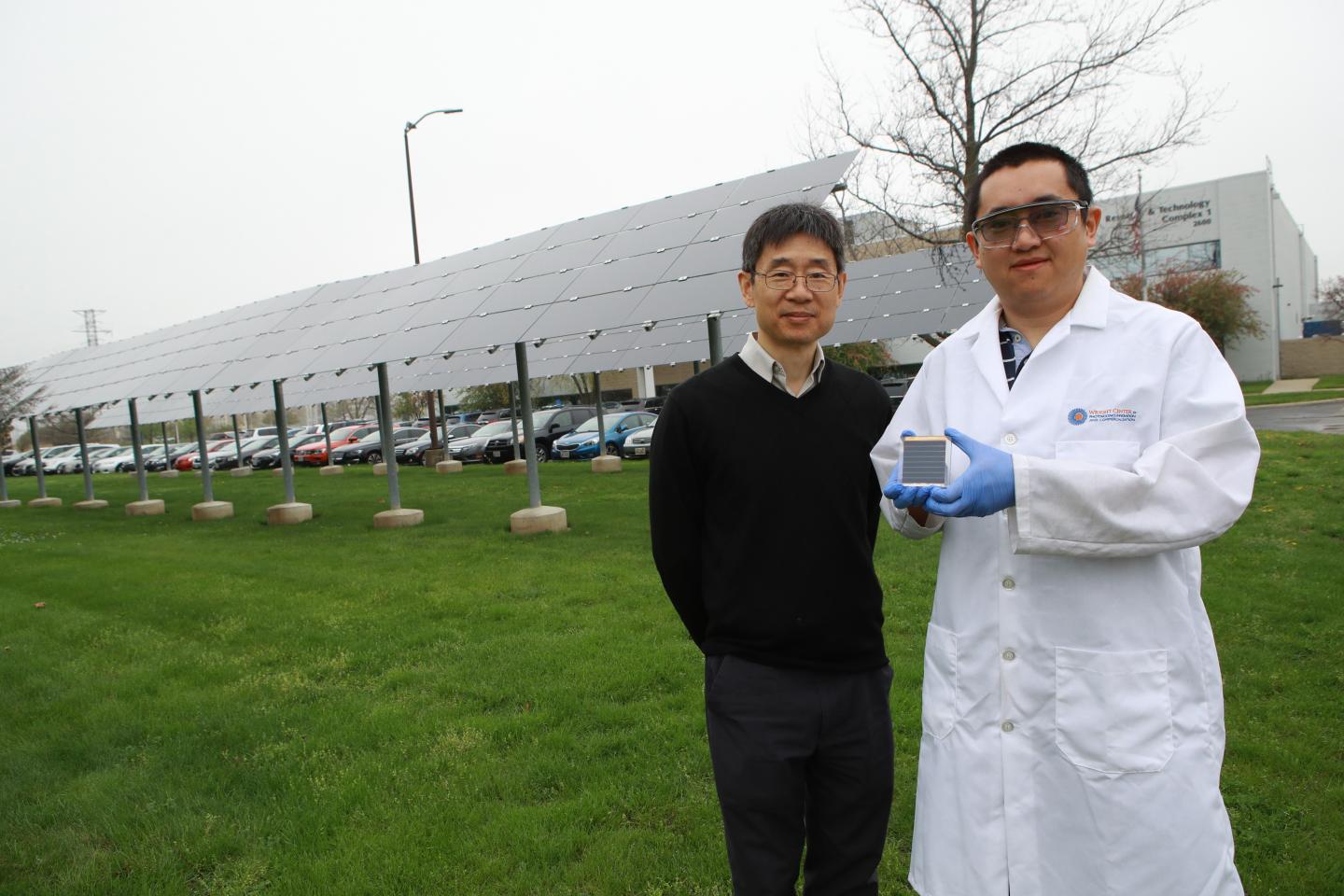
Dr. Zhaoning Song, research assistant professor in the UToledo Department of Physics and Astronomy, holds a a perovskite solar cell mini-module he developed with Dr. Yanfa Yan, UToledo professor of physics. The higher-efficiency, lower-cost solar cell technology could revolutionize energy generation around the globe. Credit: Daniel Miller, The University of Toledo
Scientists are working toward creating a new and improved solar panel, which offers a more affordable and efficient way to generate renewable energy.
A team of researchers from the University of Toledo, the University of Colorado and the U.S. Department of Energy’s (DOE) National Renewable Energy Laboratory (NREL) has found a way to increase solar energy efficiency by implementing a tandem perovskite solar cell in a full-sized solar panel.
Perovskites are compound materials that include a special crystal structure that is formed through chemistry. The researchers believe it could replace silicon as the most efficient solar cell material to convert sunlight into electrical energy.
While all-perovskite-based polycrystalline thin-film tandem solar cells could potentially reach the 30-percent efficiency threshold, they have been limited by the lack of high-efficiency, low-band gap tin-lead mixed perovskite solar cells.
The key to overcoming this limitation was guanidiunium thiocyanate, a chemical compound that significantly improved the structural and optoelectronic properties of the lead-tin perovskite films.
A mixed tin-lead organic-inorganic material containing a small fraction of guanidinium thiocyanate has a low bandgap, long charge-carrier lifetime, and efficiencies of around 25 percent, an increase from the 18-percent efficiency currently seen in silicon-solar panels.
“We are producing higher-efficiency, lower-cost solar cells that show great promise to help solve the world energy crisis,” Yanfa Yan, PhD, a professor of physics at the University of Toledo, said in a statement. “The meaningful work will help protect our planet for our children and future generations. We have a problem consuming most of the fossil energies right now, and our collaborative team is focused on refining our innovative way to clean up the mess.”
The new study is the culmination of several years of research, including the discovery of the ideal perovskites properties in 2014. Since then, Yan’s team has attempted to create an all-perovskite tandem solar cell that can combine two different solar cells to increase the total electrical power, which is generated by using two different parts of the Sun’s spectrum.
The researchers continue to work towards improving the quality of the materials, as well as the manufacturing process to drive down the costs.
“The material cost is low and the fabrication cost is low, but the lifetime of the material is still an unknown,” Zhaoning Song, PhD, a research assistant professor in the University of Toledo Department of Physics and Astronomy and co-author on the study, said in a statement. “We need to continue to increase efficiency and stability.”
According to Yan, the researchers are also working with the solar industry so that they can ensure that the solar panels made of lead, which is considered a toxic substance, can be recycled so that they do not harm the environment.
The researchers will continue their attempt to harness this type of energy thanks to a $1.1 million grant the DOE awarded in April.
“Our UToledo research is ongoing to make cheaper and more efficient solar cells that could rival and even outperform the prevailing silicon photovoltaic technology,” Song said. “Our tandem solar cells with two layers of perovskites deliver high power conversion efficiency and have the potential to bring down production costs of solar panels, which is an important advance in photovoltaics.”
The study was published in Science.