Research & Development World

  • R&D World Home
  • Topics
    • Aerospace
    • Automotive
    • Biotech
    • Careers
    • Chemistry
    • Environment
    • Energy
    • Life Science
    • Material Science
    • R&D Management
    • Physics
  • Technology
    • 3D Printing
    • A.I./Robotics
    • Software
    • Battery Technology
    • Controlled Environments
      • Cleanrooms
      • Graphene
      • Lasers
      • Regulations/Standards
      • Sensors
    • Imaging
    • Nanotechnology
    • Scientific Computing
      • Big Data
      • HPC/Supercomputing
      • Informatics
      • Security
    • Semiconductors
  • R&D Market Pulse
  • R&D 100
    • 2025 R&D 100 Award Winners
    • 2025 Professional Award Winners
    • 2025 Special Recognition Winners
    • R&D 100 Awards Event
    • R&D 100 Submissions
    • Winner Archive
  • Resources
    • Research Reports
    • Digital Issues
    • Educational Assets
    • R&D Index
    • Subscribe
    • Video
    • Webinars
    • Content submission guidelines for R&D World
  • Global Funding Forecast
  • Top Labs
  • Advertise
  • SUBSCRIBE

New Method for Uranium Extraction

By Kenny Walter | January 30, 2017

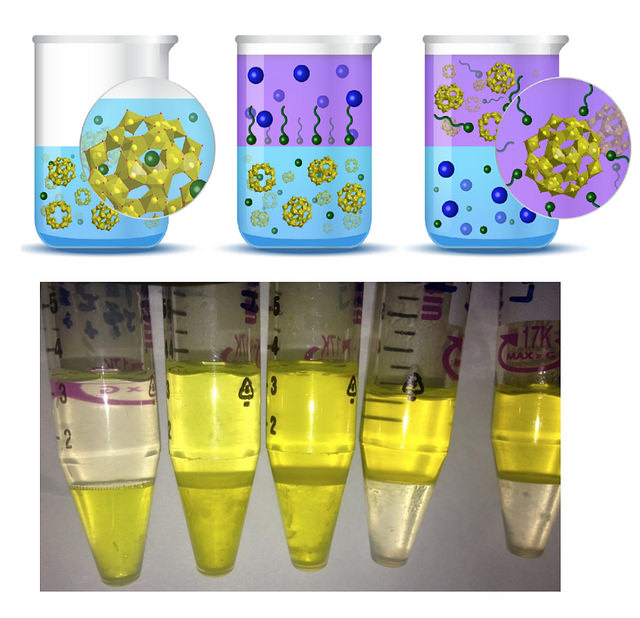
Caption: Chemists from Oregon State University have developed a new method for separating uranium. Credit: Oregon State University

A new method to separating uranium may lead to safer and more efficient fuel production.

Chemists at Oregon State University have developed a new technique using soap-like chemicals called surfactants to extract uranium from an aqueous solution into a kerosene solution in the form of hollow clusters.

This new method could be used for fuel preparation as well as for legacy waste treatment and for environmental contamination cleanup.

The technique involves a unique form of uranium discovered in 2005— uranyl peroxide capsules— and how those negatively charged clusters form in alkaline conditions.

Harrison Neal, a graduate student in Oregon State’s College of Science and lead author of the study, said the research will make separating uranium a safer process.

“This is a very different direction,” Neal said in a statement. “A lot of the work done now is in acid and we’re at the other end of the pH scale in base.

“It’s a very different approach, overall using less harmful, less toxic chemicals,” he added.

There are several separations required throughout the nuclear fuel cycle—in mining, enrichment and fuel fabrication, as well as after fuel use for the recovery of usable spent isotopes and the encapsulation and storage of unusable radioactive components.

May Nyman, professor of chemistry at Oregon State and corresponding author on the research, explained how the new method could be used to make fuel.

“When you use nuclear fuel, the radioactive decay products poison the fuel and make it less effective,” Nyman said in a statement. “You have to take it, dissolve it, get the good stuff out and make new fuel.”

According to Nyman, the work represents significant fundamental research in the field of cluster chemistry because it allows for the study of uranyl clusters in the organic phase and can pave the way to improved understanding of ion association.

“With extracting these clusters into the organic phase, the clusters themselves are hollow, so when we get them into the organic solution, they’re still containing other atoms, molecules, other ions,” Neal said. “We can study how these ions interact with these cages that they’re in.

“The fundamental research is understanding how the ions get inside and what they do once they’re inside because they’re stuck there.”

Nyman said that when the clusters form they contain 20 to 60 uranium atoms, making it possible to extract in bunches instead of one at a time.

Under existing separation techniques, two extraction molecules are required for every uranium ion, while the new technique would require less than one extraction molecule per ion.

Scientists from the University of Notre Dame collaborated on the research, which was supported by the U.S. Department of Energy.

The study was published in the European Journal of Inorganic Chemistry.

Related Articles Read More >

Chemistry Nobel goes to ‘molecular architecture’ with spaces big enough to trap gases
ORNL named on 20 R&D 100 Awards, including carbon-capture and AM tools
2025 R&D Technician of the Year: Dow’s Richard Tapper pushes flame-retardant limits to curb real-world fire risks
Researchers synthesize first Berkelium-containing molecule
rd newsletter
EXPAND YOUR KNOWLEDGE AND STAY CONNECTED
Get the latest info on technologies, trends, and strategies in Research & Development.
RD 25 Power Index

R&D World Digital Issues

Fall 2025 issue

Browse the most current issue of R&D World and back issues in an easy to use high quality format. Clip, share and download with the leading R&D magazine today.

Research & Development World
  • Subscribe to R&D World Magazine
  • Sign up for R&D World’s newsletter
  • Contact Us
  • About Us
  • Drug Discovery & Development
  • Pharmaceutical Processing
  • Global Funding Forecast

Copyright © 2025 WTWH Media LLC. All Rights Reserved. The material on this site may not be reproduced, distributed, transmitted, cached or otherwise used, except with the prior written permission of WTWH Media
Privacy Policy | Advertising | About Us

Search R&D World

  • R&D World Home
  • Topics
    • Aerospace
    • Automotive
    • Biotech
    • Careers
    • Chemistry
    • Environment
    • Energy
    • Life Science
    • Material Science
    • R&D Management
    • Physics
  • Technology
    • 3D Printing
    • A.I./Robotics
    • Software
    • Battery Technology
    • Controlled Environments
      • Cleanrooms
      • Graphene
      • Lasers
      • Regulations/Standards
      • Sensors
    • Imaging
    • Nanotechnology
    • Scientific Computing
      • Big Data
      • HPC/Supercomputing
      • Informatics
      • Security
    • Semiconductors
  • R&D Market Pulse
  • R&D 100
    • 2025 R&D 100 Award Winners
    • 2025 Professional Award Winners
    • 2025 Special Recognition Winners
    • R&D 100 Awards Event
    • R&D 100 Submissions
    • Winner Archive
  • Resources
    • Research Reports
    • Digital Issues
    • Educational Assets
    • R&D Index
    • Subscribe
    • Video
    • Webinars
    • Content submission guidelines for R&D World
  • Global Funding Forecast
  • Top Labs
  • Advertise
  • SUBSCRIBE