Research & Development World

  • R&D World Home
  • Topics
    • Aerospace
    • Automotive
    • Biotech
    • Careers
    • Chemistry
    • Environment
    • Energy
    • Life Science
    • Material Science
    • R&D Management
    • Physics
  • Technology
    • 3D Printing
    • A.I./Robotics
    • Software
    • Battery Technology
    • Controlled Environments
      • Cleanrooms
      • Graphene
      • Lasers
      • Regulations/Standards
      • Sensors
    • Imaging
    • Nanotechnology
    • Scientific Computing
      • Big Data
      • HPC/Supercomputing
      • Informatics
      • Security
    • Semiconductors
  • R&D Market Pulse
  • R&D 100
    • 2026 R&D 100 Award Winners
    • 2026 Professional Award Winners
    • 2026 Special Recognition Winners
    • R&D 100 Awards Event
    • R&D 100 Submissions
    • Winner Archive
  • Resources
    • Research Reports
    • Digital Issues
    • Educational Assets
    • Subscribe
    • Video
    • Webinars
    • PharmSci360
    • Content submission guidelines for R&D World
  • Global Funding Forecast
  • Top Labs
  • Advertise
  • SUBSCRIBE

A little light interaction leaves quantum physicists beaming

By R&D Editors | August 24, 2015

This is an artist's rendition of what occurs when one photon goes through a carefully prepared atomic medium at the same time as a pulse including many photons. Change in the colors, represents nonlinear phase shifts picked up by each pulse that is proportional to the number of photons in the other pulse. A measurable nonlinear phase shift caused by a single photon on a pulse with many photons can enable deterministic two-qubit gates, an important missing part of the optical quantum information processing hardware. Image: Amir FeizpourA team of physicists at the Univ. of Toronto (U of T) have taken a step toward making the essential building block of quantum computers out of pure light. Their advance, described in a paper published in Nature Physics, has to do with a specific part of computer circuitry known as a “logic gate.”

Logic gates perform operations on input data to create new outputs. In classical computers, logic gates take the form of diodes or transistors. But quantum computer components are made from individual atoms and subatomic particles. Information processing happens when the particles interact with one another according to the strange laws of quantum physics.

Light particles—known as “photons”—have many advantages in quantum computing, but it is notoriously difficult to get them to interact with one another in useful ways. This experiment demonstrates how to create such interactions.

“We’ve seen the effect of a single particle of light on another optical beam,” said Canadian Institute for Advanced Research (CIFAR) Senior Fellow Aephraim Steinberg, one of the paper’s authors and a researcher at U of T’s Centre for Quantum Information & Quantum Computing. “Normally light beams pass through each other with no effect at all. To build technologies like optical quantum computers, you want your beams to talk to one another. That’s never been done before using a single photon.”

The interaction was a two-step process. The researchers shot a single photon at rubidium atoms that they had cooled to a millionth of a degree above absolute zero. The photons became “entangled” with the atoms, which affected the way the rubidium interacted with a separate optical beam. The photon changes the atoms’ refractive index, which caused a tiny but measurable “phase shift” in the beam.

This process could be used as an all-optical quantum logic gate, allowing for inputs, information-processing and outputs.

“Quantum logic gates are the most obvious application of this advance,” said Steinberg. “But being able to see these interactions is the starting page of an entirely new field of optics. Most of what light does is so well understood that you wouldn’t think of it as a field of modern research. But two big exceptions are, “What happens when you deal with light one particle at a time?’ and “What happens when there are media like our cold atoms that allow different light beams to interact with each other?'”

Both questions have been studied, he says, but never together until now.

Source: Univ. of Toronto

• CONFERENCE AGENDA ANNOUNCED:

The highly-anticipated educational tracks for the 2015 R&D 100 Awards & Technology Conference feature 28 sessions, plus keynote speakers Dean Kamen and Oak Ridge National Laboratory Director Thom Mason.  Learn more.

Related Articles Read More >

OpenAI logo glowing on a smartphone screen resting on a laptop keyboard
OpenAI says its AI models produced major proofs in mathematics, computer science and physics
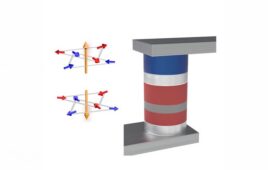
Illustration of an antiferromagnetic tunnel junction pillar beside the two spin configurations of platinum-manganese that store a bit.
Northwestern and Western Digital demonstrate a new way to write magnetic memory
How a Duke-led HPC method brought cell-scale cancer simulation to a single cloud node 
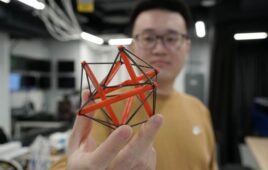
Princeton researchers uncover hidden mathematical link between origami and structural design
rd newsletter
EXPAND YOUR KNOWLEDGE AND STAY CONNECTED
Get the latest info on technologies, trends, and strategies in Research & Development.

R&D World Digital Issues

Fall 2026 issue

Browse the most current issue of R&D World and back issues in an easy to use high quality format. Clip, share and download with the leading R&D magazine today.

R&D 100 Awards
Research & Development World
  • Subscribe to R&D World Magazine
  • Sign up for R&D World’s newsletter
  • Contact Us
  • About Us
  • Drug Discovery & Development
  • Pharmaceutical Processing
  • Global Funding Forecast

Copyright © 2026 Arrowfly LLC. All Rights Reserved. The material on this site may not be reproduced, distributed, transmitted, cached or otherwise used, except with the prior written permission of Arrowfly
Privacy Policy | Advertising | About Us

Search R&D World

  • R&D World Home
  • Topics
    • Aerospace
    • Automotive
    • Biotech
    • Careers
    • Chemistry
    • Environment
    • Energy
    • Life Science
    • Material Science
    • R&D Management
    • Physics
  • Technology
    • 3D Printing
    • A.I./Robotics
    • Software
    • Battery Technology
    • Controlled Environments
      • Cleanrooms
      • Graphene
      • Lasers
      • Regulations/Standards
      • Sensors
    • Imaging
    • Nanotechnology
    • Scientific Computing
      • Big Data
      • HPC/Supercomputing
      • Informatics
      • Security
    • Semiconductors
  • R&D Market Pulse
  • R&D 100
    • 2026 R&D 100 Award Winners
    • 2026 Professional Award Winners
    • 2026 Special Recognition Winners
    • R&D 100 Awards Event
    • R&D 100 Submissions
    • Winner Archive
  • Resources
    • Research Reports
    • Digital Issues
    • Educational Assets
    • Subscribe
    • Video
    • Webinars
    • PharmSci360
    • Content submission guidelines for R&D World
  • Global Funding Forecast
  • Top Labs
  • Advertise
  • SUBSCRIBE