Research & Development World

  • R&D World Home
  • Topics
    • Aerospace
    • Automotive
    • Biotech
    • Careers
    • Chemistry
    • Environment
    • Energy
    • Life Science
    • Material Science
    • R&D Management
    • Physics
  • Technology
    • 3D Printing
    • A.I./Robotics
    • Software
    • Battery Technology
    • Controlled Environments
      • Cleanrooms
      • Graphene
      • Lasers
      • Regulations/Standards
      • Sensors
    • Imaging
    • Nanotechnology
    • Scientific Computing
      • Big Data
      • HPC/Supercomputing
      • Informatics
      • Security
    • Semiconductors
  • R&D Market Pulse
  • R&D 100
    • 2026 R&D 100 Award Winners
    • 2026 Professional Award Winners
    • 2026 Special Recognition Winners
    • R&D 100 Awards Event
    • R&D 100 Submissions
    • Winner Archive
  • Resources
    • Research Reports
    • Digital Issues
    • Educational Assets
    • Subscribe
    • Video
    • Webinars
    • PharmSci360
    • Content submission guidelines for R&D World
  • Global Funding Forecast
  • Top Labs
  • Advertise
  • SUBSCRIBE

Study Highlights Favorable Areas for High-Altitude Wind Energy Systems

By KAUST | October 17, 2017

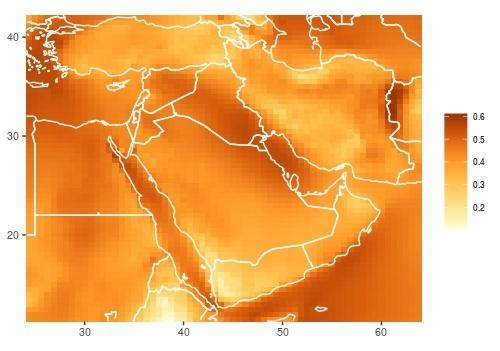
Color-coded map of the Middle East region to show areas with greatest high-altitude wind-energy potential. Source: Reproduced with permission from reference 1© 2017 Nature Publishing Group

The notion of tethered wind turbines that generate electricity from abundant and reliable high-altitude winds seems futuristic. Now, KAUST research led by Georgiy Stenchikov has identified the most favorable areas for high-altitude wind-energy systems in the Middle East.

The results confirm that there is abundant wind energy up there that could feasibly be harnessed, bringing the possibility of high-altitude power generation a step closer.

“We are very enthusiastic about taking this work forward,” says Udaya Gunturu, who studies atmospheric processes at KAUST.

“Wind turbines on the Earth’s surface suffer from the very stubborn problem of intermittent wind supply,” says Gunturu. This has led researchers and energy companies worldwide to look upwards and explore the possibilities of the strong and reliable winds at high altitudes. Flying a wind turbine on a kite — with the electricity being delivered to the ground through its tether — may seem an unlikely scenario, but several companies worldwide are already testing prototype systems.

These developments attracted the attention of the Saudi Basic Industries Corporation (SABIC), which funded the KAUST research to explore the opportunities in the Middle East. The project made an excellent PhD topic for student Andrew Yip, first author of the research paper.

The researchers used information on wind strengths at different altitudes that was already available from the US space agency NASA. They processed this raw data to identify the most favorable areas for airborne wind-energy systems, and the optimal heights at which the turbines would need to fly. They also factored in daily and seasonal variations (see image).

“Optimal altitudes for the turbines vary by region and with time of year and time of day,” says Yip. “In general, the abundance of the airborne wind-energy resources increases with altitude.”

Tethered kites could potentially offer the flexibility to vary the altitude of the turbines as wind conditions change. Current technology would most likely allow harvesting wind energy at heights of two to three kilometers, but there is also a lot of wind even higher than that.

The researchers conclude that the most favorable regions for high-altitude wind energy in the Middle East are over parts of Saudi Arabia and Oman. Their next step will be to increase the resolution of their study.

“Our work may help Saudi Arabian wind-energy technology to leapfrog into the future and fulfill the Kingdom’s Vision 2030 plan on the development of renewable energy resources,” says Stenchikov.
Related Articles Read More >

INL’s $60 million nuclear AI project will spend the first year testing where AI agents can help and where they might hurt 
The Space Systems Division (05)-developed Parallelogram Synchronized Truss Assembly (PaSTA), seen Aug. 12, 2025, is a mechanism that will be integrated into the Life-Extension In-orbit Servicer (LEXI) and Astroscale Prototype Servicer for Refueling (APS-R) spacecrafts.
One SwRI R&D 100 winner turns buckled fiberglass into a spacecraft truss. The other models freight rail with 900 hours of BNSF field data
Inside the Lab: NETL’s Oil and Gas Center of Excellence focuses on technologies to enhance production   
Inside S&C Electric’s and Argonne National Lab’s CRADA partnership
rd newsletter
EXPAND YOUR KNOWLEDGE AND STAY CONNECTED
Get the latest info on technologies, trends, and strategies in Research & Development.

R&D World Digital Issues

Fall 2025 issue

Browse the most current issue of R&D World and back issues in an easy to use high quality format. Clip, share and download with the leading R&D magazine today.

R&D 100 Awards
Research & Development World
  • Subscribe to R&D World Magazine
  • Sign up for R&D World’s newsletter
  • Contact Us
  • About Us
  • Drug Discovery & Development
  • Pharmaceutical Processing
  • Global Funding Forecast

Copyright © 2026 Arrowfly LLC. All Rights Reserved. The material on this site may not be reproduced, distributed, transmitted, cached or otherwise used, except with the prior written permission of Arrowfly
Privacy Policy | Advertising | About Us

Search R&D World

  • R&D World Home
  • Topics
    • Aerospace
    • Automotive
    • Biotech
    • Careers
    • Chemistry
    • Environment
    • Energy
    • Life Science
    • Material Science
    • R&D Management
    • Physics
  • Technology
    • 3D Printing
    • A.I./Robotics
    • Software
    • Battery Technology
    • Controlled Environments
      • Cleanrooms
      • Graphene
      • Lasers
      • Regulations/Standards
      • Sensors
    • Imaging
    • Nanotechnology
    • Scientific Computing
      • Big Data
      • HPC/Supercomputing
      • Informatics
      • Security
    • Semiconductors
  • R&D Market Pulse
  • R&D 100
    • 2026 R&D 100 Award Winners
    • 2026 Professional Award Winners
    • 2026 Special Recognition Winners
    • R&D 100 Awards Event
    • R&D 100 Submissions
    • Winner Archive
  • Resources
    • Research Reports
    • Digital Issues
    • Educational Assets
    • Subscribe
    • Video
    • Webinars
    • PharmSci360
    • Content submission guidelines for R&D World
  • Global Funding Forecast
  • Top Labs
  • Advertise
  • SUBSCRIBE