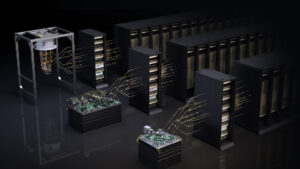
NVIDIA refers to NVQLink as an open system architecture for uniting the performance of GPU computing with quantum processors.
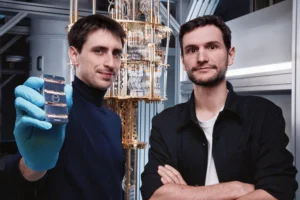
The architecture addresses a fundamental hurdle: quantum algorithms need constant classical supervision to catch and correct errors before qubits decohere. NVQLink integrates with CUDA-Q and provides the interconnect needed for key tasks such as syndrome decoding, compilation and dynamic calibration to run on GPUs rather than requiring custom hardware. Nvidia says the initiative involves 17 quantum builders, several control-electronics vendors and nine U.S. national labs, including Brookhaven, Fermilab, Lawrence Berkeley, Los Alamos, MIT Lincoln Laboratory, Oak Ridge, Pacific Northwest and Sandia.
While Nvidia is not building its own quantum computers, it is betting the near-term value in quantum will come from tighter hybrid systems. The company’s announcement described NVQLink as a “Rosetta Stone” between quantum and classical supercomputers. Independent coverage framed the announcement as enabling infrastructure, while noting commercial timelines remain uncertain.
What changes for researchers
Fault-tolerant quantum computing requires a fast, deterministic feedback loop between qubits and a classical co-processor. Right now, many labs use FPGAs or ASICs for error correction. Both are specialized chips that can be expensive to develop and difficult to reprogram.
Nvidia’s pitch is essentially this: GPUs can handle the decoding and scheduling work, especially for chemistry and materials science applications that mix quantum and classical steps. Whether this actually speeds up research depends on whether GPU-based decoders can match the latency requirements of error correction codes.
Alice & Bob’s angle
Alice & Bob has already tied its open-source simulator, Dynamiqs, to CUDA-Q, reporting up to 75× speedups on time-dependent simulations. Trade and university recaps echo the claim: Quantum Computing Report, Arizona National Security Program.
The startup is best known for “cat qubits,” a design that passively suppresses one type of error—bit flips—without requiring constant active correction. This fall it reported hour-scale bit-flip stability, extending earlier results that topped 100 seconds. That’s meaningful progress for codes that trade fewer physical qubits for built-in protection against one error type.
The company claims this approach could reduce hardware requirements by up to 200× compared to some competing architectures. Treat that as company guidance pending broader validation.
NVQLink follows Nvidia’s Boston-based Accelerated Quantum Research Center, announced earlier this year to co-develop architectures and algorithms with university and industry partners. The center underscores Nvidia’s strategy: make quantum useful sooner by tightening its coupling to accelerated classical computing.
Nvidia says the architecture is open and vendor-agnostic. Availability and maturity will roll out over time.