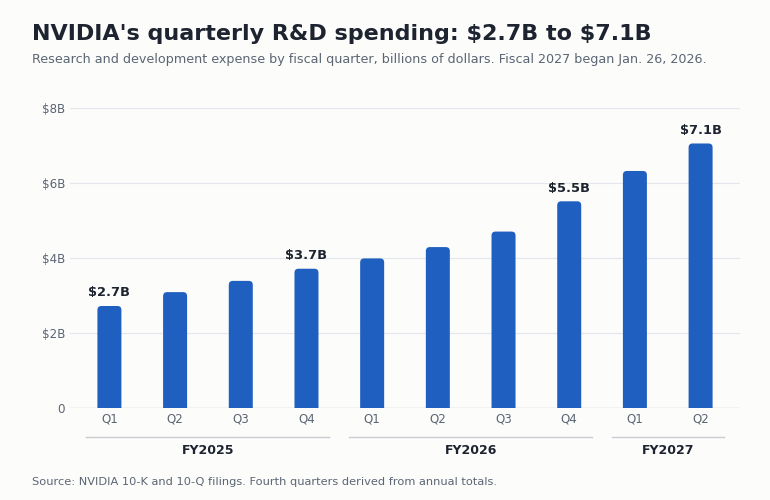
Credit: R&D World graphic. Source: NVIDIA 10-K and 10-Q filings
For the past several weeks, talk of an AI bubble, or at least a correction, had been, well, bubbling. The first tremors hit the neoclouds, the specialized providers that rent out GPU capacity. On Oct. 14, Gartner forecast that more than 80% of them will cease independent operations by 2030, and CoreWeave shares fell more than 15% that day as yields on its bonds touched 15%. CoreWeave’s third-quarter results on Nov. 10 showed why lenders are nervous: $3.66 billion in revenue, but $846 million in net interest expense against $207 million in operating income, for a $709 million net loss. Shareholders took a brighter view. CoreWeave’s stock jumped 24.7% on Nov. 11, its best day since April 2025, after the results beat estimates and the company raised its full-year guidance. CEO Michael Intrator said CoreWeave would not use the unsecured debt market “at current yields” and expects about $9 billion in customer prepayments and deposits over the next three months. Then came the departure of the executive at the center of the boom. NVIDIA said on Nov. 12 that co-founder Jensen Huang had resigned as CEO, following reports of affairs, including one with a woman U.S. officials suspect of spying for China.
NVIDIA has passed the leadership baton to interim CEO Colette Kress, NVIDIA’s CFO since 2013, who will keep the finance job while the board searches for a permanent successor. She inherits one of the fastest-growing research budgets in the industry. C.J. Muse, a semiconductor analyst at Cantor Fitzgerald who cut his price target on NVIDIA’s stock on Nov. 12, told CNBC that the company has “very talented people” and that “the key will be how do they maintain their technological roadmap over the coming five years.”
The record of earlier CEO exits suggests the direction of R&D spending’s trajectory continues to hinge on sales. And NVIDIA’s sales depend on customers who are borrowing heavily. NVIDIA’s stock has slid more than 25% over the past month. NVIDIA’s stock slide raises a question about how long its research spending can sustain its recent pace. Within the pharma sector, Moderna offers one example of how quickly an industry boom can give way to retrenchment. As its pandemic vaccine business contracted, annual R&D spending fell from $4.85 billion in 2023 to $3.13 billion in 2025, according to its annual report. For NVIDIA, one potential source of pressure lies with the customers borrowing to buy its chips. If financing becomes harder to obtain, those customers could slow purchases, potentially putting pressure on the R&D purse strings.
A research budget built on the boom
NVIDIA’s R&D spend in recent years has grown by leaps and bounds. The company reported $18.5 billion in R&D expense for fiscal 2026, the year ended Jan. 25, 2026, up 43% from $12.9 billion in fiscal 2025. That was more than double the $8.7 billion it spent in fiscal 2024.
The increases continued into fiscal 2027. R&D expense reached $6.3 billion in the quarter ended April 26, up 58% from a year earlier, and $7.1 billion in the quarter ended July 26, up 64%. In six months, NVIDIA spent $13.4 billion on R&D, exceeding its entire fiscal 2025 total.
At the same time, R&D expense fell from 14.2% of revenue in fiscal 2024 to 8.6% in fiscal 2026 and 7.3% in the latest reported quarter. The research budget, in other words, is easily affordable for as long as revenue holds.
What past CEO exits suggest about R&D spending
NVIDIA’s board followed a familiar script in naming its CFO interim CEO. When Intel CEO Brian Krzanich resigned in 2018 over a past relationship with an employee, the board named CFO Bob Swan interim CEO. Intel’s R&D held near $13.5 billion for three years after Krzanich left, and HP’s rose 13% in the first nine months of the following fiscal year. HP turned to CFO Cathie Lesjak after Mark Hurd’s 2010 exit over a conduct investigation, and Boeing to CFO Greg Smith when Dennis Muilenburg was pushed out amid the 737 MAX crisis in 2019.
There is no one-size-fits-all playbook for R&D budgets in the wake of a company crisis. Boeing, with its best-selling jet grounded, cut R&D 23% in 2020 and said it was deferring research to conserve cash, though the pandemic hit within three months of the leadership change. Intel cut R&D 17% in 2025, the year after Pat Gelsinger’s exit, as the company posted operating losses. Nissan raised R&D spending 4% in the year after Carlos Ghosn’s 2018 arrest, then cut it 11% over the next two years as sales fell by a third, a period that also included the pandemic.
NVIDIA customers are borrowing to buy
In addition to the neoclouds named at the outset, the largest technology companies are borrowing too. Alphabet sold a rare 100-year bond in February, part of a $31.5 billion global debt offering as it accelerated investment in AI infrastructure. On Oct. 29, it lost about $500 billion in market value, its worst day as a public company, after reporting $51.4 billion in quarterly capital spending against $42.3 billion in operating cash flow. S&P cut Oracle’s credit rating to BBB-, one notch above junk, in July, following disclosures of heavy capital spending, negative free cash flow and approximately $260 billion in data center lease commitments. By early November, Reuters reported that banks were growing reluctant to take on more AI debt. Christopher Wood, global head of equity strategy at Jefferies, described where that reluctance could lead in a Nov. 6 note quoted by CNBC: “The most plausible way the AI capex arms race will end is that the credit card will be taken away.”
The AI labs that rent much of that capacity are, often vastly, outspending what they earn. The Wall Street Journal reported that OpenAI’s third-quarter revenue rose about 50% to $10 billion, but its adjusted operating loss widened to $10.9 billion, and its latest funding round raised less than half of its $30 billion target. Elon Musk’s xAI, now subsumed into SpaceX, lost $2.47 billion from operations on $818 million in revenue in the first quarter, according to SpaceX’s IPO filing. Anthropic is closest to breaking even, with a $567 million operating loss on $17 billion in third-quarter revenue.
NVIDIA has lent to its buyers
NVIDIA supplies these companies and has also put its own money behind them, so a customer’s trouble would cost it twice: in lost orders and in its own investments.
It invested an additional $2 billion in CoreWeave in January, and agreed in 2025 to purchase residual unsold CoreWeave capacity through April 2032, under an order initially valued at $6.3 billion. OpenAI’s February funding announcement included $30 billion from NVIDIA, alongside an expanded commitment to NVIDIA computing infrastructure. In August, NVIDIA disclosed conditional guarantees capped at $105 billion supporting an Ohio data center campus where OpenAI will deploy its systems. NVIDIA consequently has exposure to OpenAI as an investor, supplier and financial backer of its infrastructure.
NVIDIA’s commitments extend beyond OpenAI. In its filing for the quarter ended July 26, NVIDIA listed $36 billion in agreements with AI cloud providers under which it will buy capacity they do not sell to other customers; the commitments shrink as other customers, or NVIDIA’s own R&D teams, use that capacity. The filing also lists $20 billion in data center leases NVIDIA expects to reassign to third parties and $3.5 billion in guarantees on AI cloud partners’ lease obligations. As CFO, Kress pushed back on a proposed $250 billion credit backstop for OpenAI, The Information reported on Nov. 12; NVIDIA later split that arrangement, and the signed Ohio guarantee is capped at $105 billion.
A second risk to sales: China
The scandal has its route to NVIDIA’s revenue, through scrutiny of where its chips end up. The Information reported on Nov. 10, according to Reuters, that Huang’s relationship with Alice Huang helped facilitate at least $7.5 billion in chip shipments to Chinese firms. Reuters said it could not independently verify the report. NVIDIA’s board has said it had “no reason to believe” company secrets or U.S. national security were compromised. On Nov. 12, Attorney General Todd Blanche said the FBI was investigating whether she worked for the Chinese government, with the Justice Department yet to reach a conclusion.
The board says it expects customer commitments to continue without interruption. The first test comes Nov. 17, when NVIDIA reports quarterly results under Kress. Its guidance for operating expenses will show whether the research budget keeps growing, levels off or shrinks, and its revenue outlook will show how much of its customers’ strain has reached its own order book.



Tell Us What You Think!
You must be logged in to post a comment.