Research & Development World

  • R&D World Home
  • Topics
    • Aerospace
    • Automotive
    • Biotech
    • Careers
    • Chemistry
    • Environment
    • Energy
    • Life Science
    • Material Science
    • R&D Management
    • Physics
  • Technology
    • 3D Printing
    • A.I./Robotics
    • Software
    • Battery Technology
    • Controlled Environments
      • Cleanrooms
      • Graphene
      • Lasers
      • Regulations/Standards
      • Sensors
    • Imaging
    • Nanotechnology
    • Scientific Computing
      • Big Data
      • HPC/Supercomputing
      • Informatics
      • Security
    • Semiconductors
  • R&D Market Pulse
  • R&D 100
    • 2025 R&D 100 Award Winners
    • 2025 Professional Award Winners
    • 2025 Special Recognition Winners
    • R&D 100 Awards Event
    • R&D 100 Submissions
    • Winner Archive
  • Resources
    • Research Reports
    • Digital Issues
    • Educational Assets
    • Subscribe
    • Video
    • Webinars
    • Content submission guidelines for R&D World
  • Global Funding Forecast
  • Top Labs
  • Advertise
  • SUBSCRIBE

Organic/Inorganic Sulfur May Be Key for Safe Rechargeable Lithium Batteries

By Penn State | October 12, 2017

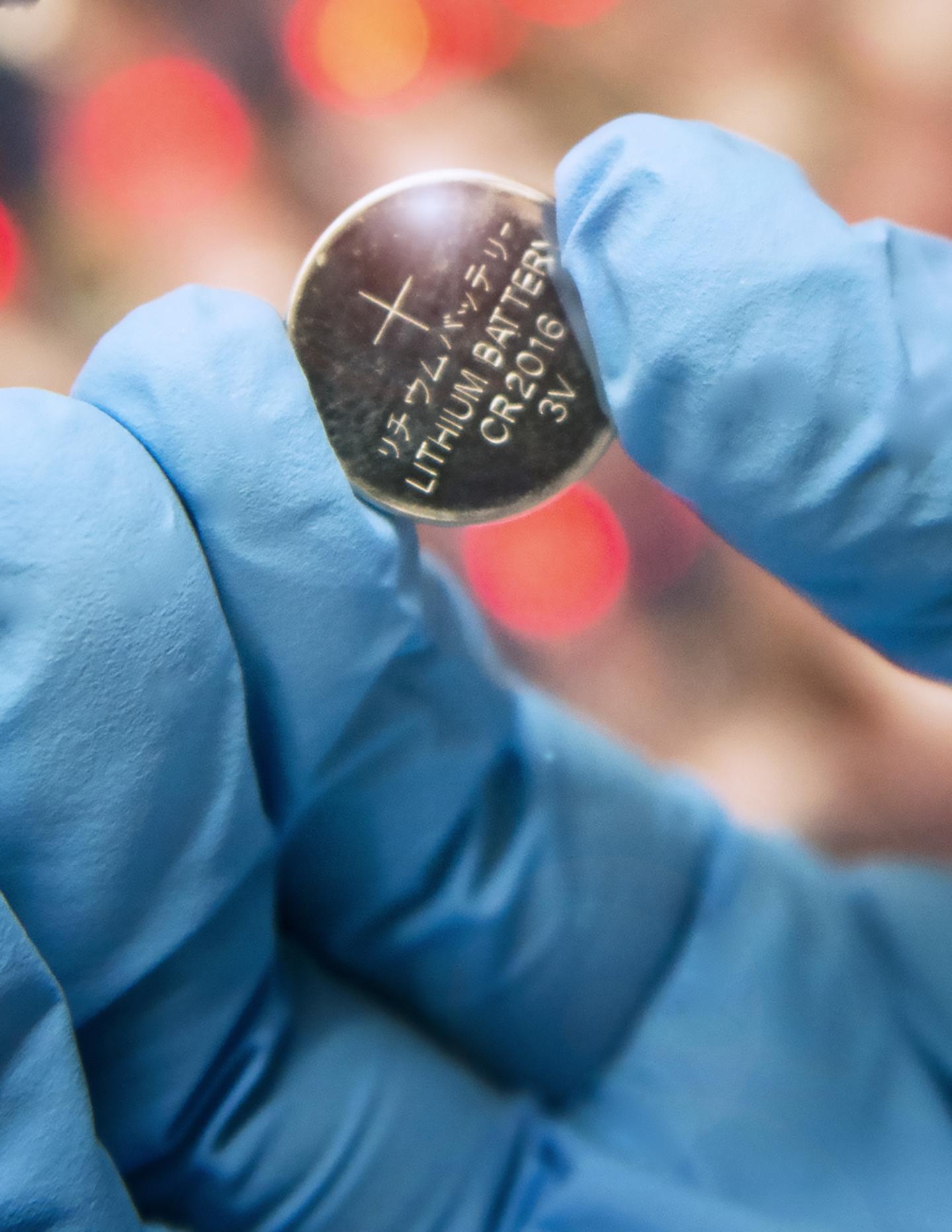
This is one of the lithium sulfur coin batteries being developed in Penn State’s Energy Nanostructure Laboratory (E-Nano).

We have come a long way from leaky sulfur-acid automobile batteries, but modern lithium batteries still have some down sides. Now a team of Penn State engineers have a different type of lithium sulfur battery that could be more efficient, less expensive and safer.

“We demonstrated this method in a coin battery,” said Donghai Wang, associate professor of mechanical engineering. “But, I think it could eventually become big enough for cell phones, drones and even bigger for electric vehicles.”

Lithium sulfur batteries should be a promising candidate for the next generation of rechargeable batteries, but they are not without problems. For lithium, the efficiency in which charge transfers is low, and, lithium batteries tend to grow dendrites — thin branching crystals — when charging that do not disappear when discharged.

The researchers examined a self-formed, flexible hybrid solid-electrolyte interphase layer that is deposited by both organosulfides and organopolysulfides with inorganic lithium salts. The researchers report in today’s (Oct. 11) issue of Nature Communications that the organic sulfur compounds act as plasticizers in the interphase layer and improve the mechanical flexibility and toughness of the layer. The interphase layer allows the lithium to deposit without growing dendrites. The Coulombic efficiency is about 99 percent over 400 recharging discharging cycles.

“We need some kind of barrier on the lithium in a lithium metal battery, or it reacts with everything,” said Wang.

Sulfur is a good choice because it is inexpensive and provides the battery with high-charge capacity, higher-energy density so a lithium sulfur battery has more energy. However, a lithium sulfur battery forms an inorganic coating in the battery that is brittle and cannot tolerate changes in volume. The inorganic sulfur interface cannot sustain high energy. In a lithium sulfur battery, the electrolyte dries up and the bulk lithium corrodes. The lithium dendrites that form can create short circuits and other safety hazards.

“Potentially we can double the energy density of conventional DC batteries using lithium sulfur batteries with this hybrid organosulfide/organopolysulfide interface,” said Wang.

They can also create a safer, more reliable battery.

To create their battery the researchers used an ether-based electrolyte with sulfur-containing polymer additives. The battery uses a sulfur infused carbon cathode and a lithium anode. The organic sulfur in the electrolyte self-forms the interphase layers.

The researchers report that they “demonstrate a lithium-sulfur battery exhibiting a long cycling life — 1000 cycles — and good capacity retention.
Related Articles Read More >

Researchers use hydrothermal carbonization to turn distillery waste into supercapacitor electrodes
175 Wh/kg: How CATL’s Naxtra Architecture Moves Sodium-Ion Beyond the Lab
Flexible electrolyte for solid batteries achieves 0.73 Li+ transference
GM XFC Cell: EV battery charges from 10% to 70% in approximately 5.6 minutes | Inside the R&D 100 win
rd newsletter
EXPAND YOUR KNOWLEDGE AND STAY CONNECTED
Get the latest info on technologies, trends, and strategies in Research & Development.

R&D World Digital Issues

Fall 2025 issue

Browse the most current issue of R&D World and back issues in an easy to use high quality format. Clip, share and download with the leading R&D magazine today.

R&D 100 Awards
Research & Development World
  • Subscribe to R&D World Magazine
  • Sign up for R&D World’s newsletter
  • Contact Us
  • About Us
  • Drug Discovery & Development
  • Pharmaceutical Processing
  • Global Funding Forecast

Copyright © 2026 WTWH Media LLC. All Rights Reserved. The material on this site may not be reproduced, distributed, transmitted, cached or otherwise used, except with the prior written permission of WTWH Media
Privacy Policy | Advertising | About Us

Search R&D World

  • R&D World Home
  • Topics
    • Aerospace
    • Automotive
    • Biotech
    • Careers
    • Chemistry
    • Environment
    • Energy
    • Life Science
    • Material Science
    • R&D Management
    • Physics
  • Technology
    • 3D Printing
    • A.I./Robotics
    • Software
    • Battery Technology
    • Controlled Environments
      • Cleanrooms
      • Graphene
      • Lasers
      • Regulations/Standards
      • Sensors
    • Imaging
    • Nanotechnology
    • Scientific Computing
      • Big Data
      • HPC/Supercomputing
      • Informatics
      • Security
    • Semiconductors
  • R&D Market Pulse
  • R&D 100
    • 2025 R&D 100 Award Winners
    • 2025 Professional Award Winners
    • 2025 Special Recognition Winners
    • R&D 100 Awards Event
    • R&D 100 Submissions
    • Winner Archive
  • Resources
    • Research Reports
    • Digital Issues
    • Educational Assets
    • Subscribe
    • Video
    • Webinars
    • Content submission guidelines for R&D World
  • Global Funding Forecast
  • Top Labs
  • Advertise
  • SUBSCRIBE